.svg)
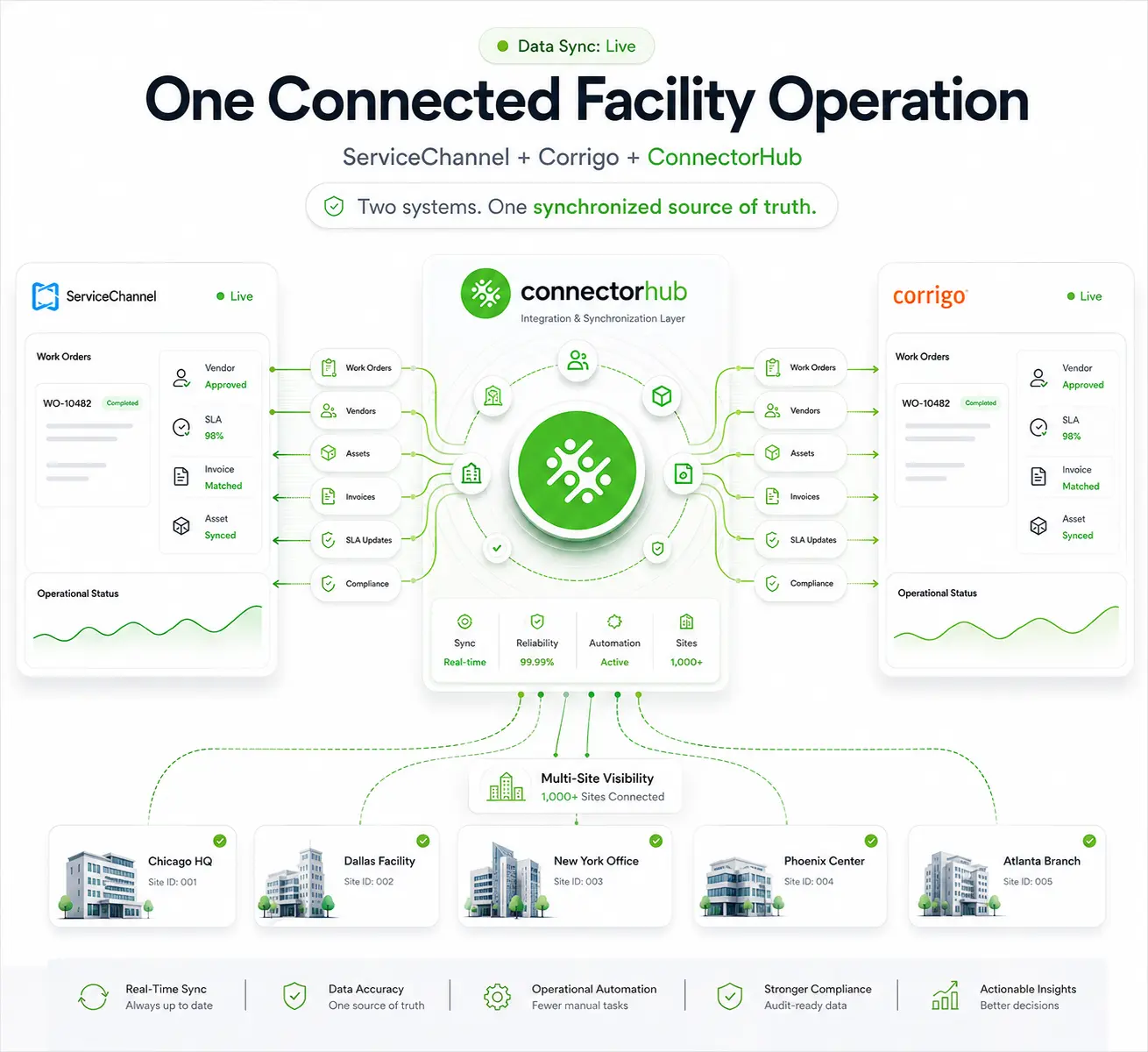
If your facilities team runs both ServiceChannel and Corrigo, you already know how well they cooperate on their own: they don't, not without help. Most multi-site operators land here through growth, not choice. An acquisition brings in a portfolio running Corrigo. A different business unit standardized on ServiceChannel years earlier. Nobody designed this on purpose.
What connects these two systems is smart facility management integration. a deliberate layer of work order software integration that lets a ticket created in one system show up, update, and close correctly in the other. When executed well, this creates true, facility management automation for your team. However, achieving this requires a genuinely dependable field service integration platform, rather than relying on outdated, custom code that someone abandoned just two years ago.
The Multi-Site Vendor Management Reality: When Two Platforms Become a Daily Tax
Facility executives rarely choose to run two vendor management platforms on purpose. It happens through mergers, franchise consolidation, or a regional team that picked its own CMMS before anyone thought about portfolio-wide standardization.
A few years later, corporate is looking at two systems of record for the same reality: work orders, vendor assignments, and spend, split across ServiceChannel and Corrigo with no shared source of truth.
Industry research backs this up. Facilities organizations run an average of fourteen distinct software tools, according to Gartner benchmarking referenced in recent facility integration research, which tracks workplace technology closely, has named platform consolidation the leading buyer priority for 2025 and 2026, not because individual tools underperform, but because fragmented systems make trustworthy, board-level reporting structurally difficult.
For an executive managing hundreds of sites, that fragmentation shows up as a daily tax:
- Technicians and vendors update job status in one system while managers pull reports from the other
- Approval chains stall when sign-off requires someone who only has access to one platform
- Spend data splinters, making it hard to benchmark vendor cost across the full portfolio
- Compliance and certification records live in two places, so audits take twice as long
- IT ends up owning manual exports and spreadsheet reconciliation nobody signed up to maintain
None of this reflects a failure of either platform. Both were built to be a strong system of record on their own. The problem starts when an enterprise needs both to behave like one.
Where ServiceChannel and Corrigo Overlap and Where the Gaps Appear
Both platforms earn their reputation for good reason, and it helps to be specific about where each pulls its weight.
The overlap is real as well. Each system creates work orders, sends out vendors, monitors SLAs, reviews invoices, and each provides at least some degree of vendor management automation.
This is the exact reason why using them together is complicated, because the director cannot choose one as "the vendor system," since each one serves as the source of truth for a part of the process.
The gaps show up in the details that matter most. A vendor approved in ServiceChannel doesn't automatically exist as a recognized provider in Corrigo, so onboarding gets duplicated. A work order closed by a technician in Corrigo doesn't update the linked ticket in ServiceChannel, so the site manager keeps chasing a status that already resolved.
Asset records drift apart, and invoice approvals stall when the approver is working from the platform that never received the latest note. None of this looks dramatic alone. Multiplied across a thousand sites and a few hundred vendors, it adds up to real operational drag.
How Data Should Actually Flow Between the Platforms
Getting ServiceChannel and Corrigo to work together isn't about mirroring every field between them. It's about deciding which system owns which piece of truth, then moving the right data at the right moment.
Core work order lifecycle sync should follow the ticket from creation to close. When a work order originates in ServiceChannel, the vendor's operating platform needs the ticket, priority, site address, and any attached photos within minutes, not hours.
As the vendor updates status, that update needs to flow back so the originating platform reflects live progress. This is what automated work order management actually means: neither side waits on a person to notice something needs updating.
Vendor, compliance, and performance data need the same discipline. A vendor's insurance certificate, license status, and performance score should live as one reconciled record, not two independent ones drifting apart.
When a certification lapses in one system, the other needs to know immediately, particularly in regulated environments like healthcare or food service, where an expired certification becomes a compliance exposure someone is personally accountable for.
Supporting flows close the loop on what happens next:
- Completed work orders and approved invoices should post into finance systems automatically, including scenarios that require integration between Corrigo and SAP for cost allocation and payable matching
- Asset updates, including status, cost, and location, should move across both platforms so neither shows outdated history
- SLA breach alerts need to trigger regardless of origin, so managers aren't blind to a problem in the "other" system
- Historical work order and spend data should feed a shared reporting layer, so benchmarking isn't built on half the dataset
None of this requires custom API integration work for every new site or vendor added to the program. A data model is needed which recognizes facility data synchronization as an ongoing need rather than a one-time migration, and an architecture which can support cloud integration rather than one-off scripts that run on a single server.
Automation Opportunities That Deliver Immediate Operational Lift
Some automation opportunities pay back almost as soon as the data pipeline between the two platforms becomes reliable. The value isn't theoretical either: automated task creation and approval routing inside a single CMMS like Corrigo is already estimated to save roughly two and a half hours per work order and reduce overall facilities spend by around ten percent. Extending that same discipline across two connected platforms compounds the effect rather than limiting it to whichever system a technician happens to be logged into.
- Automatic vendor matching, so a new work order routes to an approved, rated provider without a coordinator checking two systems
- Routing based on rules, so that the ticket that exceeds a certain spending level is routed to the correct approver rather than being left in the inbox
- SLA violation alerts in real time, so that tickets are flagged as potential violations before the violation occurs
- Automated invoice reconciliation, so that work orders are matched with invoices
- Scheduled preventive maintenance sync, so a PM schedule in one platform generates the matching ticket in the other
This is cross-platform workflow automation making itself felt by facility executives: less email for status updates, no duplicates, and a coordination team that spends its time on exceptions rather than data entry.
If coordination is dependent on an individual remembering to go to another system, even minor delays add up across hundreds of facilities. The removal of this dependency makes coordination an automated business process that scales in the same way whether it's fifty or five thousand locations.
Why Point-to-Point or Manual Bridges Fail at Multi-Site Scale
The instinct when two platforms need to talk is often to have an engineer build a direct connection between them. At ten sites and a couple of vendors, that can genuinely hold up. At enterprise scale, it tends to break at the worst moment.
Point-to-point connections are brittle by design. Each one is custom code tied to a specific API version. When ServiceChannel or Corrigo ships an update, and both do so regularly, the connection can quietly stop working.
Nobody notices until a vendor asks why their tickets stopped appearing, or a monthly report comes back with numbers that don't reconcile.
Manual bridges carry a related risk. Spreadsheet exports and copy-paste reconciliation depend on one specific person remembering to do it, correctly, every time. When that person leaves, the process falls apart quietly, and nobody finds the gap until an audit or a missed SLA forces the issue into the open.
Scale makes both problems worse. A point-to-point connection covering ten sites is a manageable liability. The same approach stretched across a thousand sites and several hundred vendors means dozens of fragile dependencies IT has to babysit indefinitely.
Generic iPaas solutions built for horizontal enterprise use can help, but they usually still require someone to build the facility-specific mapping logic from a blank canvas.
Strategic Implications for Multi-Site Facility Leaders
For a facilities executive, the case for connecting these platforms isn't really about the technology. It's about what fragmentation costs in decisions that depend on trustworthy data.
Vendor negotiations lean on aggregate spend and performance data. When that data splits across two systems, negotiating leverage weakens because nobody has full visibility into total spend with a given provider portfolio-wide.
The same problem occurs in executive reporting: When two systems give different figures for the same metric, the person who is presenting the information spends more time justifying its validity rather than interpreting it.
Compliance and audit readiness depend on records being complete and current, not scattered. An insurance gap or an overlooked inspection, left unattended in a second system, will become the very type of exposure that comes to light in due diligence or during insurance renewal.
For organizations that grow through M&A or franchise expansion, which is how most end up running both platforms in the first place, onboarding an acquired portfolio without a multi-year systems migration is a genuine advantage. Leaders who solve the integration problem once spend far less time solving it again as the portfolio changes shape.
Why ConnectorHub Is the Practical and Reliable Way to Connect ServiceChannel and Corrigo
This is exactly the environment ConnectorHub was built for. It is an enterprise integration platform for the CMMS, vendor management, and ERP tools that run multi-site facility programs, and it ships with pre-built connectors for both Corrigo and ServiceChannel alongside common ERP and finance platforms.
Built for the operational realities of multi-site facility management. ConnectorHub's facility workflows are pre-mapped to the objects that matter here: work orders, assets, vendors, invoices, and SLA milestones. A facilities team isn't reverse-engineering which fields need to match between ServiceChannel and Corrigo from scratch, since the mapping already reflects how these systems get used across retail, restaurant, and commercial real estate portfolios.
How it solves the synchronization and governance problems that break other approaches. Work orders created in either platform move automatically, with completion updates flowing back for accurate reporting. Asset changes, including status, cost, vendor, and location, sync without manual re-entry.
Each workflow is created using a visual, low-code designer tool that allows business users and not just IT to design and monitor, along with role-based security, credential encryption, and auditing built-in for governance compliance. Anomaly detection catches mapping problems before they create poor data downstream, instead of after the report has been delivered with questionable numbers.
Why it is the better option for scalable and easy to maintain processes. Companies that use ConnectorHub for system integration of their facilities have been able to save over 500 hours per year in administration, reduce SLA violations by 30 to 40 percent, shorten their invoice-to-cash process by 40 percent, while maintaining data accuracy over 98 percent.
For a facilities manager trying to decide between integration as a service versus building and developing custom bridges in-house, such a mix of quickness, governance, and quantifiable ROI is difficult to duplicate through an in-house solution. Since the connector platform already supports the ERP solution, implementing the financial integration does not start from scratch.
Conclusion
ServiceChannel and Corrigo were never designed to be enemies. Each does its job well, and multi-site operators usually end up running both for legitimate business reasons, not out of negligence. The problem was never having two platforms. It's letting them stay disconnected while the portfolio keeps growing around them.
Closing that gap doesn't require picking a winner and migrating everyone off the other platform, a project that can take years and cost more than the fragmentation itself.
This calls for a synchronization layer that honors what each platform does best and provides facility executives with one single source of truth on vendor performance, work order status, and spending at every single location.
This is where the transition from separate portals to multi-site operations truly lies, not in having fewer tools, but in having tools that can finally communicate with each other reliable enough.