.svg)
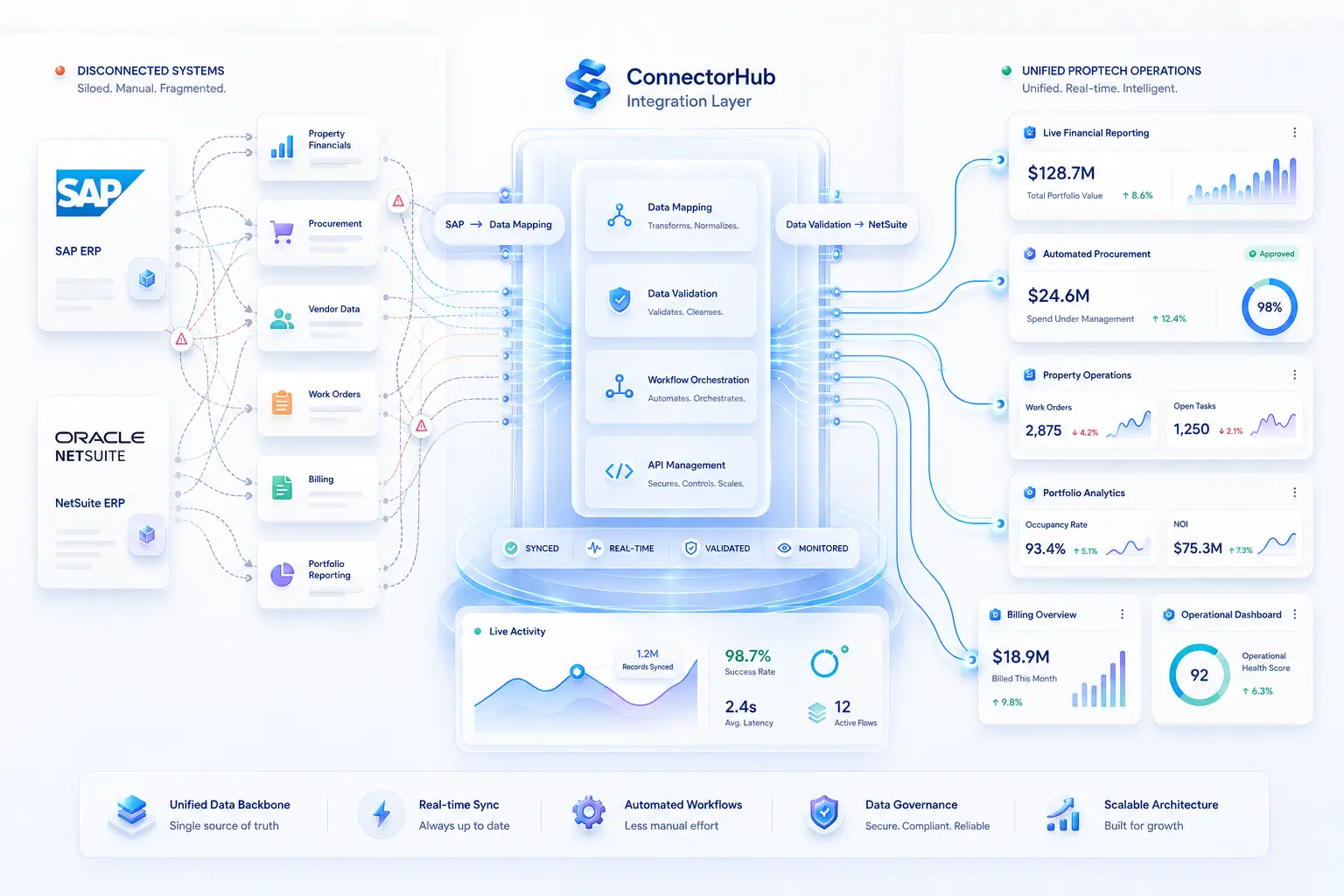
For a mid-market operator managing tens of thousands of units across a dozen legal entities, finance closes the books on NetSuite while procurement and portfolio cost tracking run through SAP. Neither team fully trusts the other's numbers.
Quarter-end often traps our teams in an exhausting week of unplanned, manual spreadsheet updates. Meaningful PropTech integration is about empowering people, transforming divided software into one reliable, shared foundation instead of managing two frustratingly separate daily workflows.
Real estate data integration between SAP and NetSuite gives PropTech finance and operations teams a shared foundation, one where property financials, vendor data, work orders, and portfolio reporting move automatically instead of through manual re-entry.
For executives evaluating PropTech ERP CRM integration, the payoff is not just fewer keying errors. It is the ability to run real estate workflow automation across billing, procurement, and reporting without adding headcount every time the portfolio grows.
The Underlying Challenges of Disconnected Systems in PropTech Operations
Most PropTech leaders already know their systems don't talk to each other cleanly. What surprises them is how much that gap costs once someone measures it.
Research on medium-sized real estate firms suggests roughly 58% still run legacy systems never designed for modern API integration, so every new connection is a custom project. Research found that around two-thirds of executive's name data fragmentation among their top three challenges.
The cost shows up in familiar places. A lease gets typed into the property system, then again into the ledger, then again into a maintenance platform. Analysts spend days each month pulling exports from separate real estate operations software platforms just to produce a portfolio number leadership can trust.
The bigger risk is what happens to decision-making. Forrester's research on data accessibility found that when employees have to hunt across multiple systems, 65% simply stop relying on the data and fall back on intuition. Jumping between five or six disconnected interfaces in a workday becomes a retention problem as new hires learn all of them.
None of this is really a technology failure. It is what happens when finance and operations each buy the best tool for their own function, with no plan for how that tool talks to everything else.
Mapping the Financial-to-Operational Data Gap
SAP and NetSuite were not built to be strangers, but in a PropTech stack they end up dividing responsibility along predictable lines. SAP typically owns asset accounting and procurement, plus work order data in facility-heavy portfolios through modules like SAP PM. NetSuite typically owns multi-entity financial consolidation and subsidiary-level reporting.
The technical gap is not cosmetic either. SAP's OData APIs process batch operations synchronously and sequentially, creating bottlenecks any time a large volume of records needs to move at once. NetSuite's webhook support is comparatively limited, so scheduled polling is often the pragmatic choice there.
This is exactly the friction a purpose-built property management integration layer is meant to absorb, so finance gets current numbers without engineering fighting two different API philosophies. Layered on top is a cloud integration question that catches operators off guard: which environment is the system of record for a given field as the portfolio grows.
Property Financials, Vendor/Procurement, Work Orders, and Billing in Silos
Walk through a typical operating cycle and the silos show up at every handoff. Property financials suffer first: SAP cost centers and WBS elements rarely map cleanly to NetSuite subsidiaries and classes, so a capital expenditure booked correctly in one system can land in the wrong bucket in the other. Vendor data drifts next, since a purchase order gets issued in SAP while accounts payable settles it in NetSuite.
Work orders and billing tell the same story. Maintenance data captured in a CMMS or SAP PM module often never reaches NetSuite job costing, so actual spend is understated until reconciliation catches the gap. CAM reconciliation and tenant billing depend on accurate data from both systems at once, and when one lags, invoices go out with numbers finance has to walk back.
Each of these is survivable on its own. Stacked across a portfolio of any real size, they explain why a genuine real estate software integration solution has become a prerequisite for scaling without adding proportional headcount in accounting.
Who Owns the Truth in a Multi-System Stack
The hardest conversations in any SAP-NetSuite project are undoubtedly about ownership.
Who updates the vendor master first, procurement in SAP or accounts payable in NetSuite? Who owns the cost center hierarchy when a property is recapitalized under a new entity? This question without an answer leaves people to choose either way based on whichever they trust more.
This is where a canonical data model, sometimes called a golden record approach, earns its keep. It designates a single owning system per data domain, SAP for vendor and asset master data, NetSuite for GL and consolidated financials, and routes every downstream system through that hierarchy. An enterprise integration platform that enforces this ownership model removes the ambiguity before it becomes a reconciliation project.
As global organizations upgrade their systems in 2026, leaders encounter a familiar roadblock: before their busy teams can pull, verify, and polish performance numbers for a board meeting, the information is already two weeks old. In our demanding market, relying on stale insights is incredibly costly.
Manual reconciliation does not scale linearly either. Doubling the properties in a portfolio multiplies the number of system pairs that need checking, not just the workload. This is where automated business process design pays for itself, and where property portfolio analytics stops describing where the business was and starts describing where it is.
Emerging Integration Patterns for SAP + NetSuite in Real Estate and PropTech
The integration patterns used for SAP and NetSuite have shifted meaningfully over the past few years, and PropTech teams evaluating a project today have more options than a straight batch export.
SAP S/4HANA supports event publishing through SAP Event Mesh, useful for pushing changes like a new purchase order to subscribers in near real time. NetSuite offers fewer native webhooks, teams typically pair its routine data polling with SAP’s proactive event publishing. When your stack grows to five or more systems, adopting centralized middleware becomes the smartest choice. It unifies data mapping and monitoring into one clear view, saving your team from untangling problems across dozens of fragile, customized scripts.
Minor network glitches can easily create duplicate invoices. Finance-grade iPaaS solutions prevent this automatically. This built-in reliability is exactly why integration as a service is a safer, smarter investment for your team than relying on fragile custom scripts.
Building a unified workflow doesn’t mean forcing everyone onto one giant platform; it means thoughtfully connecting the tools your team already trusts. By carefully syncing SAP and NetSuite, vendor details and work orders update effortlessly. This empowers your people to make confident decisions using live dashboards, avoiding those outdated monthly spreadsheets.
Getting there depends on treating the connection as infrastructure rather than a one-off project. A well-designed data pipeline for real estate operations validates records on the way through and flags anomalies before they hit the ledger, a different posture than the typical data integration platform most teams inherit by accident.
A Step-by-Step Framework for Building the SAP + NetSuite Data Backbone
Most integration projects fail not because the technology is hard, but because teams skip the groundwork. A disciplined rollout tends to follow the same sequence regardless of portfolio size.
- Audit the current data flows. Map every point where SAP and NetSuite data intersect, including vendor records, cost centers, work orders, and invoices.
- Assign system-of-record ownership. Decide which platform is authoritative for each data domain, following the golden record model, before any technical work begins.
- Match the integration pattern to the use case. High-value transactions like invoice posting warrant event-driven sync; low-frequency master data can stay on batch.
- Build validation and idempotency checks before go-live. Catching a mismatched cost center at the point of transfer is far cheaper than catching it at month-end close.
- Pilot on a single entity or property segment. Run the connection end to end on a contained slice of the portfolio before expanding.
- Roll out with monitoring and audit logging in place. Full transaction visibility lets finance and operations trust the same numbers from day one.
Skipping the ownership conversation to jump straight to building connectors is the most common reason these projects stall midway through.
How ConnectorHub Enables a Smarter SAP + NetSuite Data Backbone for PropTech
This is exactly the frustrating gap ConnectorHub is designed to solve for real estate and PropTech teams. Instead of treating SAP and NetSuite integration like an exhausting custom IT project, ConnectorHub delivers an effortless connector. It effortlessly syncs your revenue and procurement details, finally aligning finance and operations without tedious manual exports.
A few specifics that matter to a leader evaluating this kind of project:
- Faster time to value. ConnectorHub's PropTech connectors typically go live in 2 to 4 weeks, versus 2 to 3 months for generic iPaaS platforms and 4 to 6 months for custom builds.
- Visual, low-code configuration. Business teams can map fields and adjust sync schedules through a drag-and-drop interface, so IT is not the only team maintaining it.
- Governance built in. Every connector includes version control, encrypted credential storage, and audit logging aligned with SOC 2 and GDPR standards.
- Measurable impact. PropTech operators using ConnectorHub have reported roughly 30% faster property onboarding, more than $50,000 in annual administrative savings, and ROI within 3 to 6 months.
The point is not that ConnectorHub replaces SAP or NetSuite. It is that the connection between them stops being a source of risk and manual labor, and starts behaving like infrastructure both teams can rely on.
Conclusion
Viewing SAP and NetSuite integration as a simple back-office chore misses its real impact. Your portfolio growth, confident investor reporting, and daily operational accuracy depend on finance and operations trusting the same numbers.
Executives who fund this as infrastructure, not a one-time fix, position their teams to scale the portfolio without scaling reconciliation headcount alongside it. The operators who get this right stop asking whether their systems agree and start asking better questions about where the portfolio should go next.