.svg)
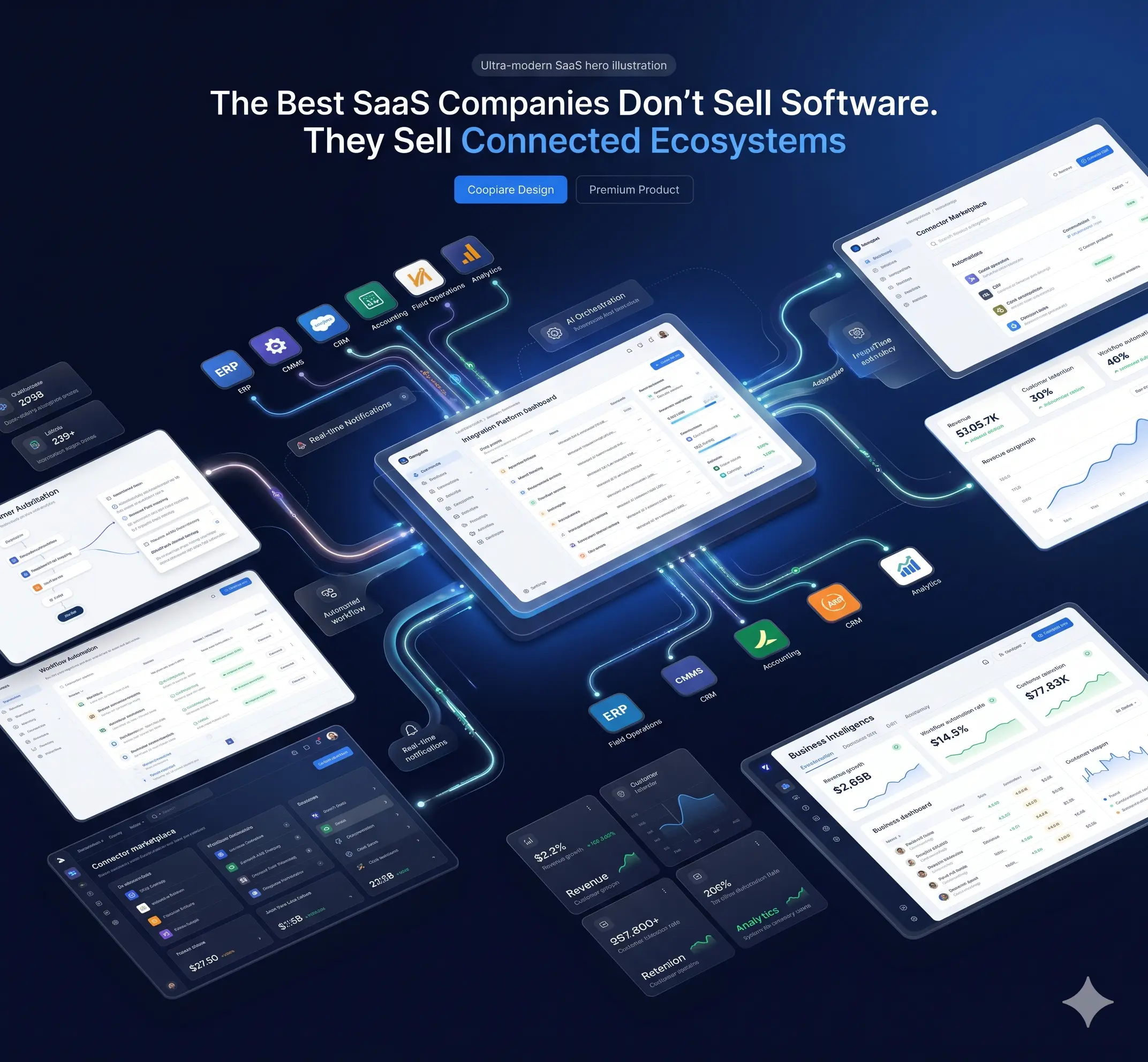
Ask any product leader what their customers request most, and integrations will be in the top three. It does not matter whether the platform serves healthcare, facilities management, finance, or field operations, the conversation always loops back to the same question. "Can it talk to our ERP?" "Does it work with our CMMS?" "What about our CRM?"
The ability to connect SAP and Corrigo, leverage robust ERP CMMS integration, push ERP data into operational workflows, or embed a SaaS integration hub natively inside a product has shifted from a roadmap request to a purchase requirement.
By implementing dedicated ERP and CMMS integration software, companies can ensure these systems communicate flawlessly. The average organization today manages 305 applications and spends $55.7M annually on software. Integrations are the connective tissue holding that stack together. When they work, everything moves.
The Evolution of Integrations Over Time
Not long ago, integrations were mostly point-to-point workarounds. A custom script here, a nightly CSV export there, a developer on retainer keeping it all from unraveling. Most SaaS teams treated connectivity as a post-launch problem, something to deal with once the core product was stable. That was defensible then.
It is not defensible anymore.
There are now over 900 integration software solutions in the market, with roughly 270 specialized iPaaS platforms. The worldwide market for iPaaS was valued at more than $9 billion in 2024. The reason behind such huge investments is that companies have realized that data integration should be regarded not as a separate project but rather as part of the product.
The catalyst is scale. Organizations with more than 10,000 employees manage upward of 660 applications across finance, HR, operations, analytics, and CRM. Any platform that cannot connect to that environment starts looking expendable at the next budget cycle. Connectivity is survival.
SaaS application integration at this scale is no longer something IT manages in the background. It is a product decision. Platforms that embed connectivity directly rather than handing customers a connector catalog and wishing them luck onboard faster, retain longer, and expand revenue more predictably.
Understanding Build vs. Buy SaaS Integration Challenges
When integrations move up the priority list, the first internal debate is almost always the same: do we build this, or do we buy it?
The instinct to build is understandable — you own the code, the experience, the timeline. The problem is that the spreadsheet almost never captures what integration ownership actually costs once it is live.
Here is what the full picture looks like:
- Delayed timelines hit harder than expected. Nearly 1 in 3 IT projects are not delivered on time with integration complexity and manual connectivity work consuming an average of 36% of IT teams' time as a key driver of delays.
- Most teams are building beyond their expertise. Most of the organizations lack the in-house capability to sustain what they build. As APIs evolve without warning, authentication requirements shift, and internal systems fail, developers are pulled away from the product's roadmap into an endless cycle of reactive fixes and temporary patches.
- Silent failures are the most dangerous kind. Silent integration failures are among the most damaging and hardest to catch problems in enterprise IT. Without an integration monitoring dashboard and real error handling automation, the first sign of a problem is often a churned account.
- Maintenance scales poorly. Each new connector request stacks on top of existing obligations. Engineers get pulled away from product development to investigate why a field stopped syncing on a connector that shipped eighteen months ago.
- APIs are someone else's responsibility until they are yours. Every API you depend on is maintained by another company. When they update it, your connector breaks. That is not a one-time event. It is a recurring cost.
Pointers to Keep in Mind to Ensure Integrations Work the Way They Should
Deciding to invest in integrations is the easy part. Getting them to work reliably across different customers, industries, and workflow requirements takes deliberate planning. These are the considerations that separate successful integration programs from expensive ones:
- Account for industry-specific variability before you build:
A facilities management firm connecting its CMMS to an ERP has completely different data structures and sync logic compared to a healthcare organization doing something that looks superficially similar. Generic connectors handle common fields reasonably well. They fall apart at the edges and in enterprise operations, the edges carry the most business-critical data.
- Choose your deployment model before you choose your platform:
Some workflows need real-time bi-directional sync. Others run fine on scheduled batch transfers. Others are best served by event-triggered logic. A good enterprise automation platform supports all three modes without requiring customers to rebuild their underlying systems around whatever the integration defaults to.
- Build for exceptions, not just the generic path:
When a data transformation fails such as mismatched field names, a missing required value, an API rate limit, what happens next matters enormously. Workflow exception management means the right person is notified immediately, and the error is recoverable without manual intervention. Platforms that handle this gracefully hold customer trust. Those that do not generate support tickets at volume.
- Consider role-based access control for integrations as a compliance requirement:
In enterprise environments, integration configurations are sensitive. Not every user should be able to modify sync schedules, access credential settings, or view data flows across an entire tenant. Companies that retrofit access governance after launch spend considerably more time and money doing it than those that built it in from day one.
- Version control your workflows:
Systems change. APIs get updated. Version-controlled integration workflows mean you can test changes in isolation and roll back without disrupting live customer operations.
CMMS, ERP, and CRM Data Automation as Growth Catalysts
The business case for integrating your enterprise's basic tech stack is easiest to see when you look at what it replaces. Imagine a nationwide facilities management firm that processes several thousand work orders monthly within its CMMS, ERP, and CRM systems. Integration would reduce this to unnecessary manual entries for every transfer of information, whereby the same work order is entered, tracked, and invoiced in three different systems.
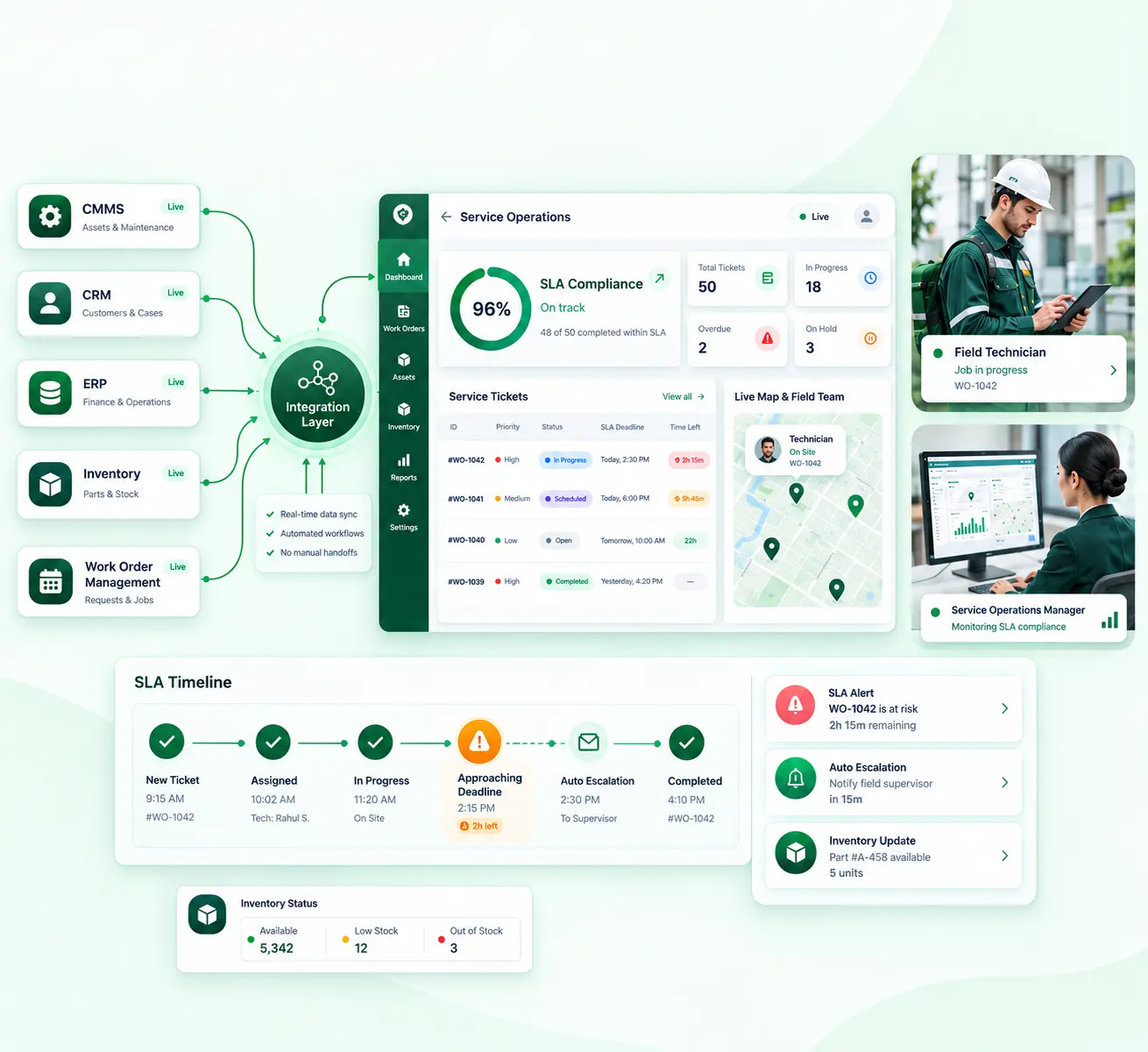
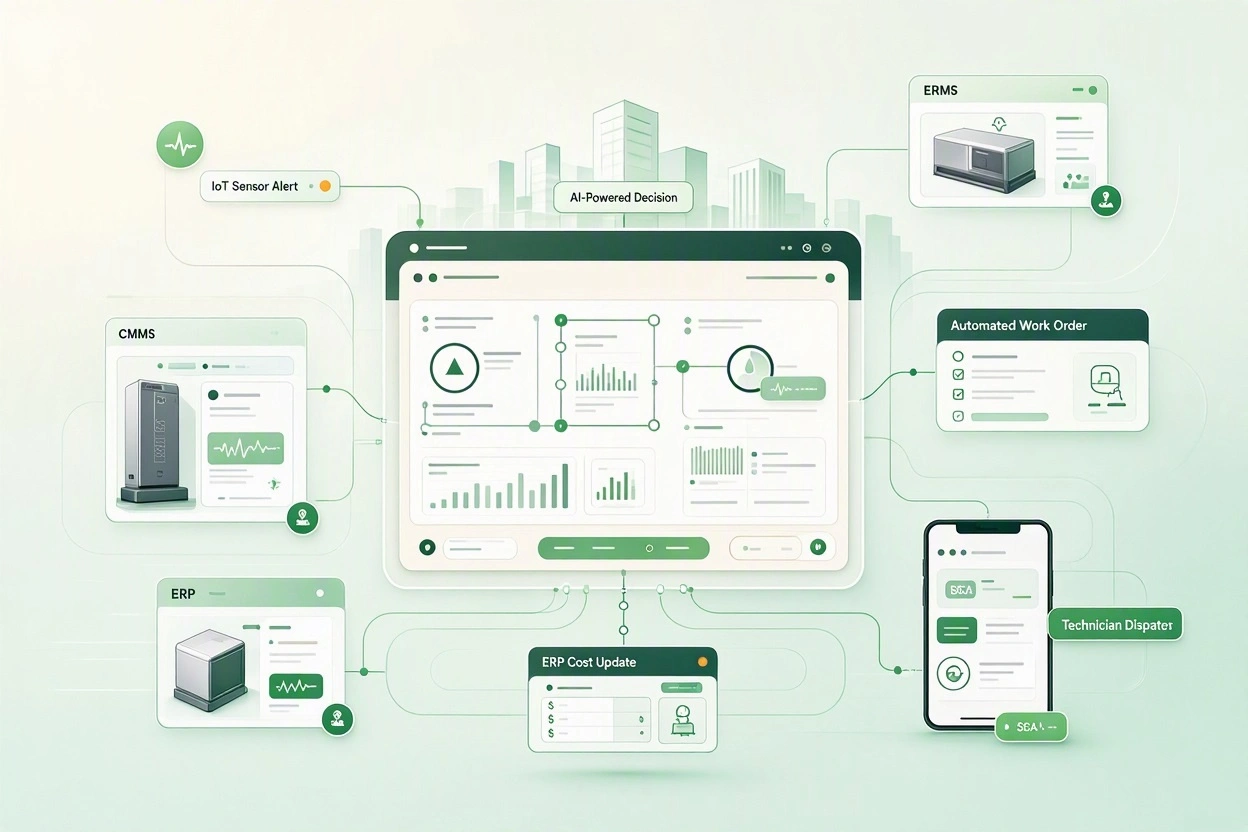
Integrating major systems like CMMS and ERP brings in substantial returns. Work orders sync automatically. Invoice data flows to finance without reconciliation work. Dispatch teams get real-time status without making phone calls. The efficiency gains are measurable within weeks.
CRM integration in service-oriented platforms delivers a different but equally direct impact. When account data, service history, and operational records live in separate systems, sales walk into renewal conversations, missing context and service teams respond to issues without knowing the account's full history. Connecting those systems gives every team member a more complete picture, which directly affects retention and expansion outcomes.
Data integrations at this depth also change what gets reported. Data that stays inside its source system lives in dashboards no one fully trusts. Data that flows cleanly across systems supports operational intelligence that actually changes decisions.
Delving into Modern Integration Mechanisms for SaaS Operations
There is a meaningful difference between offering integrations and embedding them. Traditional middleware sits between applications as a separate infrastructure layer with IT teams to configure it, manage it, and troubleshoot it outside the product. Embedded iPaaS is built directly into the SaaS product itself. Customers never leave the platform to set up or monitor their integrations.
What embedded iPaaS solutions deliver under the hood:
- A visual workflow builder for mapping and transforming data between systems without writing code
- Pre-built connectors for major platforms across CMMS, ERP, CRM, and accounting
- Field-level mapping with transformation logic to handle format mismatches between systems
- Scheduling and event-based triggers to match different sync cadence requirements
- Real-time monitoring with alerting when workflows break or behave unexpectedly
The data integration platform handles the infrastructure that developers least want to own: authentication management, rate limiting, retry logic, and error logging — running in the background, without requiring dedicated ownership.
Choosing pre-built connectors over custom cloud integration development also collapses time-to-market in a way that compounds. Configuring an existing connector against a customer's specific instance takes days. Building one from scratch takes months and someone has to own it indefinitely after it ships.
A Guideline to Translate Integrations into Sustainable Revenue
The commercial case for investing in integrations is not a soft argument about experience. It is a direct one about revenue mechanics.
- Retention improves when switching becomes genuinely costly.
Customers who have woven your product into their core operational stack do not churn lightly. Replacing an integrated platform means a migration project, workflow redesign, and retraining across multiple teams. That friction compounds in your favor with every additional workflow a customer runs through your platform.
- Tiered pricing becomes more defensible.
Integrations create natural pricing architecture. Base tiers cover core functionality; enterprise plans include premium connectors, higher sync frequencies, or dedicated support. Outcome-based pricing models fit naturally because integration value is quantifiable with hours saved, errors eliminated, workflows automated.
- Setting new clients up for success from day one.
When people can connect the tools they already use on day one instead of waiting weeks to get set up, the value clicks into place much sooner and that faster path to impact is what builds the kind of customer relationships that actually last and drive growth over time.
- New revenue streams open through coordination.
When your platform becomes the integration layer connecting a customer's CMMS, ERP, and CRM, you become structurally important to how they operate. That creates expansion opportunities such as additional connectors, managed services, analytics built on automated process data that simply do not exist when the product operates in isolation.
Set Up a Stable SaaS Integration Ecosystem with ConnectorHub
Most of the challenges we keep running into — technical debt that quietly piles up, system failures that go undetected, oversight that slips through the cracks, launches that drag on longer than they should — trace back to the same root cause: we have been treating integrations as individual coding jobs rather than building them as a shared capability that scales.
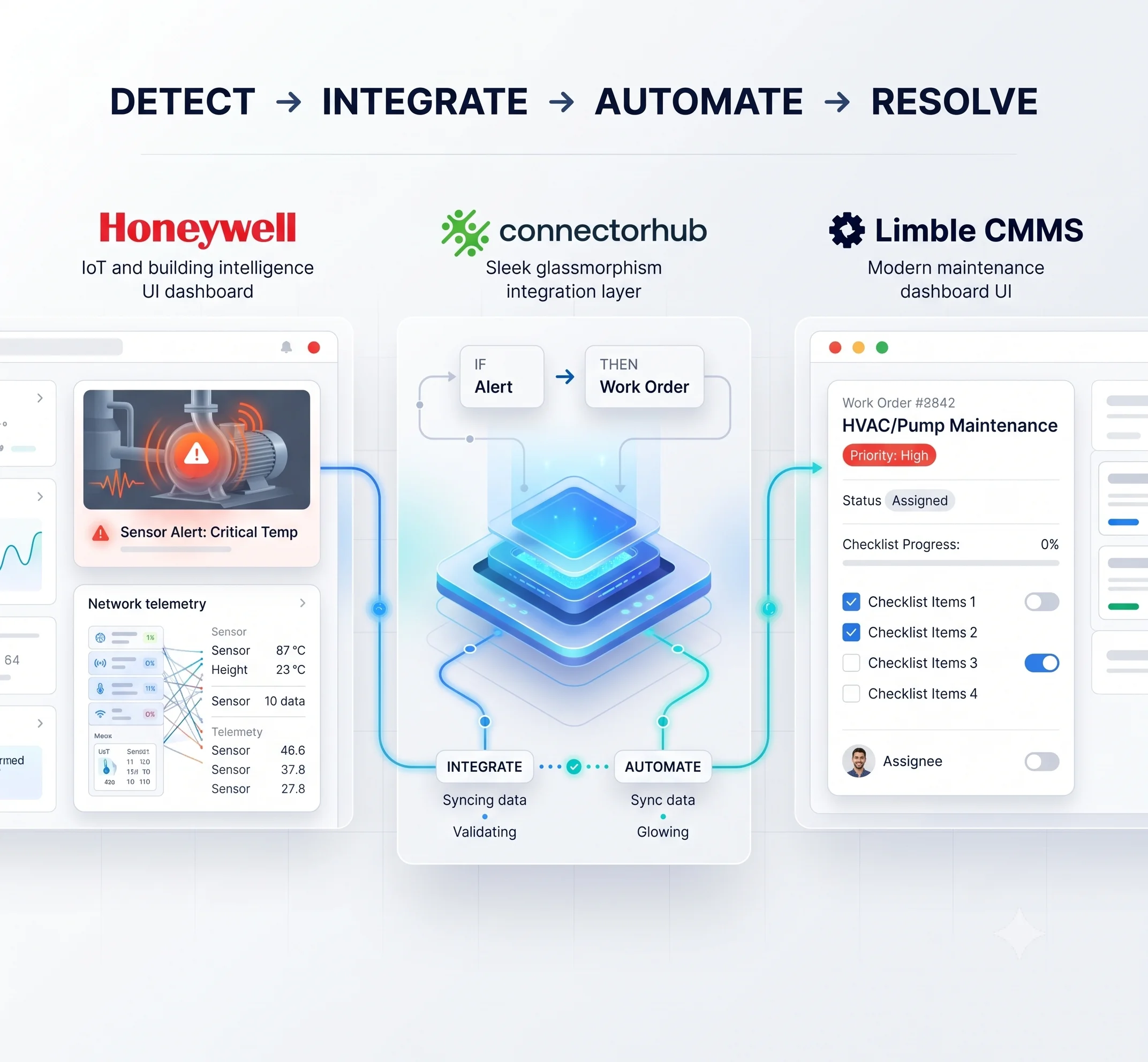
ConnectorHub comes up as an enterprise-ready SaaS integration platform that combines no-code workflow automation, real-time visibility, AI-powered field mapping, and pre-built connectors for CMMS, ERP, CRM, and operational systems in a single governed environment.
Here is what that looks like across different stakeholders:
- For SaaS providers — For software and platform providers, ConnectorHub embeds integration infrastructure directly into your product. You ship ready-made workflows to customers without building or maintaining the connector to stack yourself. Engineering stays focused on product.
- For end customers — The experience is fully white-labeled. They interact with your product, not a third-party tool. Mapping, scheduling, monitoring, and alerting all feel native.
- For operations teams — A visual low-code interface means business users and IT staff can configure workflows and adjust sync schedules without writing code.
We get integrations live in days, not quarters, and most CMMS and ERP systems are up and running within two to four weeks. The way we have built this reflects what we actually believe in: taking real ownership of how people experience the product, staying ahead of workflow gaps before a client ever runs into one, and weaving governance into the foundation of the system from the very beginning.
Also Read: From APIs to Automation: Building End-to-End Connected Business Workflows
Conclusion
This is no longer a dialogue for engineers alone. Integration is a topic for product strategy, pricing analysis, customer success meetings, and discussions about sources of growth.
The SaaS platforms consistently outperforming their peers are not doing anything exotic. They made a quiet but consequential decision: stop shipping integrations as an afterthought and start building connectivity into the product from the ground up because a platform woven into a customer's daily operations holds on far longer than one that simply sits alongside them.
The discipline of Integration Ops — combining integration engineering, data operations, and systems thinking — is gaining traction because organizations have learned that integrations are not a project you complete. They are an operational capability you build, instrument, and maintain over time. Learn today how to turn your integration into revenue opportunities with ConnectorHub.