.svg)
Integration always makes it into the budget. What never makes it in is the real cost of getting it wrong. Not the software spends, the quiet operational drag that shows up everywhere else. Data that lives in three systems and agrees in none of them. Decisions that stall because the right number exists, just not where anyone can reach it.
Poor data quality costs organizations with an average of $12.9 million annually. But that figure understates the real damage, because it does not account for the strategic cost which accounts for the opportunities missed while your teams are busy carrying out tedious repetitive tasks, which can be automatically handled using no-code integration platforms.
Here is the uncomfortable truth: most organizations that believe they have solved integration have only solved connectivity. But connectivity without continuity should not be what an integration platform offers in the long run.
The usual scenario is one which have APIs in place. Data moves between systems — sometimes. It is infrastructure with gaps, and every gap is a place where speed, accuracy, and accountability leak out of the business.
The shift from basic API integration tool to end-to-end workflow automation platform is not a technology upgrade, it is a fundamental change in how a business operates. This article breaks down what that shift requires, why the architecture behind it matters more than most executives realize, and what it looks like when an organization gets it right.
Why the Evolution from APIs to Intelligent Automation Matters Now?
The case for moving beyond basic API integration has been built for years. Three forces have now made it urgent.
- Hyper-automation has moved off the analyst's slide deck and into daily operations. The organizations feel it is not talking about it in strategy meetings, they are living in it. A work order is created. An invoice needs approval. A customer record changes. Each of those events should set off a coordinated chain across systems, departments, and locations without anyone manually carrying the baton between steps.
- Artificial intelligence in API environments is shifting integration from passive data movement to active operational intelligence. Systems are detecting anomalies, flagging exceptions, and routing decisions to the right people but only when the underlying data infrastructure is clean, connected, and real-time. AI running on fragmented enterprise data automation pipelines produces unreliable outputs.
- The third driver is a quiet shift in how competitive advantage actually works. Owning every capability in-house used to be defensible. Today it is mostly a constraint. Organizations pulling ahead are the ones connecting best-of-breed platforms quickly and coherently — not the ones with the most proprietary software. That coordination is harder than it sounds when engineering teams are already stretched.
API-Led Connectivity as the Essential Foundation for Scalable Automation
API-led connectivity is not a methodology, organizations adopt because it sounds architectural. They adopt it because the alternative, which is years of custom connections held together by institutional memory eventually stops working at the worst possible moment.
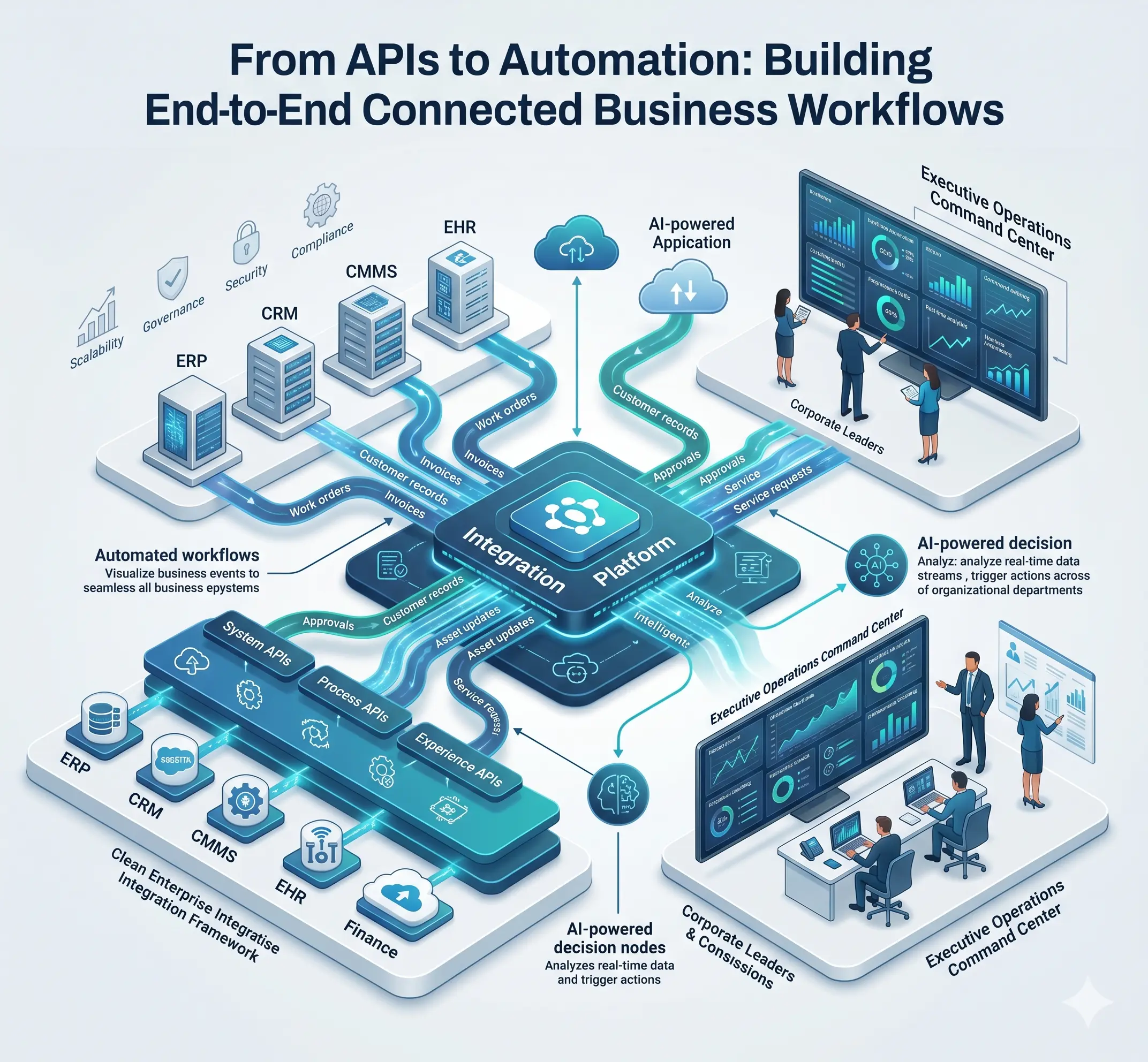
At its core, API-led design organizes integrations into three purposeful layers:
- System APIs sit at the foundation, connecting directly to core systems — ERPs, CRMs, CMMS platforms, databases — and abstracting their complexity, so the data becomes accessible without exposing technical internals.
- Process APIs sit in the middle tier and orchestrate logic across multiple system APIs. This is where business rules are enforced, where workflows are composed, and where enterprise data automation takes shape.
- Experience APIs sit at the top and handle a deceptively simple job: giving each consumer exactly what they need without exposing what is underneath. A mobile app, an operations dashboard, a finance portal, with each getting its own tailored view of the data, with none of the underlying system complexity bleeding through.
The practical benefit of this layering is resilience. When an underlying system changes, only its system API needs updating. Every workflow, application, and process built above continues to function. For enterprises running fifteen or more specialized platforms, it becomes the only way to maintain integration at scale without an unsustainable engineering overhead. In API-led design, access controls, authentication protocols, and data validation are defined at the integration layer from day one.
Transforming Operations from Fragmented Systems to Connected Workflows
Understanding the operational difference between legacy integration approaches and API-led connectivity helps executives make a more informed investment decision.
How to Deploy End-to-End Automated Workflows in Practice?
Moving from architecture principles to operational reality requires deliberate choices. Here is how organizations that do this well typically approach it.
- Start with the pain, not the platform
Before evaluating any enterprise iPaaS solution, map the processes where disconnection is causing the most friction. Where are people manually re-entering data? Which reports are unreliable because systems show conflicting information? Which workflows stall because a handoff between systems requires a human to bridge the gap? These are the integration candidates that deliver the fastest, most measurable ROI when automated.
- Choose a platform built for governed scale
A cloud integration platform with pre-built connectors, visual workflow configuration, and centralized monitoring reduces both initial deployment time and ongoing maintenance cost. The alternative, building custom middleware, almost always underestimates the long-term engineering burden. Most organizations that have done it once choose a purpose-built enterprise workflow automation platform for the second time.
- Embed compliance from day one
Regulated industries do not get the luxury of figuring out compliance after deployment. In healthcare, financial services, and the public sector, an integration that goes live without audit logging, role-based access, and data retention controls already in place becomes a liability. The right platform carries that responsibility at the infrastructure level, so implementation teams do not have to.
- Treat integration as a capability, not a project
Organizations that build a governed integration layer rather than isolated point solutions develop the ability to automate new workflows incrementally without starting from zero each time. That compounding advantage is what separates operationally mature enterprises from those that perpetually play catch-up.
A ROI-Driven Perspective to API Integration & Automation
The business case for API-led design and enterprise automation is no longer abstract. The numbers are concrete enough to take to a board.
Organizations that move to a governed, automated integration model typically see measurable improvements across three dimensions.
First, speed: reusable API components compress the time to build and deploy new digital capabilities from months to weeks.
Second, cost: When data stops moving manually and integrations stop breaking quietly, the cost reduction shows without anyone having to engineer it.
Third, optionality: A modular integration layer means changing an underlying platform stays contained. New ERP, acquired infrastructure, next-generation analytics tool with none of it unraveling what was built around it when the architecture was designed to absorb change from the start.
The build-vs-buy decision deserves a direct answer. Building your own integration middleware means taking on the initial engineering cost plus years of maintenance, upgrades, and incident response. Buying a purpose-built workflow automation solution and configuring it to your operational context is, for most enterprises, the better trade freeing engineering capacity for the differentiated capabilities that actually create competitive advantage, rather than the infrastructure that everyone needs but no one benefits from owning exclusively.
ConnectorHub: Connecting APIs, Automation, and AI Readiness
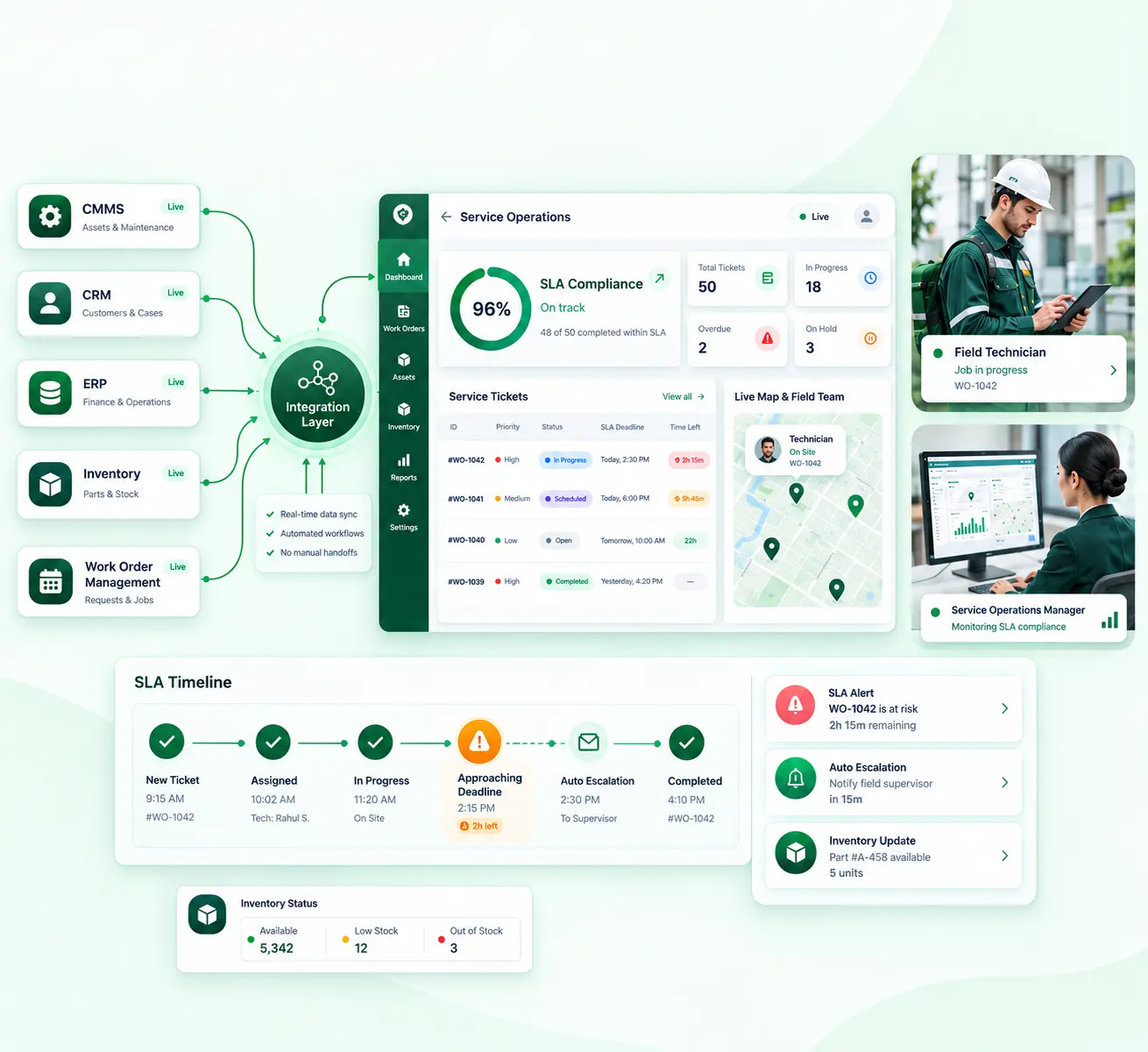
ConnectorHub was built specifically for industries where integration complexity is high and the cost of disconnected systems is tangible — facility management, healthcare, real estate operations, service providers, and industrial operations. The platform brings together everything discussed above into a single, deployable solution.
At its core, ConnectorHub functions as a visual integration platform. Teams configure integrations through a drag-and-drop workflow builder, mapping fields, setting transformation logic, and defining automation triggers without writing code. Auto-fetched schemas accelerate setup, and most integrations are production-ready within two to four weeks.
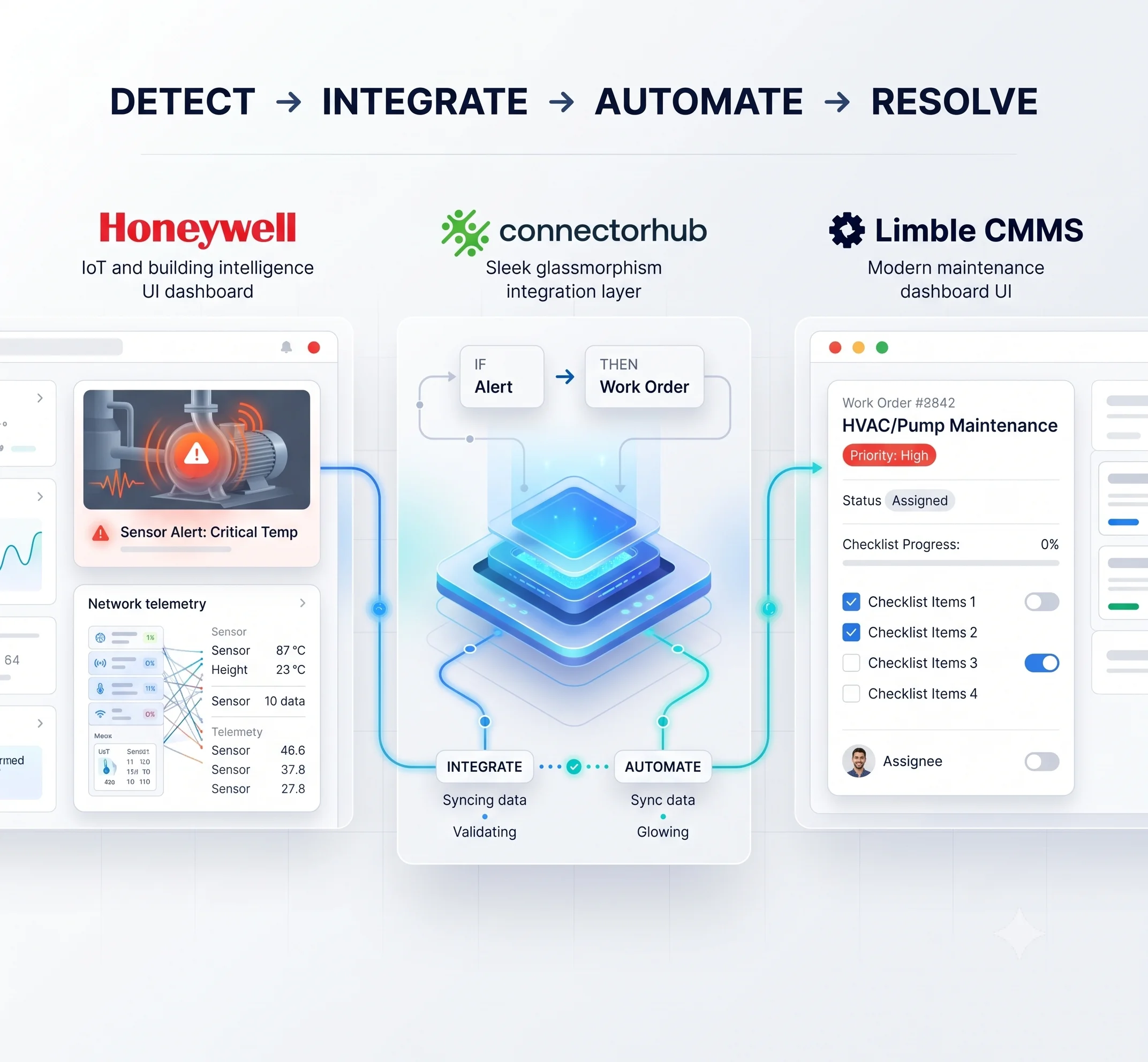
The platform ships with 100+ pre-built system connectors across CMMS platforms, including Corrigo, Nuvolo, FMX, and ServiceNow, as well as ERP, CRM, and EHR systems. This library eliminates the blank-slate configuration work that consumes engineering bandwidth on custom builds. For work order automation specifically, ConnectorHub synchronizes work orders, asset data, invoices, and completion status across systems automatically, removing the manual handoffs that cause delays and data errors at scale.
On the compliance side, the platform operates within a secured AWS infrastructure with encrypted credentials, role-based access control, full audit logs, and tenant isolation built in from day one. SOC 2, HIPAA, and GDPR compliance are inherent to the architecture.
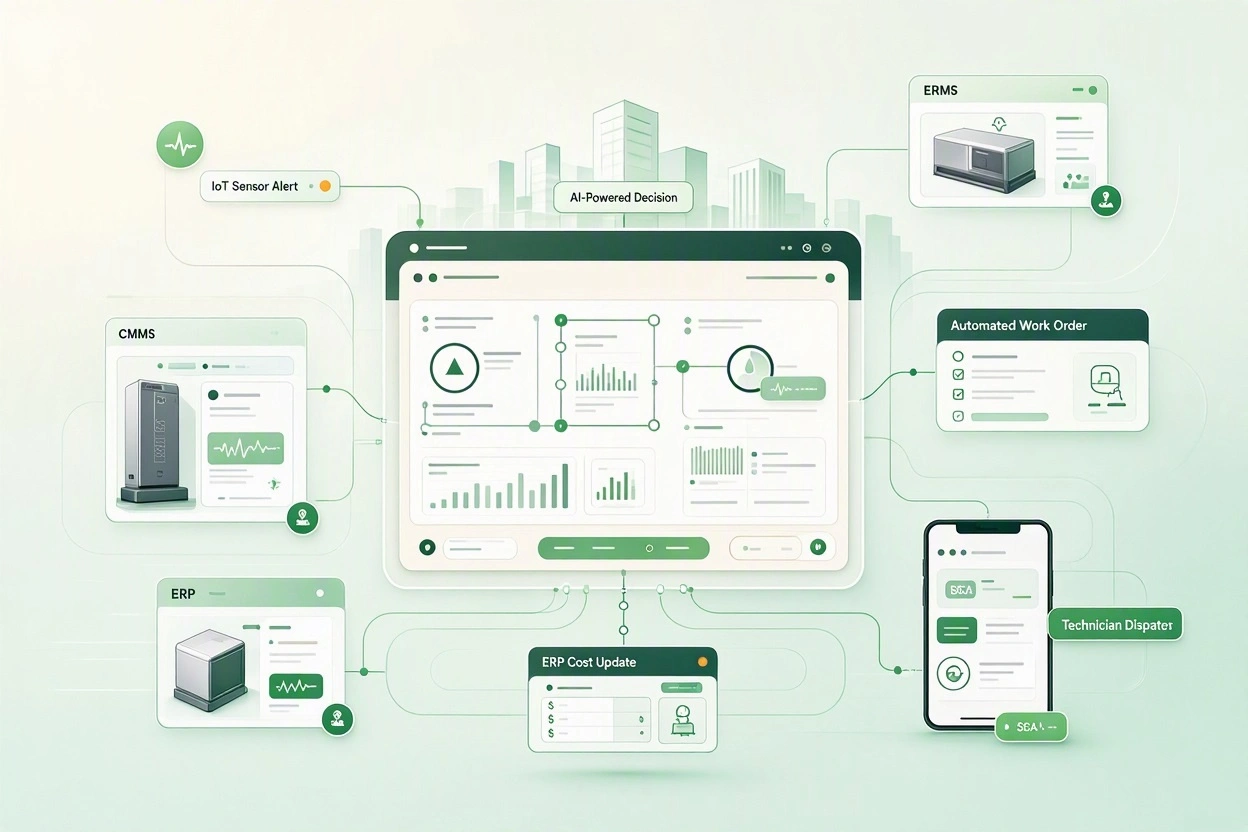
ConnectorHub also functions as an AI-ready data integration platform, enabling AI agents and analytics tools to access clean, real-time data across integrated systems. That means the platform is not only solving today's integration problem, but also building the tech framework that tomorrow's intelligent operations can depend on.
Also Read: Why SaaS Companies Are Moving Away from One-Off Integrations?
Conclusion
Organizations that continue treating integration as a series of tactical IT projects will find themselves progressively slower to respond to market changes, progressively more expensive to operate, and progressively more dependent on manual effort to hold their systems together.
API-led design provides the architectural discipline. A purpose-built enterprise workflow automation platform turns that discipline into operational capability, without requiring organizations to build and maintain the infrastructure themselves. The result is a business that can automate processes, adapt its integration layer to new systems, and scale its operations without proportionally scaling its overhead.
The intelligent enterprise is not a future state. It is a set of decisions about architecture, tooling, and governance that organizations are making right now. ConnectorHub exists to make those decisions faster, safer, and more impactful for industries where integration is already an operational backbone.