.svg)
Most mergers are won or lost within a hundred days after closing.
Not in the boardroom during negotiations. Not during due diligence. In the operational grind that follows, when two IT teams, two data architectures, and two organizational cultures collide under real pressure with no room for prolonged delays.
The deal rationale is usually sound. What consistently erodes that promise is execution, specifically the absence of a scalable integration framework capable of absorbing the complexity of combining two enterprise technology stacks without disrupting ongoing operations.
The organizations that get M&A integration right are not just faster. They are built differently, with a mature API integration platform, and the high-volume data sync and multi-tenant platform performance to absorb a new acquisition without breaking stride.
Why Most M&A Integrations Still Fail?
Research shows that 70 to 90 percent of mergers do not create the expected value. The most common reason for this does not involve faulty structuring of the deal. It is poor integration execution, the inability to consolidate systems, harmonize data, and align operations within the window when leadership attention and organizational momentum are both available.
The challenge is not complexity in isolation. Every large organization manages complex systems. The real issue is translation. Two companies arrive at a transaction with years of configuration decisions embedded in their ERPs, CRMs, and operational platforms. Each system reflects how that organization actually works. Almost overnight, both are expected to function as one unified enterprise.
The cost of getting this wrong compound month over month. Duplicate licensing fees accumulate. Support contracts for redundant platforms run in parallel. Entire IT teams stay embedded in technology stacks already marked for retirement. Temporary manual fixes designed to connect separated platforms frequently become lasting burdens that overwhelmed teams simply cannot ever resolve.
The problem is not that integration is impossible. It is that most organizations attempt it without the infrastructure to do it at the pace the business requires.
Common Pain Points for Acquisitive Companies
Understanding where integration pressure concentrates is the starting point for building a plan that holds. The challenges that consistently derail post-merger IT programs fall across three interconnected layers: people, process, and technology.
On the people's side, every enterprise application runs on role-based access controls tied to specific organizational structures. The moment a deal closes, employees from the acquired entity need access to systems they have never used. Without automated provisioning, this takes weeks and creates security gaps that take months to close. When key personnel leave during integration, their institutional knowledge about system configurations leaves with them.
On the process side, merged organizations routinely find themselves running every major workflow twice. Finance close runs twice. Procurement approvals run twice. HR onboarding runs twice. Employees on both sides know the duplication is temporary, which creates quiet resistance rather than urgency to consolidate. Integration planning frequently gets treated as a box-ticking exercise with no defined milestones, and the consolidation work slips quarter after quarter.
On the technology side, the challenges are the most persistent:
- Legacy systems with undocumented schemas that resist clean data extraction
- Point-to-point connectors that break each time a vendor updates their API
- Data silos that prevent a unified view of customers, assets, and financials across the combined entity
- Duplicate technology stacks generating ongoing cost without generating new value
- Hidden data flaws often remain completely unnoticed until they actively damage your strategic insights and daily operations.
These three layers reinforce each other. Access gaps slow process consolidation. Duplicated processes generate more data inconsistencies. Poor data quality delays the reporting that would otherwise reveal where integration is falling behind.
How iPaaS Changes the Game Enabling M&A Success?
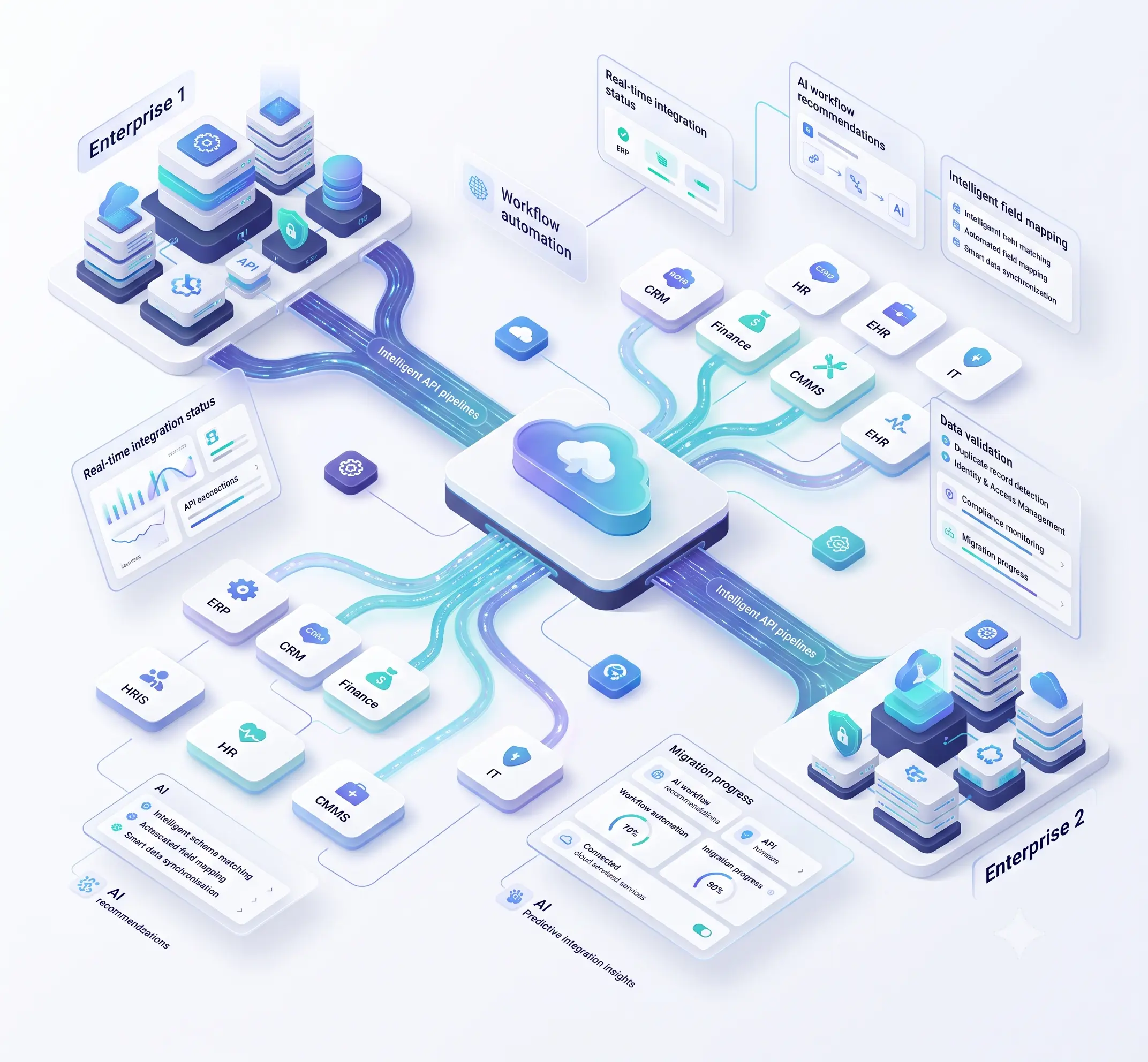
An Integration Platform as a Service fundamentally changes how businesses merge their tools after an acquisition. Instead of manually linking each distinct application directly together, this unified central hub seamlessly directs all shared information, workflow automation, and daily operational processes across your newly combined digital workspace environment effortlessly.
An integration platform with pre-built connectors changes the starting point entirely. Connections to common enterprise systems including ERP platforms, CRM environments, HRIS tools, and financial systems are already built, tested, and maintained by the platform vendor. The integration work shifts from construction to configuration. CRM consolidation that previously required 90 days of development can move in 30 minutes. Employee provisioning workflows that once took four weeks can be live in under one.
The scalability dimension matters as much as speed for acquisitive organizations. A PE-backed firm completing multiple acquisitions annually is not solving separate problems each time. It is building a repeatable capability that absorbs each new entity with decreasing friction. An integration layer built for portfolio-scale governance handles this natively. It also changes who can participate in that work, because teams no longer need to know how to build integrations without code from first principles when the platform handles the structural complexity for them.
The role of AI in integration automation accelerates this further across several areas:
- Automated data mapping identifies schema relationships across disparate systems in hours rather than weeks
- Process optimization tools surface redundant workflows across the merged entity before they become permanently embedded
- Compliance support functions cross-reference regulatory obligations across two organizational histories at a pace no manual review team can match
- AI-assisted field matching suggests transformation logic and flags data quality exceptions before they propagate downstream
As a result, your integration specialists spend less time on tedious paperwork and manual infrastructure builds. Instead, they focus deeply on strategic workflow designs and core governance choices that truly drive your combined business.
A Step-by-Step Integration Roadmap
After a merger, technology executives rarely ask if they should connect their systems. The real challenge is deciding exactly where to begin, which order works best, and how to fix current issues without sparking new ones. This guide outlines the exact steps to accelerate your returns while strictly safeguarding core data security.
Step 1: Conduct the Architecture Audit Before Close
Integration planning should begin during due diligence, not after the transaction finalizes. Map the target organization's full system landscape. Identify legacy dependencies, undocumented APIs, schema conflicts, and technical debt. Organizations that arrive at Day 1 with a costed, sequenced integration inventory are weeks ahead of those that start scoping after close.
Step 2: Establish Day-One Operational Connectivity
The immediate priority after close is keeping both organizations running without disruption. Connect identity management, payroll, HR, and compliance systems first. These affect every employee immediately and carry the highest operational risk if delayed. Connectivity at this stage should be automated, not manually administered.
Step 3: Build the Data Governance Layer
Before migrating your live information, you must set clear governance standards. Determine exactly which platform acts as the ultimate truth for every specific subject. Decide how your team will handle duplicate entries and what formatting rules apply during the transfer. Transferring messy records without fixing underlying flaws simply shifts those headaches into your fresh setup, making them significantly harder to resolve.
Step 4: Consolidate and Redesign Workflows
Once the data governance has been established, duplication of processes in operations can be optimized. Processes such as finance closing, procurement approval, and order management usually incur the highest cost of duplication. The goal is not to migrate existing processes as they stand. It is to redesign them for the combined organization and then automate processes that previously required manual coordination across two separate entities.
Step 5: Decommission Redundant Systems
System retirement follows consolidation, not the reverse. Organizations that decommission platforms before consolidated workflows are validated create operational gaps that are expensive and disruptive to resolve. Validate first, then decommission.
Step 6: Optimize and Build for the Next Acquisition
Once consolidation is stable, document connector configurations, workflow templates, and governance policies. The architecture built for the first acquisition becomes the foundation for every subsequent one. Each new entity onboards faster because the infrastructure already exists.
For data integration specifically, effective governance during M&A integration addresses three interconnected requirements:
- Deduplication and data cleansing as a structured process prior to migration, not as a post-go live cleanup activity
- Schematic validation and field transformation logic documented and under version control, ensuring that every data component can be traced to its source
- Compliance requirements spanning both organizational histories mapped explicitly, with the integration architecture configured to satisfy the most stringent applicable standard
CRM integration is where data quality causes the most financial damage. Overlapping client records leads to duplicate messages, internal sales disputes, and inaccurate profit tracking. Choosing the best data integration platform for your new workspace requires a system that automatically removes duplicates, checks accuracy, and keeps detailed logs. Ultimately, strict API data integration dictates whether your shared data empowers smart choices or silently sabotages your business success.
On the process side, enterprise automation changes what is achievable during consolidation. Manual handoffs that existed because two departments operated across separate organizational boundaries become automation candidates once those boundaries no longer exist. Automated business processes reduce cost and remove friction that slows the combined entity's ability to respond to market conditions. Cloud integration allows organizations to connect on-premises infrastructure from the acquired entity to cloud-based workflows without requiring a full cloud migration first.
Getting Started with ConnectorHub to Become M&A Integration Ready
What organizations need from an integration platform during M&A is not just connectivity. They need speed, governance, and results they can measure from the first week of deployment. That is what ConnectorHub is built to deliver.
Businesses choosing ConnectorHub to manage their iPaaS needs post-merger typically shrink their integration backlogs by more than sixty percent within just three months. Those exhausting daily administrative duties that previously burned hundreds of hours annually are effortlessly replaced with intelligent workflows running entirely on autopilot. Furthermore, service level failures caused by delayed data updates plummet when you link critical platforms through a controlled, real-time central hub instead.
The outcomes that matter most to IT leadership include:
- Integrations live in two to four weeks rather than the months typical of traditional middleware deployments
- Over 98 percent data accuracy maintained across connected systems once deduplication and validation rules are in place
- Integration backlog reduced by 60 percent in the first quarter of deployment
- Invoice-to-cash cycles shortened by up to 40 percent when ERP and finance systems are connected and syncing in real time
- Compliance reporting readiness maintained continuously rather than rebuilt before each audit cycle
ConnectorHub provides over one hundred seamless integrations for the exact platforms that drive complex business mergers today, such as Salesforce, ServiceNow, QuickBooks, Nuvolo, and Corrigo. Every newly acquired company receives a fully secure private workspace featuring distinct passwords, strict user limits, and independent activity tracking. Furthermore, crucial compliance frameworks like SOC 2, HIPAA, and GDPR are securely hardwired into our foundation immediately, rather than added later.
Software robotic process automation capabilities within the platform also reduce the load of manual coordination that normally piles up during consolidation, as well as making the workflows repeatable for every future acquisition.
This creates a compounded effect for PE-owned companies and serial acquirers because each subsequent acquisition is completed at an increasingly faster rate since the architecture, connectors, and policies are already established. Integration stops being a constraint on deal velocity and starts functioning as a structural advantage.
Also Read: Custom Integrations vs iPaaS vs Embedded iPaaS
Conclusion
The measure of M&A integration success has shifted to how quickly the combined entity can operate as one, making decisions from unified data and delivering consistent operations to every stakeholder involved.
Enterprise integration platform maturity is increasingly a factor in deal valuation, not just a post-close concern. Acquirers with a proven integration architecture move faster and spend less. Targets with clean, well-documented systems command better terms.
ConnectorHub is built for organizations operating at this level of integration complexity. With capabilities such as pre-built connectors, a no-code visual workflow builder, a workflow automation dashboard for real-time visibility, and compliance alignment built in from day one, it gives IT teams the infrastructure to move from transaction close to integrated operations in weeks. For PE-backed firms and serial acquirers, that capability is a structural advantage.
The path from deal close to integrated operations used to be measured in quarters. With the right foundation in place, the same journey now runs in weeks. That compression is where deal value is created, costs are captured, and the rationale for the transaction is realized.