.svg)
For SaaS product teams, it always comes down to the same make-or-break issue: prospective customers request native integrations with their other core systems (ERP, CRM, CMMS etc.), customer success teams deals with increasing volume of multi-system data sync and integration related support tickets, and the engineering queues for custom integrations get larger and larger.
Ultimately the choice: custom built integrations, embedded integration platform, a SaaS integration hub or other solution, will directly impact a product roadmap, engineering spend, and a competitive posture long term.
Let’s look at some of the industry stats. The global iPaaS market expanding from $12.87 billion in 2024 to a projected $78.28 billion by 2032 (CAGR of ~26%). The average enterprise managing 250–300 SaaS applications. 63% of companies building integrations specifically to reduce customer churn.
Options for SaaS teams range from building custom integrations to embedded integration platform, adopting a SaaS integration hub, workflow automation, or implementing no-code ERP/CMMS integrations. This guide helps product and technology leaders across industries make that call with clarity.
What's at Stake When You Pick an Integration Architecture?
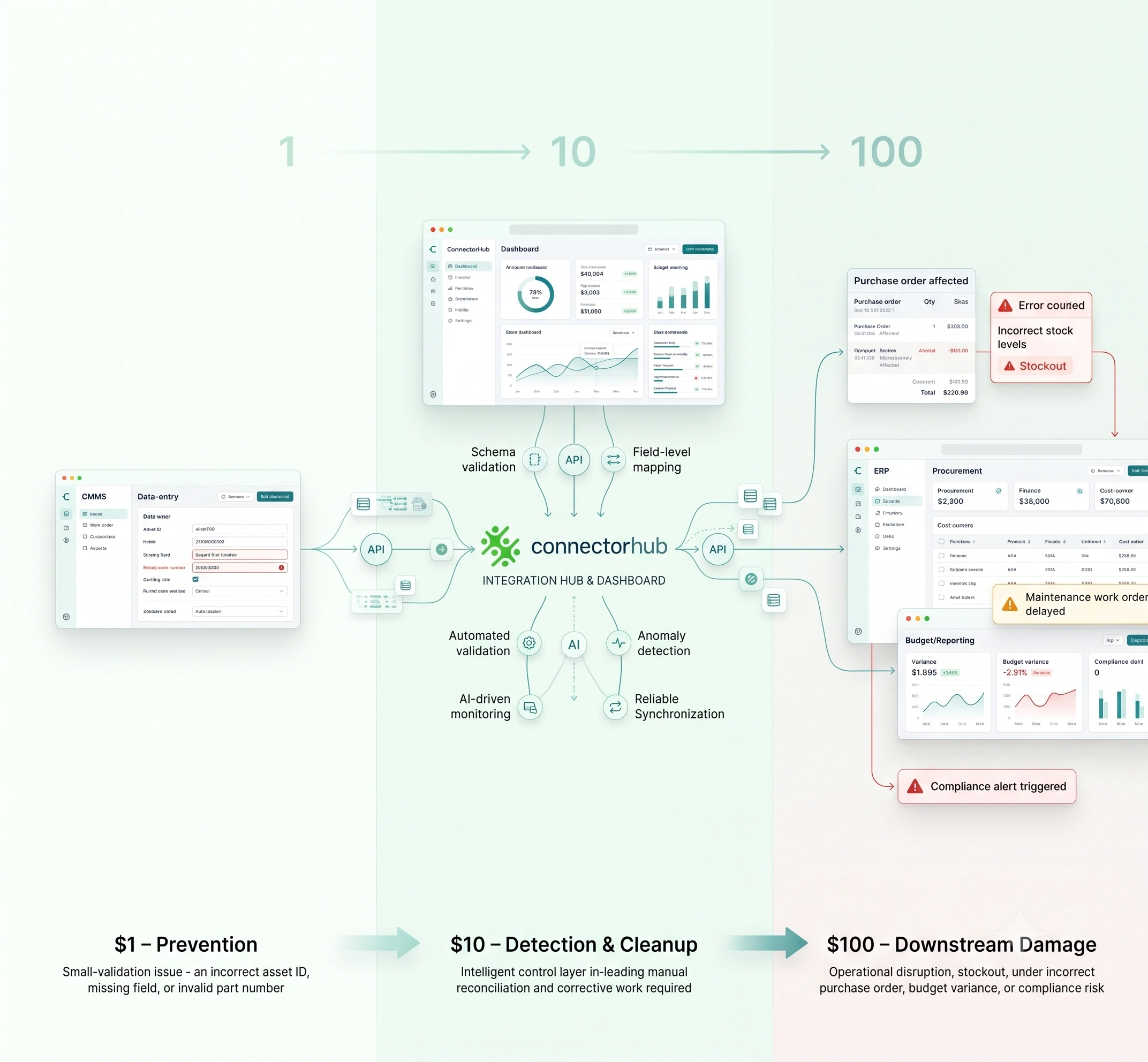
Poor integration architecture causes technical debt: wasted engineering effort writing and maintaining hard to debug custom connectors; lost enterprise sales because key integrations are unavailable while they are available in competitive products and heavy support burden associated with time-consuming data synchronization problems.
In contrast, the right architecture accelerates time-to-value for new integrations, improves win rates in competitive sales cycles, and frees engineering resources to focus on core product development.
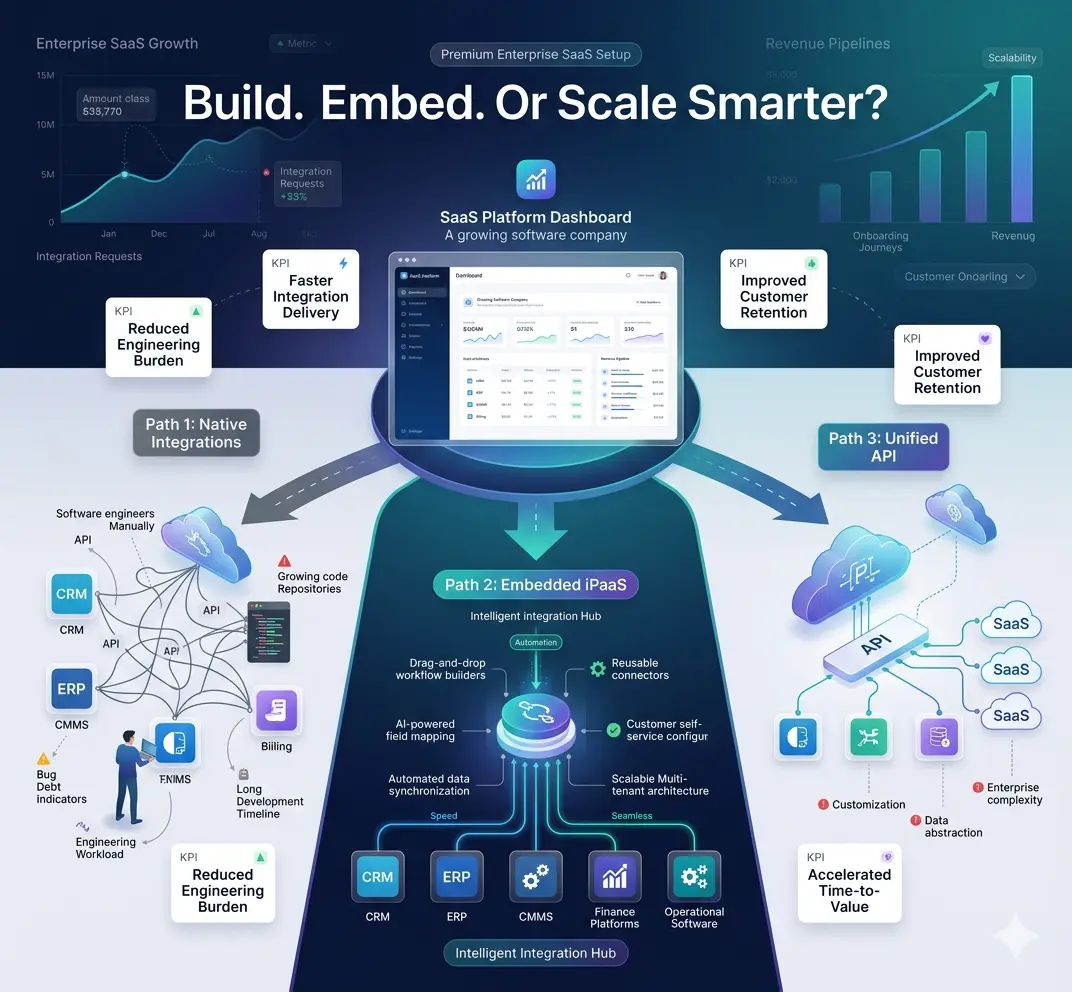
You have basically got three options on the table: build the integrations yourself in-house, bring in an embedded iPaaS system, or go with a unified API layer. None of them is universally "right" which one makes sense really comes down to where you are as a company and who your customers are.
3 Paths: Native Build, Embedded iPaaS, and Unified API
Path A: Building Native
Native development is justified when you have clear and consistent requirements for integration, where the systems involved are proprietary or poorly understood, and when you have enough capacity within your engineering staff to consider integration a core competency.
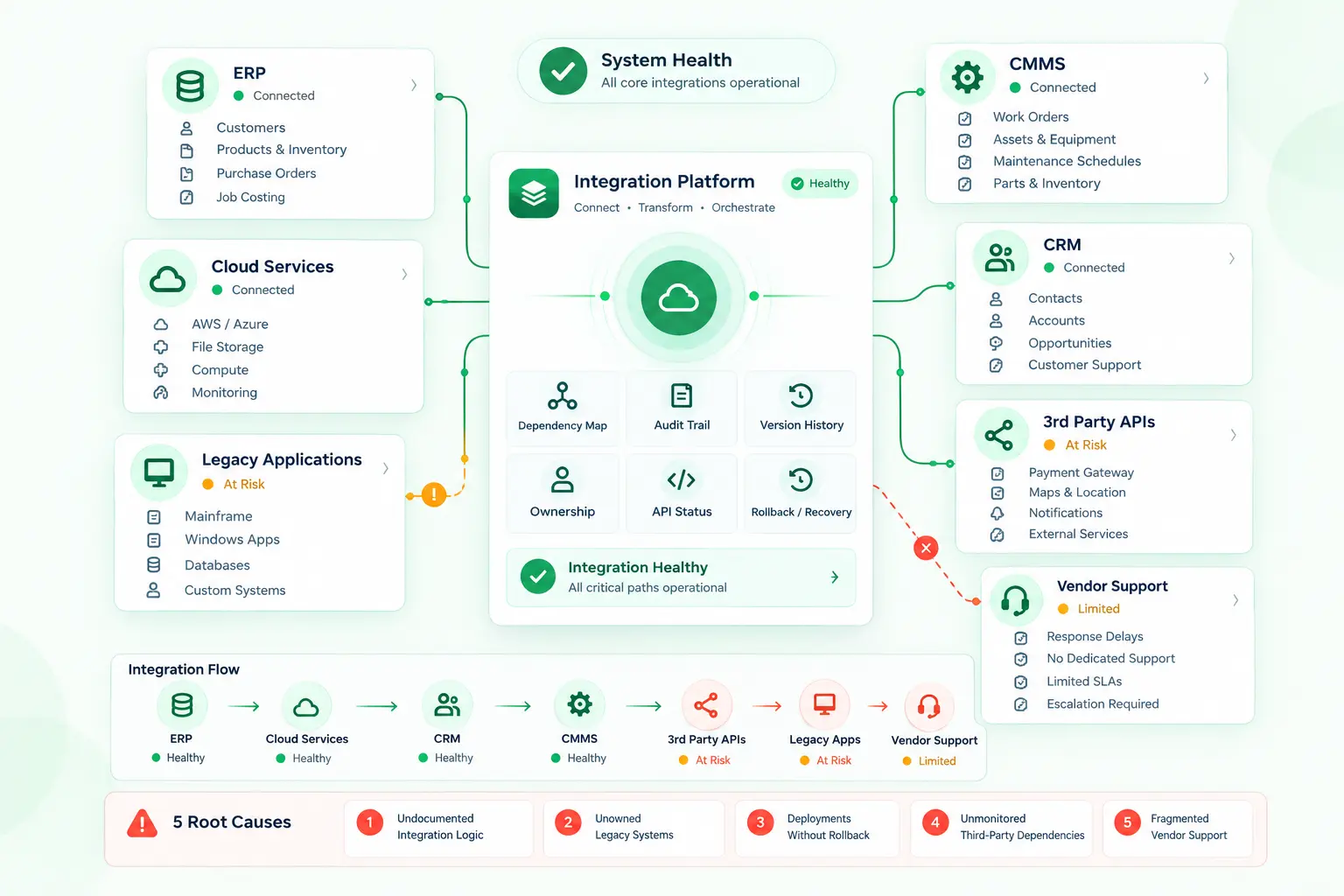
The honest cost: a custom-built integration for a single system typically consumes three to four months of engineering time upfront, with ongoing maintenance costs that compound as APIs evolve, and customer configurations diversify. Multiply across ten or twenty integration requests and the math becomes difficult to defend. Engineers who built the integrations become the only people who understand them, a knowledge silo that delays troubleshooting and complicates scaling.
Path B: Embedded iPaaS
Embedded iPaaS refers to an integration platform as a service which integrates applications in a cloud-based environment. The platform is integrated within your SaaS application and helps customers integrate different systems. Unlike traditional enterprise iPaaS platform used by the IT professionals to integrate applications, an embedded iPaaS is scalable to hundreds or even thousands of customers at once.
When your customer needs to sync their Salesforce instance, NetSuite environment, or CMMS platform with your product, that is precisely the scenario embedded iPaaS is built for. The integration appears native to your product and accommodates each customer's individual setup.
The embedded iPaaS market has matured considerably, and the differences between platforms are now sharper not just in feature sets, but in the depth of industry expertise each brings.
Path C: Unified API
A unified API standardizes data schemas across multiple tools within a category. Build once against the unified schema and gain access to dozens of connected systems with minimal incremental effort.
The appeal is real for teams serving mid-market customers with predictable, standard integration needs. The ceiling arrives quickly in enterprise deals. When a prospect's Salesforce deployment contains custom objects built for their specific compliance workflow, or when a facility management team needs to sync non-standard asset classifications from their CMMS, a unified schema cannot accommodate that specificity.
The choice between embedded iPaaS and unified API is fundamentally a decision about your customer profile: standard SMB use cases reward breadth, complex enterprise environments reward depth.
Key Considerations Before Committing to an Integration Path
Before committing resources to any path, work through these questions honestly:
- How many integration requests are sitting unfulfilled in your backlog? If the answer exceeds five, the manual build path has already demonstrated its limits.
- What percentage of your active enterprise pipeline is conditioned on a specific integration? If that number exceeds 20%, your integration gap is already measurable in deal velocity.
- How stable is your customers' tech stack? In industries like facility management and healthcare, vendor-driven API changes arrive on timelines your team cannot control. Your architecture needs to absorb that volatility.
- Can your engineering team sustain both product development and integration maintenance without one crowding out the other? If the answer depends on the quarter, that is effectively a no.
- What does your expected connector count in 36 months? A platform that handles five integrations gracefully may become a maintenance burden at twenty-five.
How to Choose the Right Embedded iPaaS
- Integration Depth vs. Breadth
Depth-first platforms let you read and write to custom objects and non-standard fields that do not exist in any standardized schema, accommodating real enterprise environments. Breadth-first platforms give faster coverage across common apps but constrain you to pre-standardized fields. The right choice follows directly from your customer profile, not from a feature matrix comparison.
- Developer Experience
Integration code accrues technical debt faster than other product code — it lives at the boundary between your systems and your customers, a boundary that changes constantly. Look for version control, CI/CD compatibility, and code-level testing. Visual-only workflows impose a ceiling on logic complexity and testing rigor.
- Customer Self-Service & UX
The best embedded platforms enable customers to configure, activate, and troubleshoot integrations independently. Role-based access control for integrations is a requirement frequently overlooked at evaluation — enterprise customers expect granular permission controls, and without them you create governance gaps that surface in procurement reviews.
- Scalability & Performance
Performance KPI tracking and scalability constraints appear only after you have committed. Evaluate how a platform handles rate limiting, bulk API operations, and real-time versus batch processing. Platforms adequate at 10,000 records may degrade at 10 million.
- Customization & Flexibility
Webhooks integration and custom connector development become critical when customers use industry-specific or proprietary applications outside standard connector libraries. Platforms that constrain customization through rigid schemas create ceiling effects that surface mid-enterprise sales cycle.
- Observability & Support
Field-level logging — showing which record, field, and transformation step failed — is materially better than object-level logging. Support responsiveness matters equally; some platforms offer technical guidance as standard, others reserve it for premium tiers.
- Pricing Model & Economics
Plug-and-play integrations delivered through usage-based pricing align costs with value delivered. Per-connector pricing escalates unpredictably as your portfolio grows. Model total cost of ownership at three-year projected scale, not current footprint.
Integration Guidelines Across Seed, Scale-Up & Enterprise Stages
Is Your Integration Strategy Ready for the Rise of AI-Native Products?
Most integration architectures have been developed under the assumption that information was exchanged in batches nightly syncing, hourly updates, or periodic reconciliation processes. This architectural approach is becoming obsolete for what AI-enabled products need.
Enterprise automation architecture that enables agentic work processes represents an entirely new set of requirements altogether. With the increasing rate of AI technology, this gap will become increasingly prominent for the two sets of needs. As per Gartner, up to 40% of enterprise software applications would be equipped with task-specific AI agents by 2026.
Three trends reshaping the space for 2026 and beyond:
- AI-native integration patterns. RAG pipelines, semantic search, and real-time agent context delivery are creating new demands on cloud integration infrastructure. Platforms investing in these patterns now will set the category standard for the next five years.
- The developer-first vs. low-code divides. The market has been bifurcated. Developer-first platforms treat integrations as versioned, testable code. Low-code platforms optimize speed and accessibility. The most capable platforms in 2026 support both because different integration types require different tools.
- Compliance as a procurement prerequisite. Providers that cannot demonstrate SOC 2 compliance, GDPR alignment, and audit-ready logging are increasingly disqualified at the procurement stage, not the evaluation stage.
What ConnectorHub Brings to Your Integration Ecosystem?
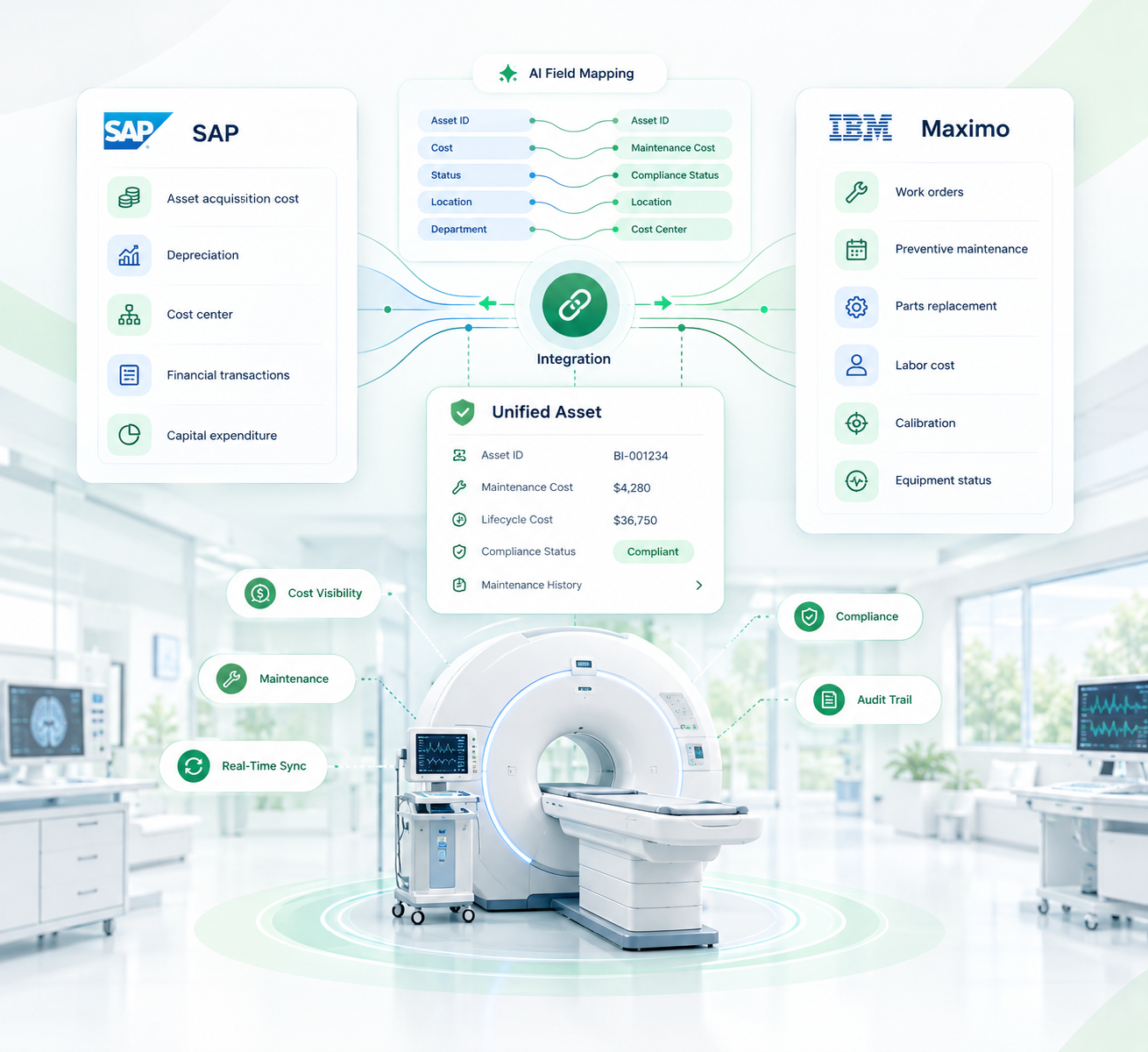
ConnectorHub was purpose-built for the operational industries that most iPaaS solutions and general-purpose cloud integration software were never designed to serve well. Facility management firms, healthcare facilities, real estate operations teams, and industrial operators run on CMMS platforms like Corrigo, Nuvolo, and FMX; ERP systems like SAP and QuickBooks; and CRM platforms like Salesforce systems that require integration partners who understand operational context.
The no-code workflow builder, AI-powered field mapping, and built-in capabilities to automate processes allow both technical and non-technical teams to manage integrations without routine engineering intervention. SOC 2, HIPAA, and GDPR compliance with tenant isolation and encrypted credential storage meets the governance requirements of enterprise procurement teams in regulated industries consistently impose.
Also Read: Custom Integrations vs iPaaS vs Embedded iPaaS
Conclusion
Choosing an integration architecture is ultimately a business decision disguised as a technical one.
The right approach should align with your customers' expectations, your engineering capacity, and your long-term product strategy. What works for a startup supporting a handful of integrations may become a bottleneck as enterprise requirements, customer volume, and integration complexity grow.
Before committing to any path, quantify the impact of your current integration backlog, evaluate the revenue tied to integration requests, and assess whether your existing approach can scale over the next three years. The most successful SaaS companies treat integrations as a strategic capability, not a collection of one-off projects.
Whether you build, embed, or standardize through a unified API, the goal remains the same: deliver connected experiences that help customers realize value faster while allowing your team to focus on what differentiates your product.
Because while integration architecture can always be changed later, the cost of waiting too long to address it tends to compound with every customer, every connector, and every release.