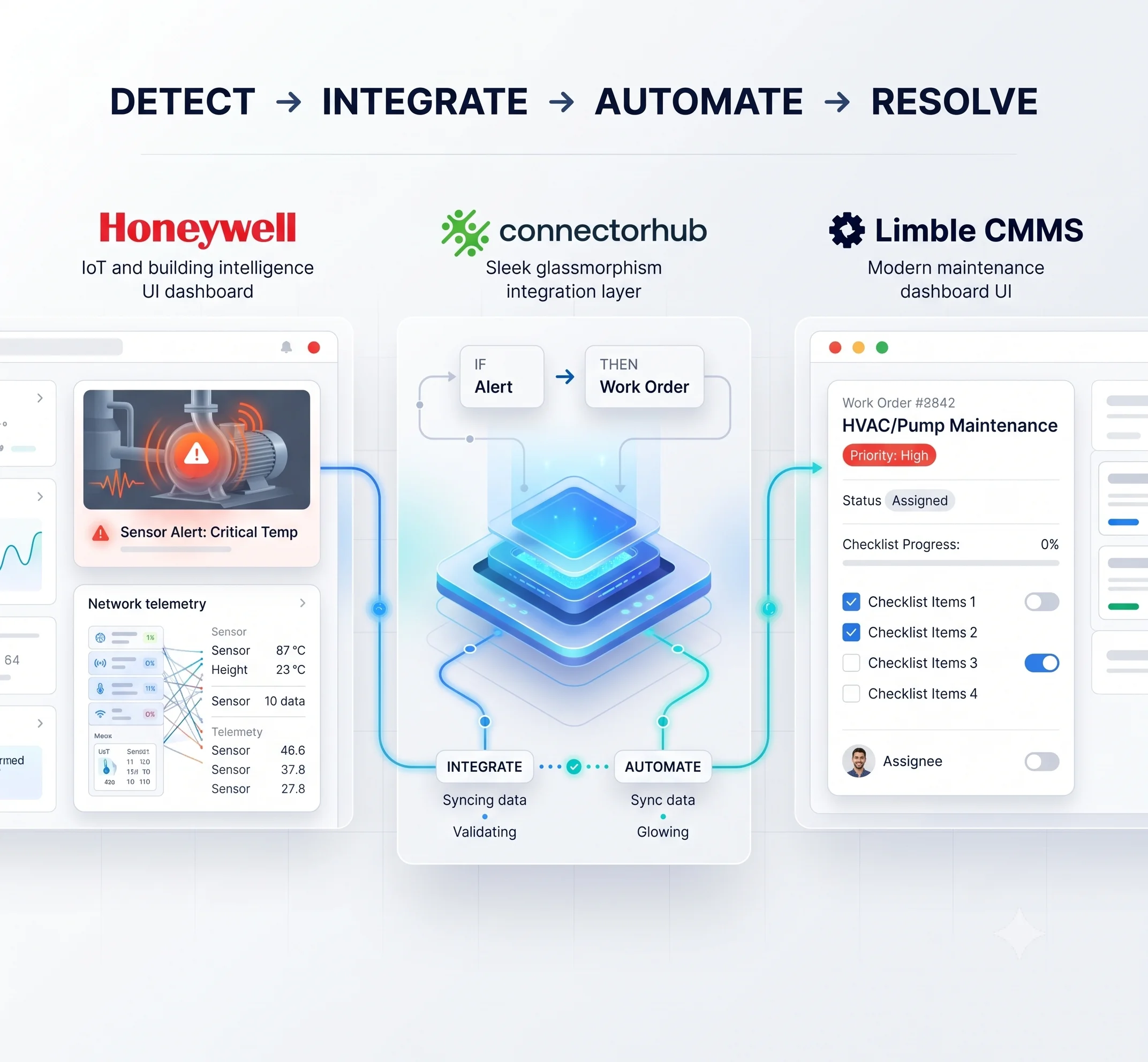
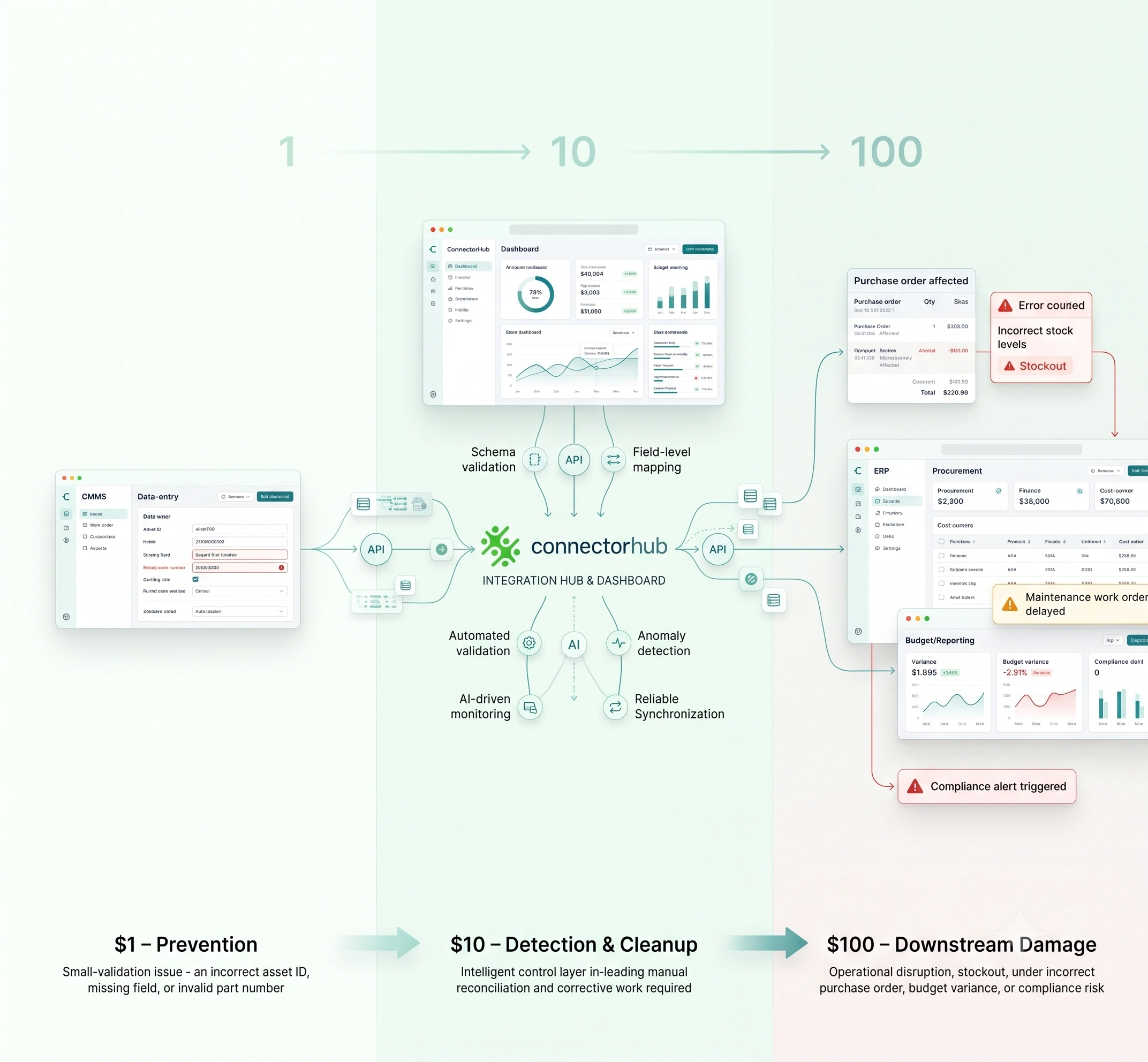
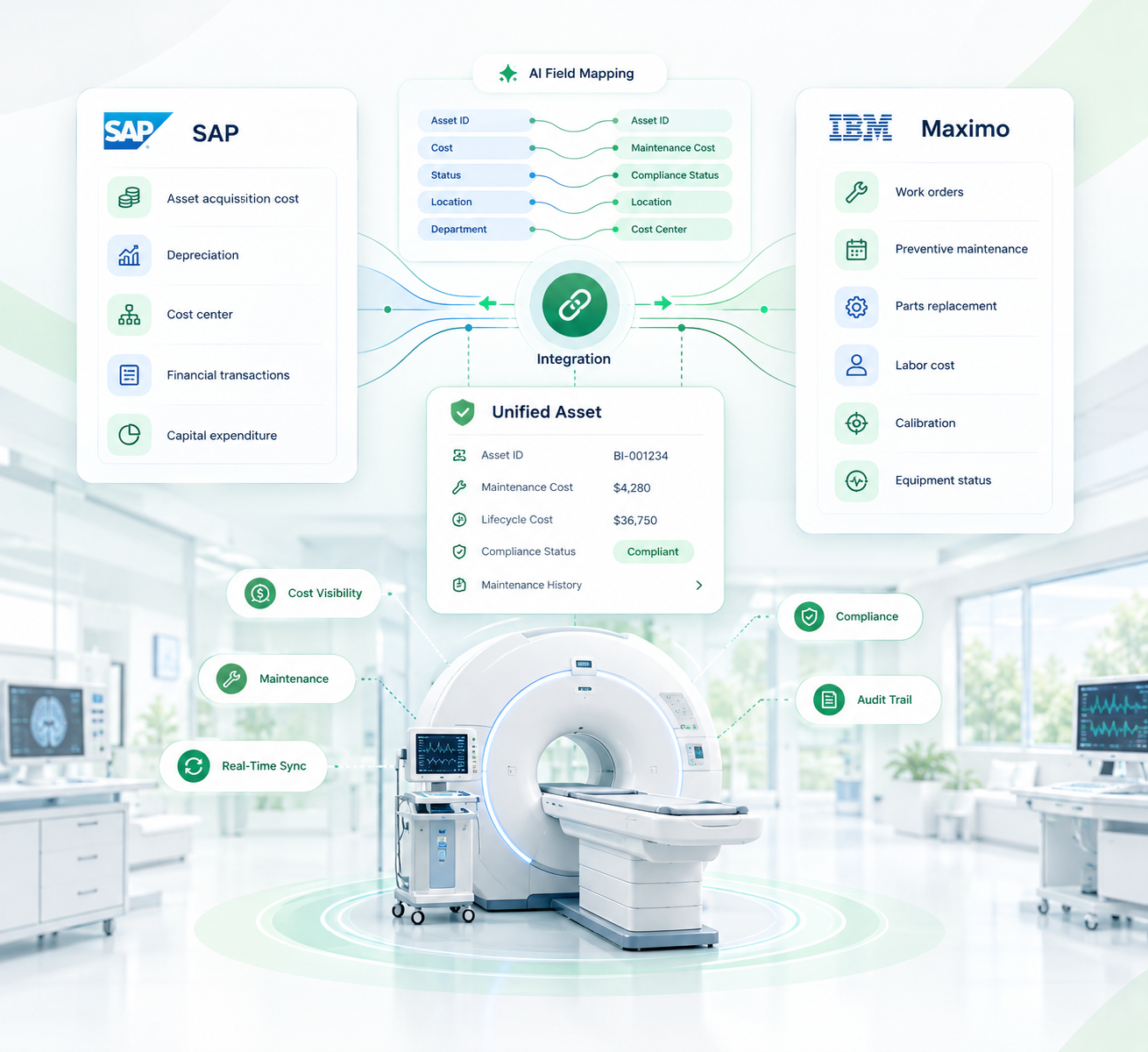
.svg)
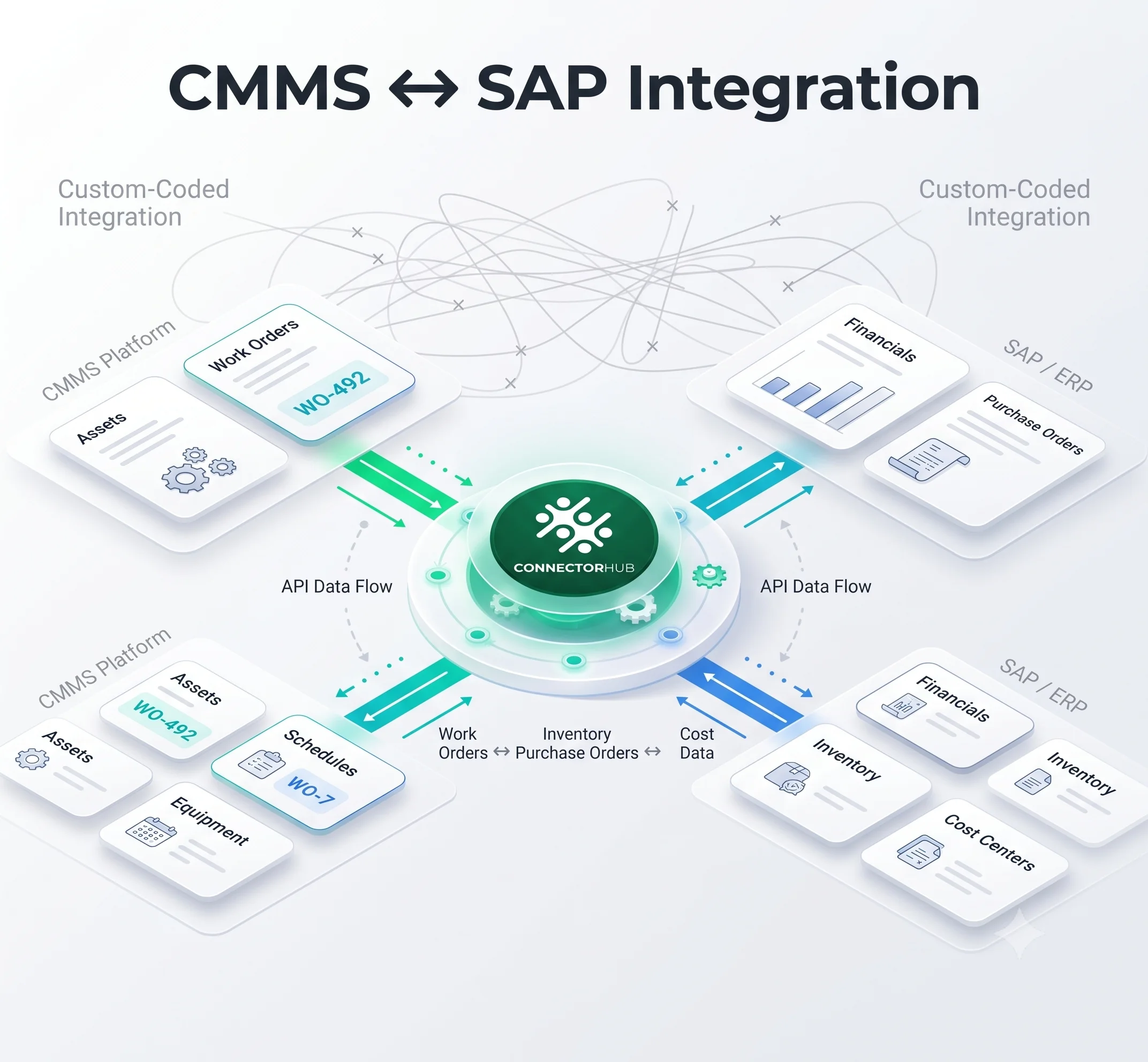
CMMS vendors love to talk about “complete visibility” into assets and maintenance.
But ask where that visibility ends, and you’ll often hit the same wall: SAP.
Finance needs costs in the right cost centers. Procurement needs POs in the right workflow. Inventory needs to match the balance sheet. Without a real integration, all of that gets stitched together manually through spreadsheets, retyped orders, month-end reconciliations.
Pre-built system connectors are the alternative. They turn what used to be a custom, six-figure integration project into a standard capability that expands the platform’s value by connecting maintenance directly to the financial system of record via a CMMS ERP integration.
Now many of them are building an ERP CMMS connector once, testing it on actual SAP setups, and delivering it as a core component of their platform rather than selling it as a discrete consulting service. Pre-built data connectors transform a fragile process, dependent on engineers, into something a sales person can reference right from day one in a demonstration.
Consultants and system integrators usually feel this shift before their clients name it. A client might be shopping for a new CMMS, or trying to fix one that never talked to finance properly. Either way, the connector question comes up early and tends to linger.
Why CMMS-SAP Integration Remains a Persistent Challenge
SAP was built around cost centers, purchase requisitions, and general ledger entries. A CMMS wasn't. It runs on assets, work orders, and downtime, a different vocabulary entirely for what is often the same physical equipment.
Neither system was designed with the other in mind. The translation work between them has traditionally landed on whoever is running the implementation.
For most consultants and system integrators, that has meant custom API integration work built from scratch, for every client. Not once. Every time.
The pattern is familiar to anyone who has sat through one of these projects. Most statements of work never price in the associated risks properly. Independent research into enterprise software rollouts has repeatedly found that a large share of ERP-related projects run past their original budget, with integration work cited as one of the more common reasons why.
Custom connectors also concentrate knowledge in one or two people. When those people leave, maintenance turns into archaeology.
A handful of patterns show up again and again in troubled CMMS-SAP projects:
- Point-to-point scripts that break with every SAP patch or CMMS release
- Field mappings that exist only in someone's memory, not in documentation
- No monitoring, so failures surface only after finance notices a missing cost entry
- Duplicate data entry that technicians quietly route around instead of flagging
- A one-line scope, "just connect the systems," that balloons into months of custom work
None of this is theoretical for a system integrator. It shows up as change orders nobody wanted to write, strained client relationships, and support tickets that consume billable hours without generating a dollar of new revenue.
How Pre-Built Connectors Change the Equation
A pre-built connector gets built once, tested against real SAP environments rather than a sandbox someone spun up for a demo, and packaged so it can be reused instead of rebuilt. An implementation team configures field mappings, authentication, and sync timing through a template that already knows where SAP tends to misbehave.
That's the real difference. The work moves from writing new logic to configuring something proven, and it lets a team automate the process of syncing work orders, inventory counts, and cost postings without starting from zero on every account.
Reliability comes from mileage. A connector that has already run in dozens of client environments has already hit the unusual edge cases: partial batch failures, duplicate purchase orders, currency mismatches, custom fields nobody documented. Each one gets solved once, in the connector logic itself, instead of being rediscovered by a new team every time.
The vendor's own pitch changes too. "SAP integration is available through professional services" becomes "SAP integration ships with the platform." That single shift alters how a sales rep positions the deal, and how fast a new customer sees value from it. Plug-and-play integrations aren't just a convenience here. They're a sales argument.
The numbers back this up.
Consultants feel this most directly in project scoping. A build that once required a dedicated integration developer for six to eight weeks can now be scoped around configuration and validation instead, freeing senior engineers for the advisory work that actually pays better.
It also means an SI doesn't have to steer a client away from a no-code integration between ERP and CMMS conversation just because the custom-build version would blow the budget. That conversation becomes affordable to have.
The broader market backs this shift too. Market research projects the global integration platform category to grow past $71 billion by 2030, expanding more than 30 percent a year, largely because organizations are choosing to buy proven integration capability rather than build it themselves.
Core Capabilities That Unlock Greater Platform Value
Connectors are not interchangeable, and the gap between a shallow one and a genuinely useful one comes down to which data flows actually run in both directions. A shallow integration might push a work order status into SAP as plain text and call it done. A well-built one treats work orders, purchase orders, inventory levels, and cost postings as living records, updated from both sides, all the time.
At minimum, a connector built for CMMS-SAP environments needs to handle:
- Work order creation and status changes flowing both ways, so technicians see approvals and finance sees closure in real time
- Inventory and spare parts data synced against SAP material master records, so the two systems stop disagreeing about stock counts
- Purchase requisitions and purchase orders generated automatically when a work order needs parts, instead of a planner keying in a request by hand
- Cost postings and labor charges landing in SAP's cost center structure as work orders close, so maintenance spend shows up without a month-end scramble
Predictive and condition-based maintenance programs live or die on cost visibility, since that visibility is what justifies budget for sensors and monitoring equipment in the first place. Asset lifecycle planning gets sharper too, once total cost of ownership pulls directly from SAP's financial data instead of a spreadsheet estimate.
A data integration platform that keeps these numbers current on both sides gives operations leaders an answer they can actually defend when finance asks why the maintenance budget crept up. ConnectorHub's SAP and Nuvolo template already runs this exact set of flows in production: work orders, purchase requisitions, inventory, and cost control data, moving between systems without a custom build behind it.
Platforms that also touch customer or field service data can extend the same architecture into CMMS ERP CRM connectors, tying work orders to service contracts, warranty terms, or billing triggers without spinning up a separate integration project for each connection point.
Benefits Specifically for Consultants and System Integrators
A consulting firm's margin on an integration project depends almost entirely on how much of the work is templated versus built from scratch. The integration logic becomes reusable intellectual property instead of a cost that dies with one client.
Firms that make this shift tend to see the same handful of changes:
- Discovery and design shrink, since the reference architecture already exists
- Delivery timelines compress, often by half or more against a fully custom build
- Junior consultants can configure a proven template, freeing senior architects for design and governance work instead of plumbing
- Post go-live support turns into a managed service line instead of unplanned rework nobody billed for
Most consulting firms quietly absorb integration maintenance as a cost after a project wraps. Pre-built connectors turn that cost into revenue instead. Monitoring dashboards, version updates, and field mapping adjustments become a recurring managed services contract, and that contract renews every year as enterprise automation revenue rather than a favor a project manager does for free.
A system integrator who can point to a library of tested CMMS-SAP integration patterns, proven across several SAP versions and several CMMS platforms, has a credibility edge in a proposal that a firm still quoting custom-build timelines simply cannot match.
How ConnectorHub Serves as the Integration Layer
ConnectorHub exists to close exactly this gap for consultants and system integrators working across CMMS and SAP environments. It operates as an ERP integration platform that a consulting practice can license, configure, and fold into its own delivery methodology.
The SAP connector library covers the flows that come up constantly in practice: work order and purchase requisition sync with platforms like Nuvolo, master data alignment for customers and vendors, and financial reporting pulled automatically from separate business units instead of reconciled by hand.
Because the templates already exist, a consulting team running an assess, build, and run delivery model can treat ConnectorHub as the reference architecture during discovery, configure the actual workflow during implementation, and hand off monitoring as a managed service afterward.
A handful of architectural details matter specifically for firms juggling several client engagements at once:
- Multi-tenant architecture that lets a consulting team manage multiple client environments from one console, with role controls that keep each client's data properly walled off
- A custom connector toolkit for the SAP configurations or CMMS variants that fall outside the standard template library
- Live performance tracking with SLA alerts, so a firm can prove uptime and response times in a managed services contract rather than waiting for a client to complain
- SOC 2, HIPAA, and GDPR aligned governance, which matters the moment a client operates in a regulated space like healthcare facilities or utilities
- AI-powered field mapping that cuts down the manual work of matching CMMS fields to SAP's data structures
Firms weighing what actually counts as the best integration platform for CMMS environments in a consulting context tend to land on the same short list: reusability across clients, governance they can show a client's IT team without hesitation, and an architecture that doesn't need months of setup before the first engagement can use it.
ConnectorHub runs as cloud integration infrastructure, paired with a partner enablement program built specifically around consulting delivery, so most of that list is already covered. Alongside it sit iPaas solutions style capabilities, scheduling, triggers, role-based access, that a firm would otherwise have to build or license separately.
Conclusion
CMMS platforms that treat SAP connectivity as a core capability, not a professional services afterthought, open up a wider slice of enterprise deals. The consultants and system integrators building on top of those platforms inherit that advantage automatically.
ConnectorHub was built around that shift. As an enterprise integration platform built specifically for CMMS and SAP environments, it hands consulting teams a reference architecture they can configure instead of construct, and gives CMMS platforms a way to say SAP connectivity ships with the product rather than living buried in a statement of work.
For any firm still deciding whether to keep building these connections from scratch or standardize on a layer built for exactly this problem, the math is starting to tilt in one direction.