.svg)
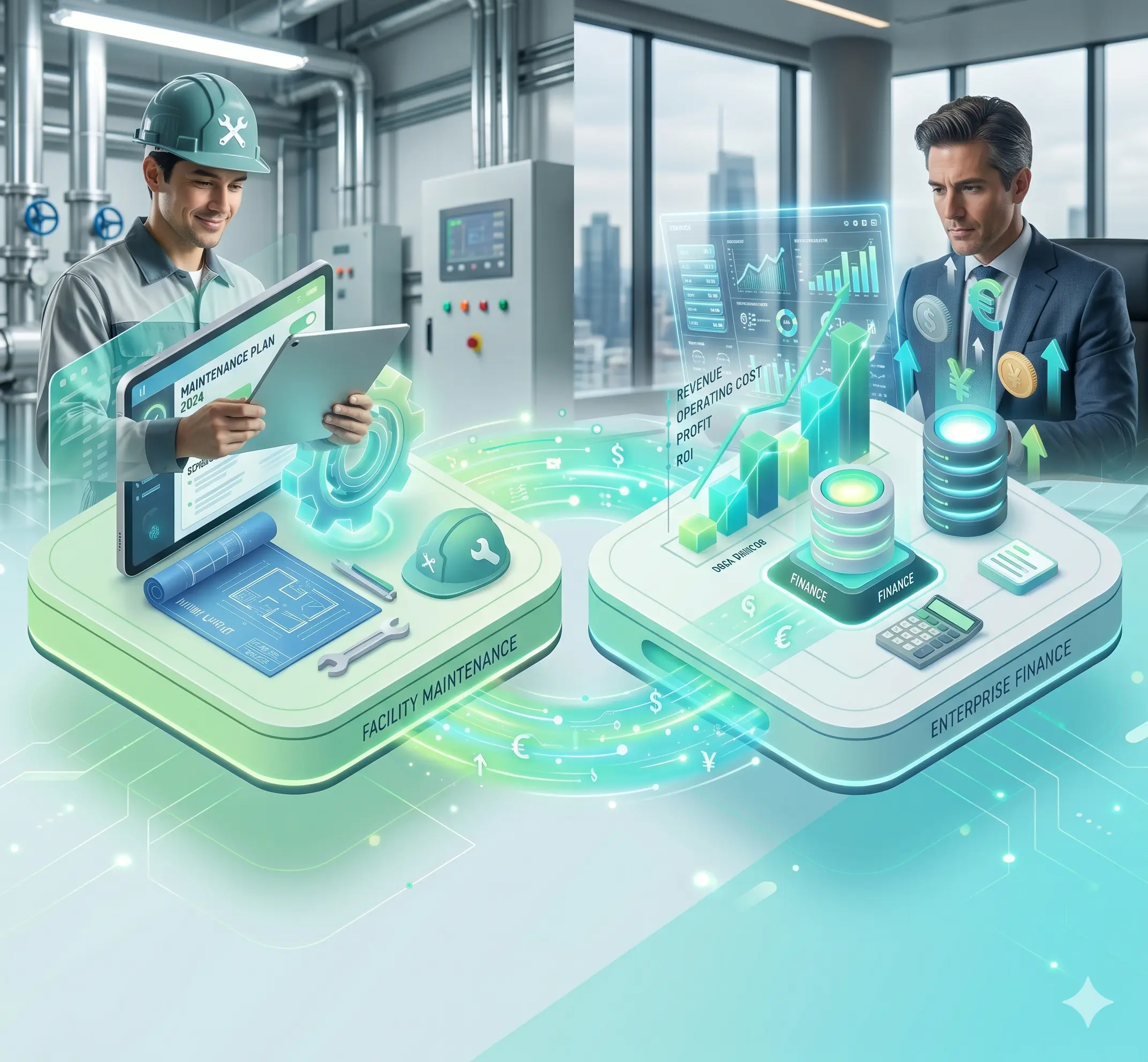
This is a far too common operational headache for facility executives: your maintenance crew just finished a critical emergency repair using one app, but your finance team is still staring at outdated budget numbers in another.
At the end of the day, it's really about what each system is built to do. A CMMS is your boots-on-the-ground tool, keeping up with equipment, repairs, and making sure the building doesn't fall apart. Your ERP handles the bigger picture: the money, the people, the purchasing.
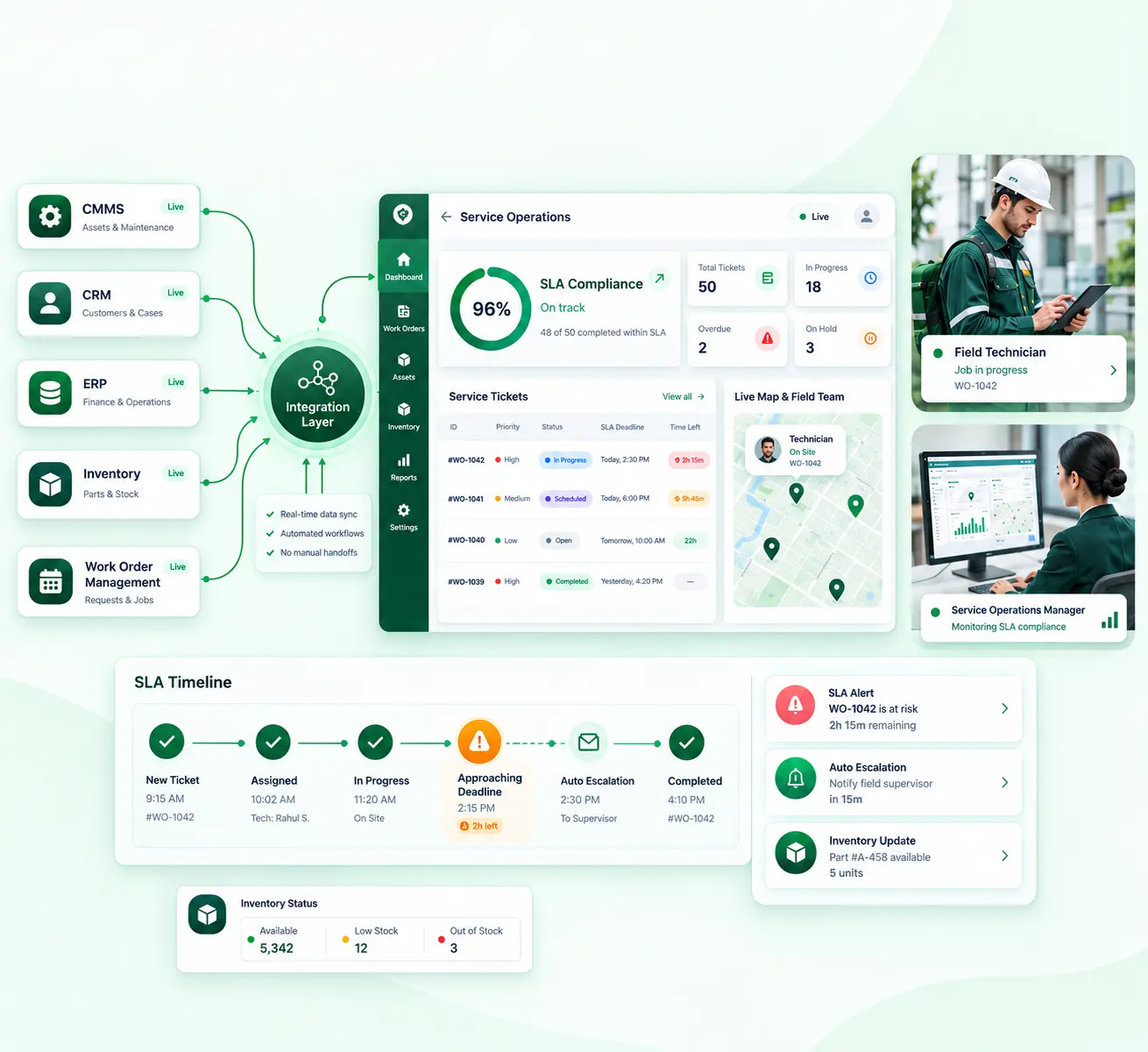
A more connected approach through orchestrated integration linking CMMS to ERP brings these systems onto the same page, linking financial data with day-to-day facility operations, so nothing goes missing to cause bottlenecks.
Instead of juggling disconnected tools, teams gain a real-time view of both on-the-ground work and its financial impact. And with no-code integration for facility management solutions like ConnectorHub, making this shift no longer means months of heavy IT effort or oversized budgets.
Let’s now dive into what building maintenance integration looks like in practice, the common challenges, and where no-code CMMS-ERP integration fits in.
The Real Pain of Siloed CMMS and ERP Systems in Facility Operations
It is a common misunderstanding that one system can perfectly substitute the other. An ERP acts as your company’s record system and is the single data repository used by accounting and procurement.
The truth is, an ERP isn't always the most practical tool for a technician in the middle of a repair. A CMMS belongs to where the work happens. It is fast and intuitive, designed to empower technicians rather than slow them down.
These two systems shouldn’t be competing for dominance; they are partners that work best when they focus on the specific jobs they were actually made for.
When discussing operational systems, several misconceptions emerge as massive daily challenges:
- Our ERP already handles maintenance, While an ERP might have a maintenance module, it rarely supports the actual day-to-day execution. The clunky interface leads to a severe challenge: poor user adoption among technicians on the floor.
- Dedicated maintenance software is only for small teams, Failing to deploy a dedicated tool creates hurdles in scaling operations. Large organizations face the challenge of needing robust tools to standardize preventive templates and enterprise reporting across multiple sites.
- Merging the two is too complex, Leaders often fear long IT timelines, but avoiding the project leads to the biggest challenge of all: permanently isolated data and blind spots in reporting. Implementing a reliable data integration platform is the key to overcoming this exact hurdle.
Disconnected systems are a silent drain on your budget. Every time a technician has to stop work just to track down a part of approval, you are losing valuable hours to busy work when you could easily automate the process.
Worse yet, if your repair logs don't match your receipts during an inspection, a job well done becomes a major liability and puts your security compliance readiness at risk. It’s frustrating to be stuck explaining a discrepancy that shouldn't even exist simply because your office and your floor aren't on the same page.
Core Architecture Framework That Actually Address These Pain Points
Think of your ERP as the operational anchor of your business. It’s the place where everything from HR to contracts comes together to give you a big picture. But here's the thing—for that big picture to actually be useful, it needs a reality check from the people on the front lines, feeding in straight-from-the-ground data, so the reports leadership sees truly match what's happening day-to-day in your facility.
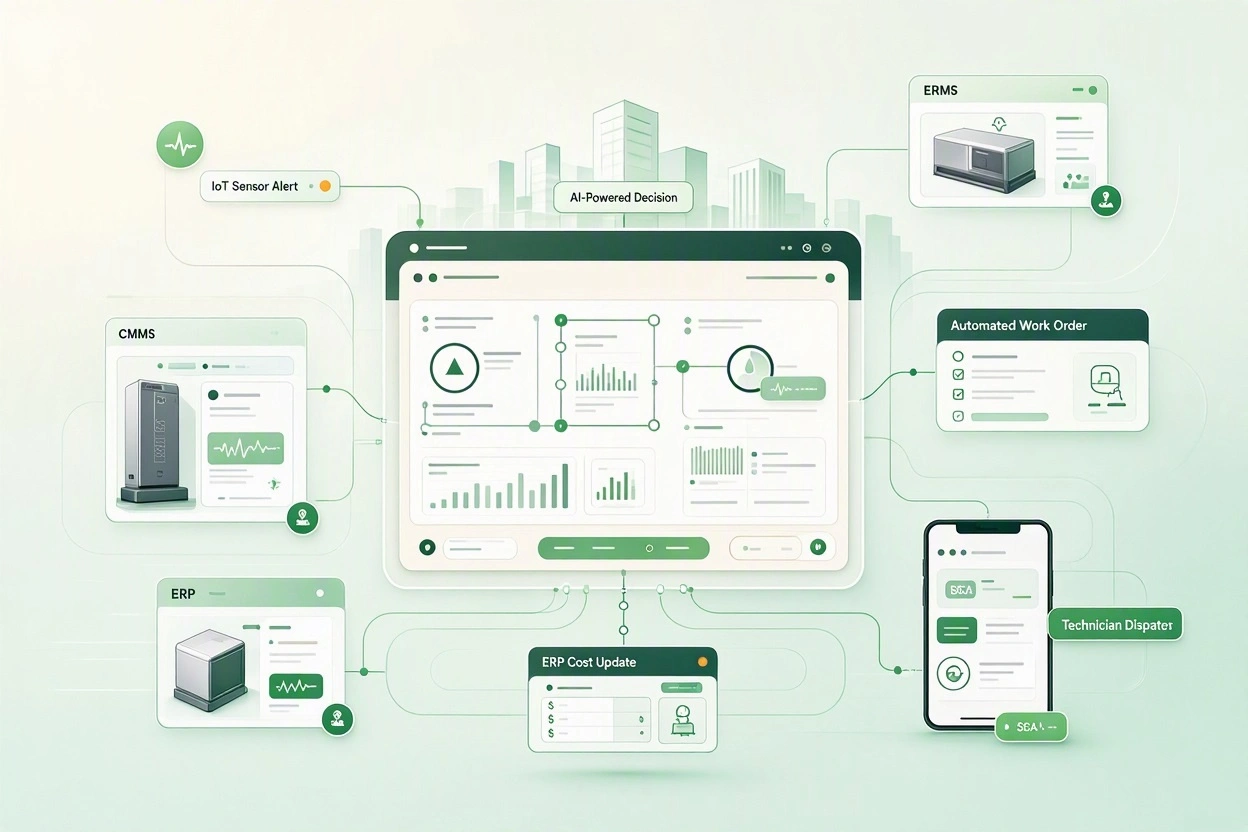
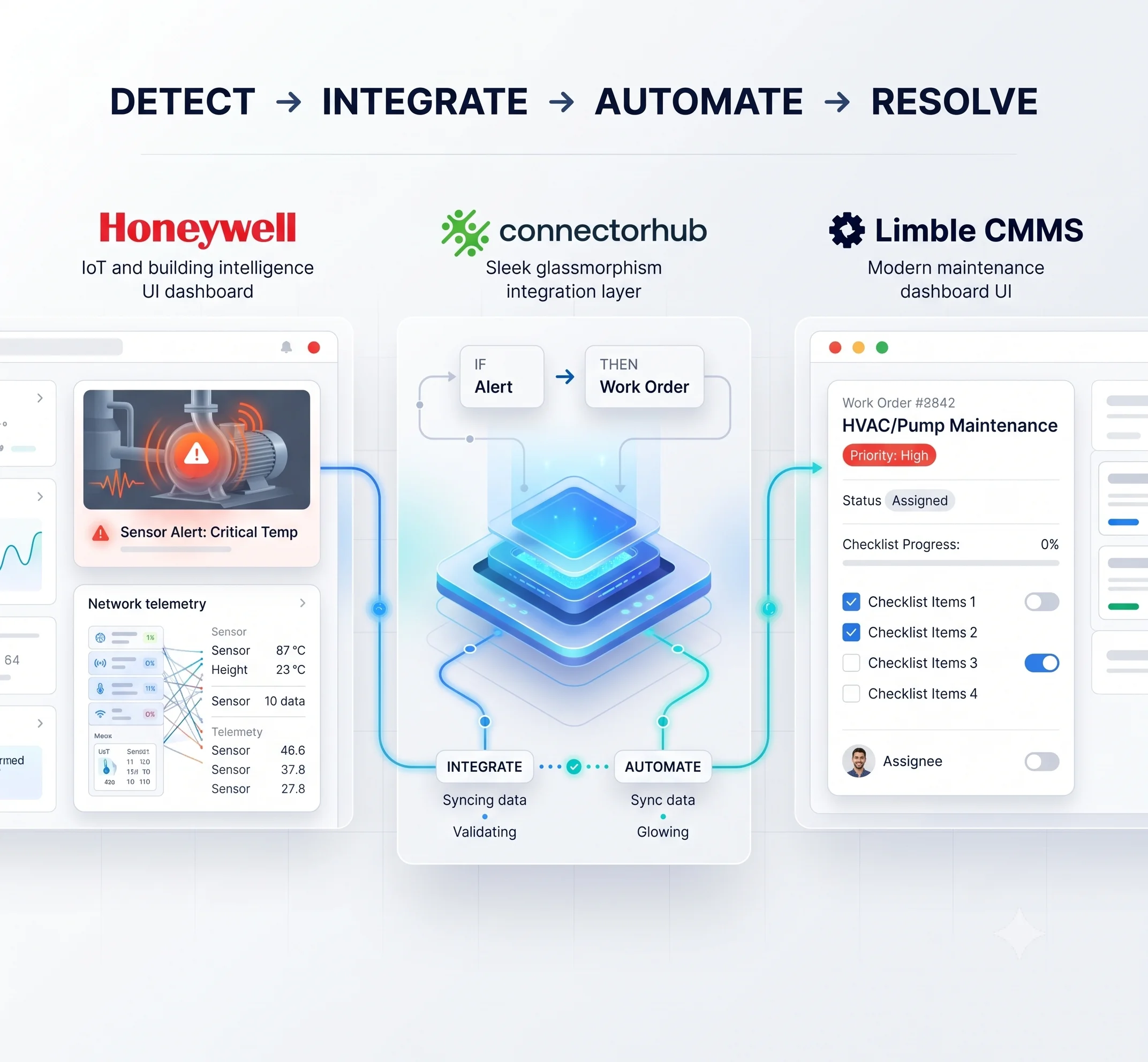
When this integration between systems is set up correctly via a CMMS integration solution, it brings in overall clarity. You can set up automated triggers for real-time monitoring and alerts so that the systems look out for you, like automatically flagging a low stock level before a technician even realizes a part is missing.
Ultimately, it simply kills the headache of double data entry, tracks the life of your equipment accurately, and gets the paperwork started the very second a technician identifies a need. It’s about working smarter, not harder, to keep the wheels turning and achieve true enterprise integration.
The secret is making sure your tools speak the same language from the start and partnering with experts providing software integration services who can bridge the gap without throwing a wrench into your daily routine.
To get technical for a second, a great setup uses real-time handshakes powered by modern API integration tools (like APIs and webhooks). It is built for real-world reliability; even if the connection drops, your data stays secure and catches up the moment you are back online. This keeps every department aligned and ensures no data is lost in the transition.
When to Consider CMMS – ERP Integration for Your Enterprise
If your maintenance needs are minimal and mostly tied to high-level financial tracking, your ERP alone might be enough. But for most mid-sized to large operations, that setup quickly falls short.
You will usually notice the need for integration before you formally decide on it. It shows up when reconciling maintenance expenses turns into a monthly scramble, or when work orders get delayed because inventory data doesn’t match reality.
These are clear signs your systems are out of sync. If you’re scaling, disconnected tools only make things harder. Bringing them together, especially through no-code integration for facility management, helps you stay in control as complexity grows instead of adding to it.
Once uptime, asset performance, and cost control all become priorities, ERP CMMS CRM integration becomes necessary. Connecting them keeps maintenance activity and costs aligned without constant manual effort.
Why Facility Executives Struggle with Integrating Maintenance and Financial Data
Merging two massive architectures naturally presents technical hurdles. To understand better:
Challenge1: Different data structures make things slow
The maintenance software knows about assets right down to individual parts and previous repairs, whereas the financial systems treat each asset as one item, creating problems with data harmonization.
Challenge 2: Synchronization issues cause delays
Procurement processes are affected by the different approaches that systems take to updating their data.
Challenge 3: Data mapping is complicated and needs special care
Without proper guidelines for mapping asset hierarchies and data items between systems, synchronization cannot happen smoothly, which is when middleware comes into play.
Challenge 4: People are pushed to do things outside their comfort zone
Tech support specialists shouldn't worry about the financial side of maintenance, and finance managers shouldn't be interested in maintenance logs, but without the integration, that's how things go.
Challenge 5: Lack of visibility due to silos of information
Maintenance information, compliance information, SOPs on the one hand, and costs and inventory on the other hand
To solve these, facility leaders must rely on intelligent iPaaS that handles schema inconsistencies and event-driven triggers. Establishing clear mapping rules ensures that granular asset hierarchies align perfectly.
True digital transformation happens when you stop forcing technicians to adapt to financial software and stop forcing accountants to decipher maintenance logs. By leveraging a real-time asset sync between systems, you unify the entire operation.
A Practical Playbook to Overcoming Integration Challenges
The primary error that companies make in dealing with conflict between CMMS and ERP is believing that the way out is consolidation, whereby one of the systems will be replaced by another, or everything will have to fit in one single system. Every system excels in certain things, and the purpose of integration is to give both a chance to do what they do best without having to communicate with each other through manual workarounds.
When it comes to properly connecting CMMS and ERP systems, the company should use advanced REST APIs or use out-of-the-box connectors provided through iPaaS. Such connectors can automatically interpret work orders as journal entries. Anyhow, before any coding is done, the best way to prepare for integration would be figuring out whose responsibility each data type is.
Data ambiguity causes almost all errors in integration. The simple rule of thumb is that the maintenance software will manage real-time parts usage, diagnostic trouble codes, and labor hours, whereas the financial application will have its way with vendor contracts, cost center hierarchies, vendor master lists, and asset capitalization records.
In implementation, this structure results in a process-driven feedback loop that is orderly and almost invisible for those using it. Every time the technician closes out the work order, the system automatically transfers labor hours into the right GL cost centers through the ERP without the need to manually post any entries or export any files at the end of the week.
Parts usage automatically updates in real-time as they are used, and once their count reaches a certain threshold, a purchase process starts automatically through an API link. The process then sends a purchase request to the ERP procurement engine, which works just like any other transaction, including the automatic assignment of a purchase order to the right vendor contract. The flow works in reverse as well.
Whenever an asset becomes capitalized through the accounting function in the ERP, the record is instantly available for the CMMS system to pull down. Scheduling is thus always done in conjunction with active assets that have been financially validated by the company's accounting process.
Procurement and scheduling of maintenance occur simultaneously, there being no risk of attempting to schedule any form of maintenance procedure on an asset that had been written off.
As a result, not only will the financial department know in real-time the costs involved with maintenance, but the operations department will also be able to make decisions on asset management instantly. This system does not complicate matters; it simplifies them.
Tangible Benefits You Yield from an Automated CMMS-ERP Ecosystem
The return on investment is immediately visible across several operational touchpoints:
- Faster Spare Parts Management: Technicians no longer guess about stock levels or double-enter usage.
- Easier Purchase Orders: A missing part flagged by a worker automatically generates a purchase request in the financial system.
- Streamlined Reporting: Management gains a single source of truth for facility data synchronization, pulling typical response times alongside enterprise budget impacts.
- Improved Communication: HR data regarding overtime or certifications can inform dispatchers, optimizing how shifts are scheduled.
How ConnectorHub Solves the Major CMMS-ERP Integration Bottlenecks for Facility Leaders?
Building this ecosystem shouldn't require an army of developers. That’s where ConnectorHub steps in as your dedicated integration platform. Designed with a multi-tenant architecture and AI-powered field mapping, our solution helps facility leaders design, deploy, and manage an optimal CMMS and CRM workflow without writing a single line of code.
No matter whether you need help managing data streams between legacy platforms or require cloud-based integration software, our visual designer will simplify things for you. Our team constantly monitors your workflows with SLA notifications and proactively detects anomalies that could lead to your processes breaking down.
Also Read: Unifying Your Construction Project Data with Building Management Integrations Linking SAP and PlanGrid
Conclusion
Getting your maintenance and enterprise systems to work together has become the need of the hour for modern facilities to operate. When you take the time to understand how these systems connect, tackle the data gaps head-on, and use the right tools to automate the handoffs, the whole operation starts to feel a lot less chaotic.
The right integration doesn't just cut down on paperwork but rather makes your assets last longer, keeps your financial projections grounded in reality, and frees your technicians up to do their jobs instead of chasing information.
Imagine the possibilities when your CMMS and ERP systems begin to communicate effectively. You are doing more than simply getting rid of digital junk or debugging software. You are laying down the groundwork for the future success of your team.
As things like AI and predictive maintenance move from scientific to standard, they are going to need one thing to work: honest, clean data. Creating a unified system with the help of leading solutions like ConnectorHub is one way in which you will be ending that frustrating process of upgrading at all costs. When the next big tech breakthrough arrives, you will know that there won't be any need for upgrading, just plug it in and focus on your goals.