.svg)
Facility teams usually know something is about to fail before it actually does.
A vibration sensor drifts out of range. A compressor starts short‑cycling. A chiller’s discharge temperature climbs a degree a day for three days straight.
The warning is there. What most teams don’t have is a fast, reliable path from that signal to a completed work order, without someone copying data between systems just to make the ticket exist.
That gap, more than any lack of smart sensors, is what keeps maintenance stuck in reactive mode. ConnectorHub closes it by turning condition alerts into ready-to-execute work orders automatically.
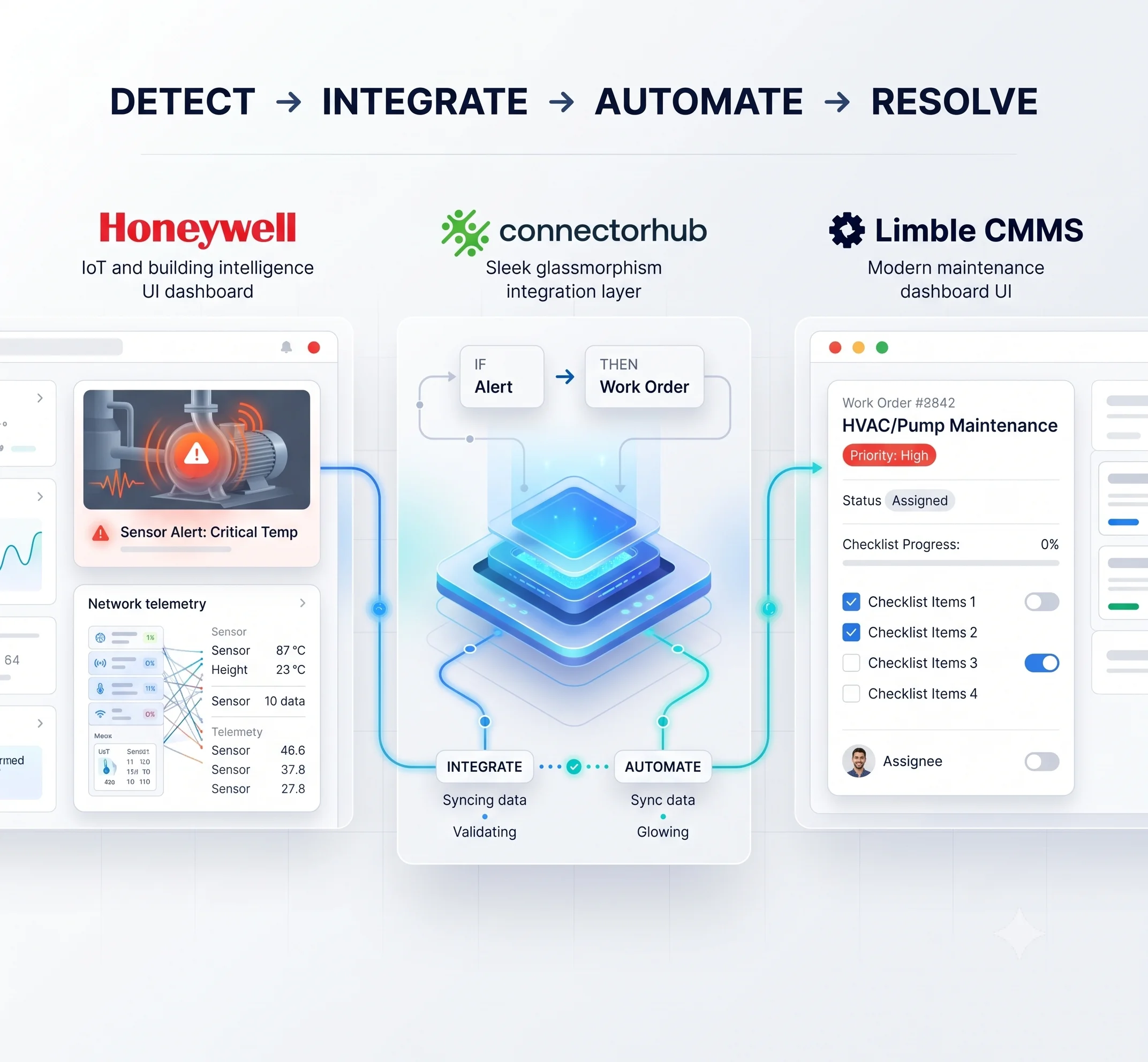
It connects Honeywell's building intelligence platform directly to Limble's CMMS, using real-time data synchronization to move sensor alerts into actionable maintenance tasks without a manual relay in between.
Rather than forcing facility leaders to choose between adding more sensors or buying better software, this approach pairs Honeywell's monitoring layer with Limble's execution layer inside a multi-system integration purpose-built for maintenance operations.
Why Data Integration Is Critical to Modern Facility Operations
The sheer volume of data being generated in the modern facility is a feat unmanageable for even the most dedicated individual team. This information will only turn into useful metrics unless it flows freely and logically between the teams and system that will ultimately consume, process, monitor, make decisions, act upon information or data, and perform maintenance based on those metrics.
While BMS and IoT sensors have proven useful in notifying of a deviation, this lack of integration prevents them from feeding their triggers directly to the CMMS in a streamlined manner. In order to convert that alarm into a work order necessitates either manual ticket generation (introducing a time delay or error) or a system of automatic generation. Data integration between BMS/IoT and the CMMS solves this issue by converting all critical alerts into a new, automatically-generated work order (with associated assets, location, relevant asset details & diagnoses), thus closing the gap.
Not only can the quality and response time of a critical repair be improved with integrated systems, but this automation enhances the intelligence of the decision-making processes as well.
Many organizations find themselves subscribing to the concept that newer generations of smart, efficient sensors will automatically take care of your reactive maintenance issues. If they aren’t connected to an appropriate execution platform, then more sophisticated sensors just exacerbate the issue with more noise than is appropriate. Linking that information directly to your execution platform such that alarms immediately generate tickets in the CMMS, which would subsequently generate and/or reserve needed parts and summon personnel, would actually be a complete solution.
Honeywell's Real-Time Intelligence Meets Limble's Work-Order Agility
Honeywell's sensor and building management ecosystem, including its Forge platform, was built to answer one question well: what is happening to this asset right now.
Temperature probes, vibration monitors, and energy meters feed continuous streams into a unified data model. Raw readings are often normalized from multiple communication protocols like BACnet and Modbus, so equipment from different eras and different vendors can be read the same way.
Edge processing filters noise close to the source, which keeps the data usable instead of overwhelming.
Independent research on IoT-driven predictive monitoring programs has found maintenance costs drop by roughly 25 to 30 percent, largely because problems get caught while they're still cheap to fix.
Limble answers a different question: what should someone do about it, and who is doing it.
Its CMMS turns maintenance intent into an executable task, complete with checklists, parts availability, technician assignment, and a due date, all trackable through completion.
API integration connects Limble's work order engine to outside systems through webhooks and endpoints for tasks, parts, and assets. That's exactly the layer ConnectorHub uses to receive Honeywell's signals and act on them.
Put together, Honeywell tells you something is wrong and Limble makes sure the right person fixes it.
The problem enterprises run into is that these two capabilities usually live in separate vendor ecosystems with no native handshake.
That's the specific gap ConnectorHub's AI-ready integration platform was built to fill. It maps Honeywell's sensor taxonomy to Limble's asset and task fields, so a temperature anomaly becomes a properly categorized, properly prioritized work order.
The Integration Gap That Keeps Facilities in Firefighting Mode
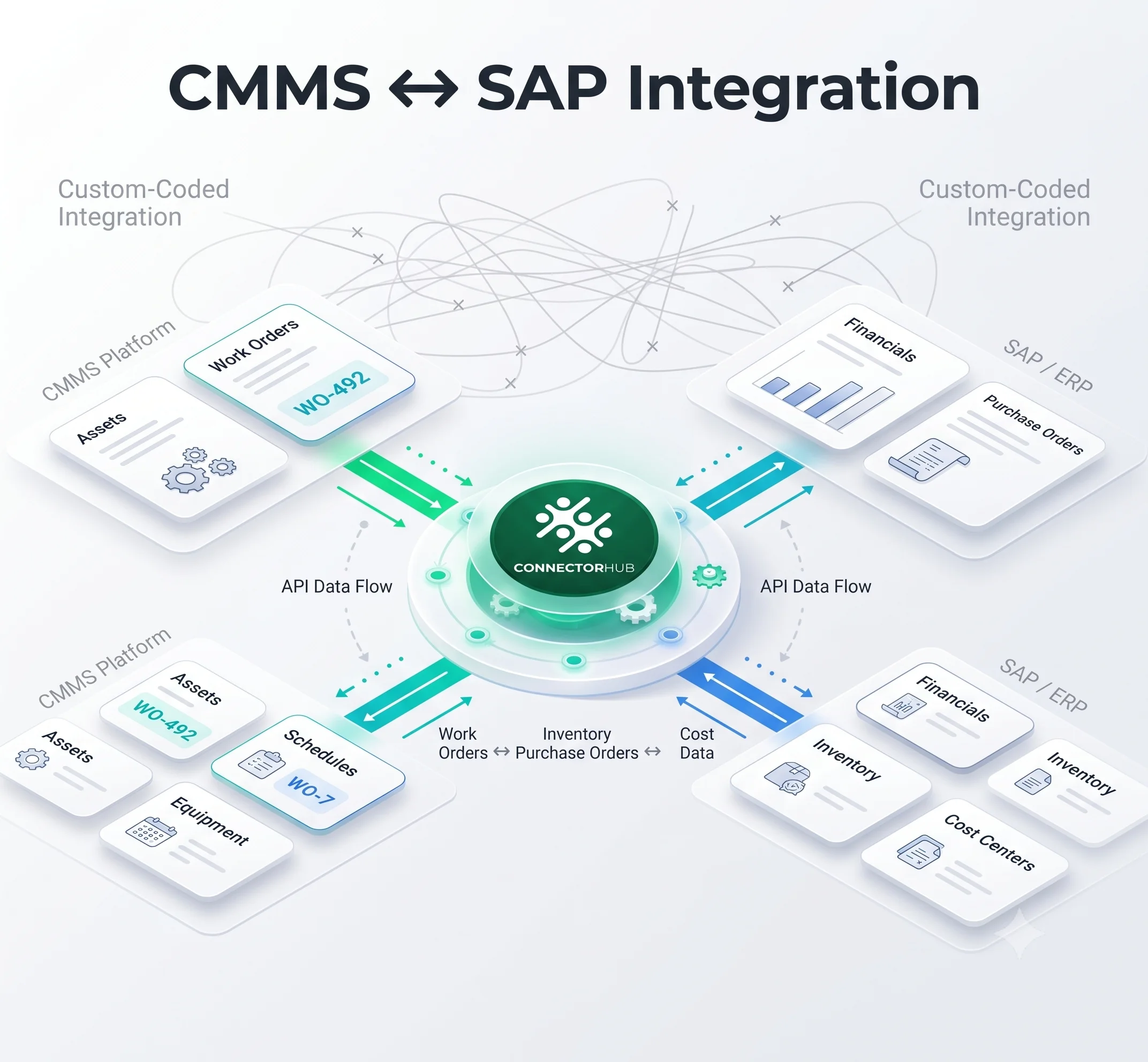
Even facility teams with both Honeywell sensors and a Limble deployment often find themselves stuck exporting CSVs or running nightly batch jobs.
Some pay a systems integrator for a custom API bridge instead, one that breaks every time either vendor pushes an update. This is the quiet cost of running strong point solutions without a connective layer between them.
A few patterns show up consistently in enterprise facility operations:
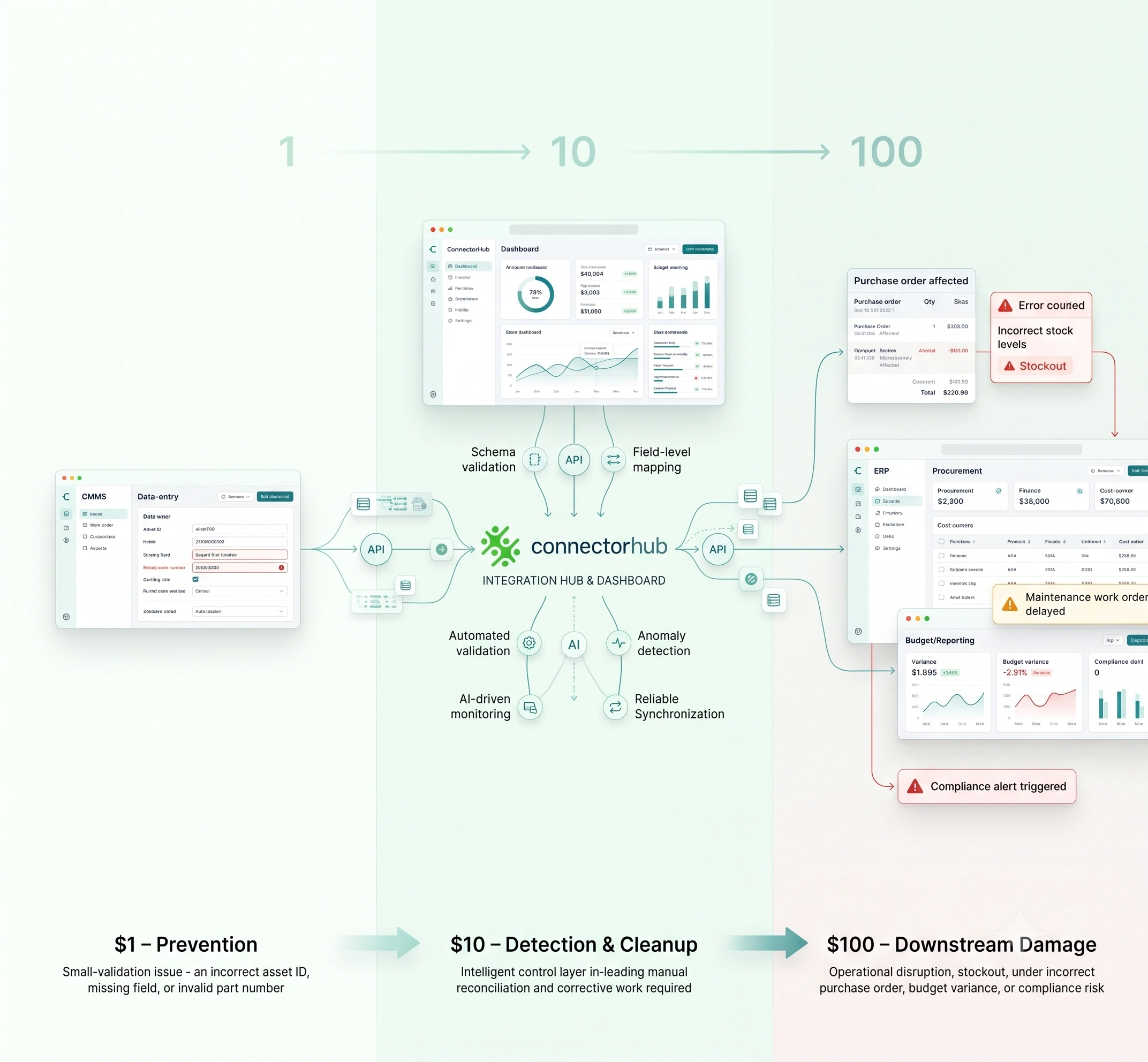
The financial impact of these gaps is well documented outside of facility management.
When a manufacturing line goes down unexpectedly, it's an expensive problem — research puts the cost at around $260,000 per hour in lost production. HVAC issues add to that toll too, quietly costing U.S. businesses close to $50 billion every year.
Trace most of those losses back far enough, and it's the same story: the data that could have flagged trouble already existed. It just never reached the team fast enough to act.
A proper application integration solutions approach removes that lag by design rather than patching it after the fact. A modern cloud integration layer means the connection stays live regardless of which system updates its schema next.
How Connecting the Two Systems Changes the Maintenance Equation
Once Honeywell and Limble are bridged, the maintenance workflow stops depending on someone noticing a problem in real time.
Take a bearing vibration signature trending toward failure. Once the reading crosses a defined threshold, it gets evaluated against historical patterns. The system automatically opens a work order in Limble, complete with the right asset, location, priority level, and even a suggested checklist based on prior similar incidents.
This changes a few things at once:
- Detection and dispatch happen in the same motion instead of two separate, human-dependent steps.
- Technicians will have context beyond the alert, which is the trend of sensors lately and the maintenance history of the particular asset.
- The facility manager will have a feedback loop, where the status of resolution of the work order will go back to the monitoring layer.
- Escalation rules can route based on severity, so a minor drift triggers a scheduled visit while a critical failure risk triggers an immediate dispatch.
This is enterprise automation applied to a problem that has historically resisted it, mainly because building systems and maintenance software evolved in separate industries with separate vendor roadmaps.
ConnectorHub's role is to make the handoff between detection and resolution invisible to the people doing the work, while keeping every step visible to the people managing the program.
Practical Outcomes for Facility Management Teams
The value of connecting Honeywell and Limble shows up in numbers facility executives already track.
ConnectorHub's broader facility management deployments, spanning platforms like Corrigo, FMX, and Nuvolo, have delivered measurable results that hold true for the same underlying integration pattern:
- Reduced unplanned downtime and faster response. Closing the gap between sensor detection and work order creation cuts the hours that would otherwise pass before a technician even knows there's a problem.
- Better visibility across assets and sites. A single, synchronized maintenance record replaces two half-complete pictures, which matters most for multi-site portfolios where regional managers need consistent reporting.
- Lower administrative load without adding headcount. ConnectorHub's facility management customers have reported saving over 500 hours of administrative work annually and cutting SLA breaches by 30 to 40 percent, gains that come directly from removing manual data entry rather than hiring more staff.
A well-configured integration platform doesn't just move data faster. It removes the specific delays that turn a minor equipment issue into an expensive failure.
How ConnectorHub Makes the Honeywell–Limble Bridge Reliable
None of this works if the connection itself is fragile.
ConnectorHub was built around a no-code workflow builder specifically because facility operations teams shouldn't need a developer on staff to keep an integration running.
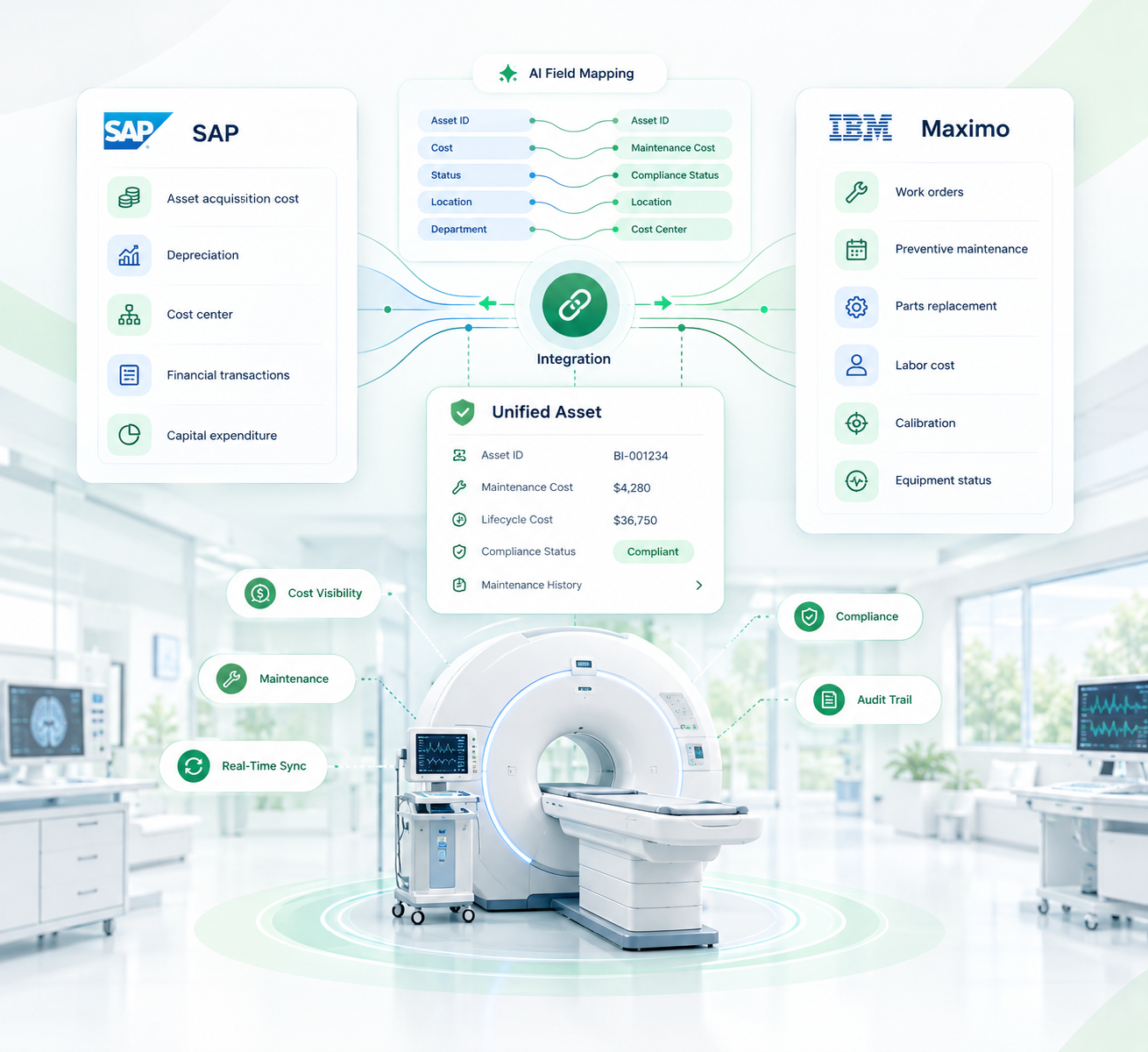
Field mapping between Honeywell's sensor taxonomy and Limble's asset and task structure happens visually, with pre-built system connectors that already understand how each platform names and structures its data.
Onboarding a new site typically takes two to four weeks. Compare that to the two to six months common with custom-built bridges or generic iPaaS solutions not designed for facility-specific data models.
Reliability at scale depends on a few things most generic integration tools weren't built to handle:
- Governance and monitoring. Each workflow incorporates versioning, auditing, and SLA dashboards in real time to ensure that facility managers know precisely when the request was initiated, based on what sensor data, and how long it took to resolve.
- Security built for regulated environments. Data in transit and at rest is encrypted, with role-based access control aligned to SOC 2, HIPAA, and GDPR requirements, which matters for healthcare facilities and multi-tenant properties running the same Honeywell-Limble pattern.
- Scalability across sites. A multi-tenant architecture means a facilities group managing dozens of properties can replicate the same Honeywell-Limble workflow across every site from one console rather than rebuilding it location by location.
For organizations that want to offer this kind of connectivity to their own customers, ConnectorHub's integration as a service model lets platform providers license the same underlying connector layer.
Conclusion
ConnectorHub moves the vision of smart buildings into everyday work by automatically bridging detection and action. Instead of forcing teams to pick between new sensors and new software, this integration easily connects Honeywell's intelligent awareness to Limble's work order engine, automatically assigning properly filtered, properly prioritized tickets once alerts rise above noise without manual forwarding.
The bottom line can already be measured in the metrics facility managers are accustomed to: no more unforeseen breakdowns, quicker reaction times, and fewer manual process headaches.
For enterprise, this becomes reliability writ large: the easy configuration of a pre-mapped, no-code integration layer brings new sites live within weeks, not months. It maintains consistent workflows between vendors’ system updates and produces an auditable single point of maintenance history per asset, transforming proactive, scheduled tasks to a predictable system where the right tech gets there with the right details before small problems lead to massive ones.