.svg)
A well-run operations team can go months without a serious incident, then lose an entire shift to a workflow that quietly stopped syncing weeks earlier and went unnoticed until the damage was done.
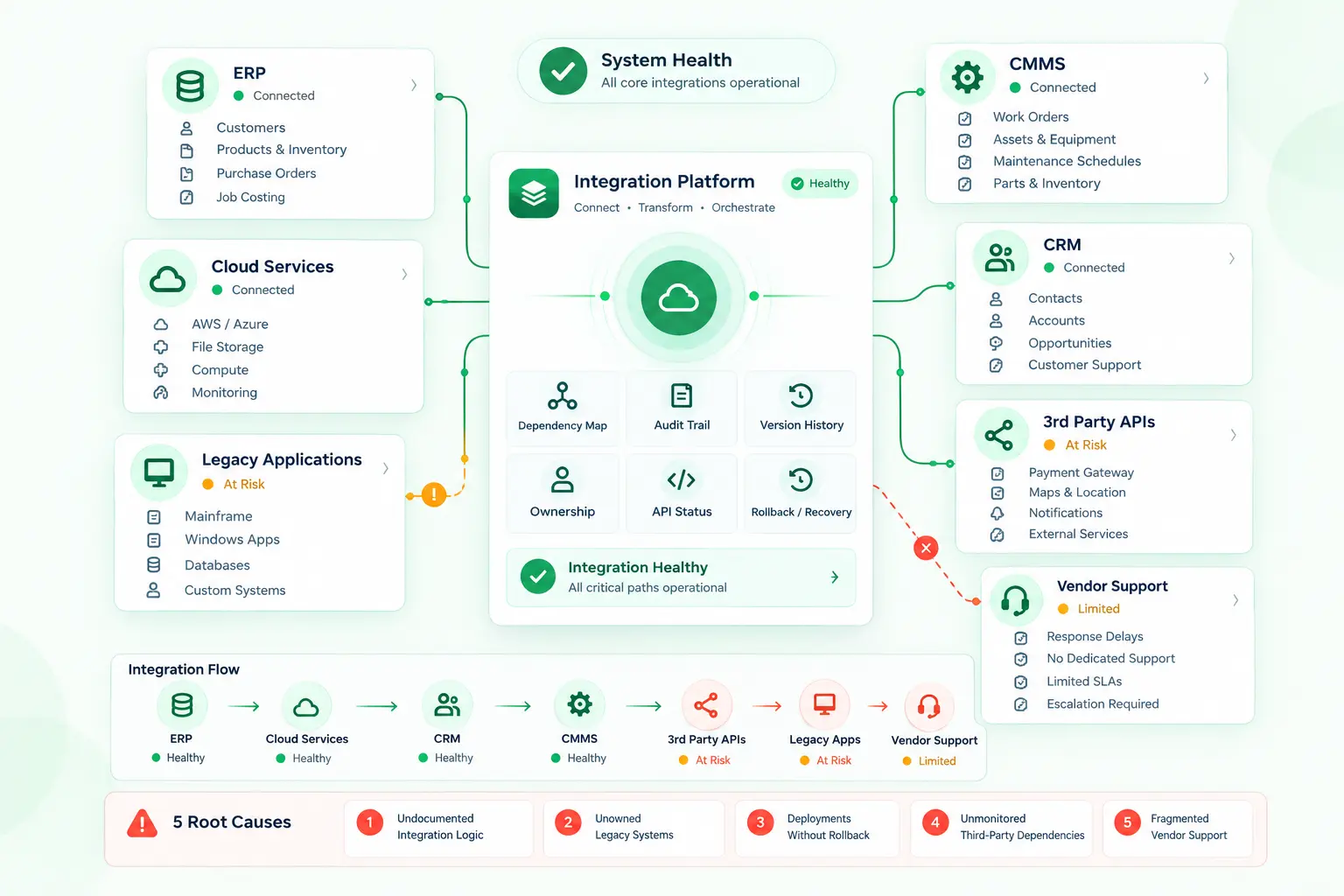
Cases like this rarely trace back to a single system failure. They trace back to a handful of structural gaps that build quietly inside connected environments and stay invisible until they cause real damage.
With maintenance automation and asset maintenance automation replacing many tasks that were once done on paper and spreadsheet, the software that drives the processes of preventive maintenance scheduling and maintenance work order automation carry equal importance in the operations of the company as ERP and CRM.
Why Most Preventable Outages Still Happen in Connected Enterprises
Companies have their dashboards, alerts, and status pages to monitor their infrastructure. However, outages continue to occur in monitored systems.
The reason is simple. Visibility tools tell you a system is down, but they rarely tell you why it broke, who owns the fix, or what else depends on it. That gap is where operational resilience quietly fails, and it is also why tools marketed as application integration solutions rarely ship with audit-ready documentation by default.
Recent industry outage analysis found that configuration and change management failures now sit at the top of network-related outage causes, ahead of both third-party provider issues and hardware failures.
The largest source of preventable downtime is no longer hardware wearing out. It is decisions, documentation, and process discipline inside the organization.
Integration debt compounds the problem. Every point-to-point connection and script written to patch two systems together adds a small liability that never appears on a budget line but accumulates the way technical debt does in software.
A CMMS communicating with an ERP through nightly batch transfer files, or a facilities platform sending financial data through a CRM integration built during a merger and left unexamined: each functions reliably until an unexpected failure occurs, after which nobody retains knowledge of its construction.
In asset-heavy operations, the workflows most exposed are the ones quietly keeping the business running, including automated work order management, asset tracking, and compliance reporting. Nobody notices these on a dashboard. They notice when a technician shows up at the wrong site or an inspection deadline gets missed.
Root Cause 1: Undocumented Code and Hidden Integration Logic
Every long-running enterprise has integration logic nobody wrote down. It lives in a middleware script, a scheduled job on a laptop that quietly became a server, or field mappings configured once and never documented.
This tribal knowledge is the most common driver of avoidable outages in connected operations.
Roughly eight in ten operators who experienced significant downtime believe better management and process discipline would have prevented it, according to a recent industry outage study. That should concern any executive who assumes their environment is well documented, because most are not.
How to audit for it:
- List every scheduled job, script, and middleware process touching a production system, and confirm each has a named owner, not just a team.
- See if API integration code and mappings reside in a central version-controlled repository or are contained within just one laptop.
- Ask when each integration was last modified and by whom. Anything untouched for two years with no documented owner is at high risk.
The impact shows up fastest during turnover.
When the one person who understood a custom sync leaves, then the company does not have any operational mental model of the process, and the next occurrence takes much more time than necessary to figure out.
Root Cause 2: Unowned Legacy Systems That Still Run Critical Workflows
Some of the riskiest systems in an enterprise are not the newest ones.
These legacy systems continue processing active business transactions even though no designated department retains formal accountability: a CMMS implemented ten years prior, a SCADA installation maintained by a departed external consultant, or a bespoke software solution designed for a defunct organizational division. Because critical failures remain absent, organizations rarely examine system governance.
How to audit for it:
- Build a system inventory listing every production platform with a named business owner and technical owner. A blank field is a finding.
- Cross-check vendor contracts and support tickets against the inventory; no recent activity and no assigned owner means a shadow dependency.
- Interview adjacent teams, not just the presumed owner. Institutional memory usually sits with whoever built the workaround.
Root Cause 3: Deployments Without a Reliable Rollback Path
Change windows are supposed to be the safest time to make updates. In practice, they are where cascading failures start.
Coverage of several major 2026 incidents points to one pattern: routine changes pushed without a tested way back caused disruption far beyond what the original change was meant to touch.
There are many companies that regard the deployment and configuration changes as a one-way process. Changes in field mappings and workflows go live, and if anything goes wrong, the idea is to fix things going forward since no one has ever bothered to test the rollback.
That is a very different posture from a properly versioned workflow, where every change is tracked, reversible, and testable before it touches production.
How to audit for it:
- Verify that a validated, active rollback procedure exists for every production system, rather than an untested concept stored inside an unexecuted operational runbook.
- Confirm that system modifications maintain version histories, enabling isolated rollbacks of targeted updates without needing to redeploy full operational workflows.
- Evaluate the five most recent change incidents to measure how much time elapsed identifying modifications before initiating actual system recovery.
Root Cause 4: Unmonitored Third-Party Dependencies
Enterprises rarely run into an outage caused entirely by their own systems anymore.
Recent research puts the share of impactful outages involving a third-party vendor failure at roughly 43 percent in 2025, and separate analysis found that about three in four IT leaders now consider third-party dependency the most common trigger of downtime.
As critical system dependencies increasingly run through shared cloud integration layers instead of internal corporate infrastructure, technical outage impacts no longer remain contained within local data centers. A major cloud failure in late 2025 disrupted more than two hundred dependent organizations, many of which possessed zero visibility into the underlying system problem until the vendor refreshed its central status dashboard.
Unmonitored external dependencies present the greatest operational risk: embedded payment processors within transactional checkout flows, identity verification services supporting internal facility applications, or external weather data feeds driving automated preventive maintenance system triggers.
None show up on a typical dashboard, because it only watches systems the organization built, not the ones it depends on.
How to audit for it:
- Document every external API, SaaS platform, and managed service tied to critical workflows, including nested vendor dependencies.
- Maintain direct oversight across vendor relationships: evaluate service agreements, confirm primary contact channels, and verify key notification paths.
- Prioritize dependencies by operational impact rather than technical scale. A simple API delivering real-time maintenance updates to field technicians can outweigh a massive reporting platform.
Root Cause 5: Support Split Across Multiple Vendors
The fifth root cause is less technical and more organizational, and executives underestimate it most.
When a workflow spans a CMMS, an ERP, and two or three point solutions, an outage rarely has one obvious owner. It has several vendors, each confident the problem sits elsewhere. This fragmentation shows up in resolution times as well.
How to audit for it:
- Document the escalation path for every critical integration, naming the specific team or vendor responsible at each stage, not a general support inbox.
- Test the escalation path before an incident happens. A support model never exercised will fail exactly when it matters most.
- Track how much of resolution time goes to diagnosis versus repair. A high diagnosis ratio signals fragmented support, not technical difficulty.
Turning the Five Root Causes into a Repeatable Outage Audit Framework
One-time audits identify the clear problems but overlook those that emerge in the next eighteen months.
As companies continue to automate their operations further through enterprise automation efforts, it is more important to establish these five reasons as a reusable framework than to execute the checklist just once.
Start by prioritizing systems and integration touchpoints with the highest business impact rather than auditing everything at once. A data integration platform connecting your CMMS to finance deserves more scrutiny than a reporting tool used quarterly, simply because the cost of failure is higher.
From there, combine three types of review:
- Process reviews checking documentation, ownership records, and escalation paths against what teams can actually demonstrate.
- Dependency mapping tracing every system, script, and vendor connection feeding a critical workflow, including indirect ones.
- Runtime visibility that tracks what changed, when, and who approved it, beyond simple uptime monitoring.
Audit maturity is not checklist completion. An organization can check every box and still be exposed if nobody revisits findings after the next reorganization or vendor change.
The better measure is whether ownership records stay current, which means treating this less like an annual project and more like operating an enterprise integration platform with its own governance rhythm.
How ConnectorHub Helps Close the Gaps Behind Preventable Outages
Most of the five root causes share a common thread: gaps in visibility and ownership that accumulate silently across connected systems.
Executives evaluating iPaas solutions to close these gaps often focus on connector count, but governance and visibility matter more for preventing outages than raw connector volume.
ConnectorHub consolidates CMMS, ERP, and core operational software from legacy point-to-point scripts into a single governed integration platform. Role-based security permissions and complete audit histories clarify system responsibility instead of leaving it to assumption. Furthermore, visual version-managed workflows allow engineering teams to thoroughly review, validate, and safely revert configurations without operational uncertainty.
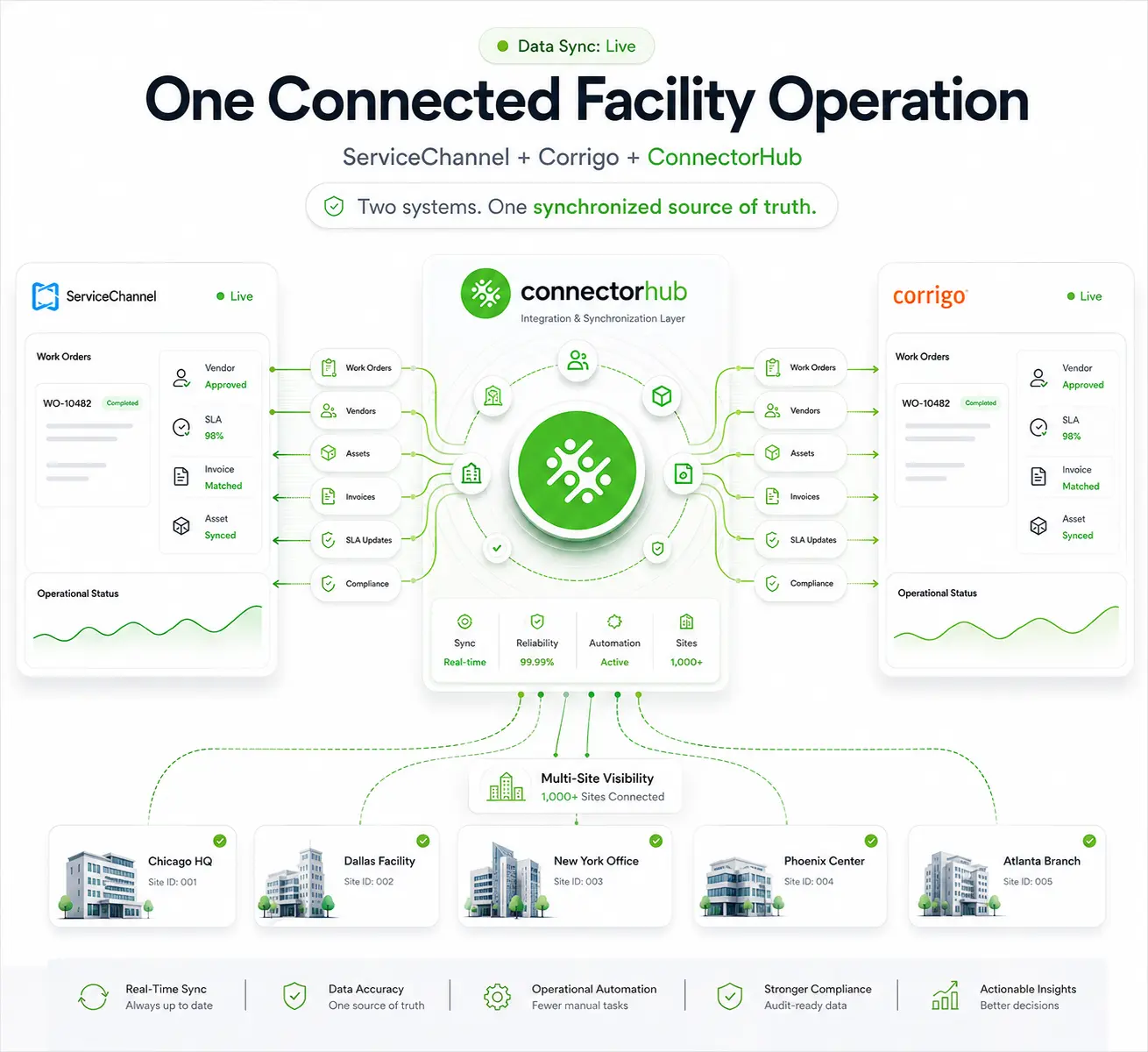
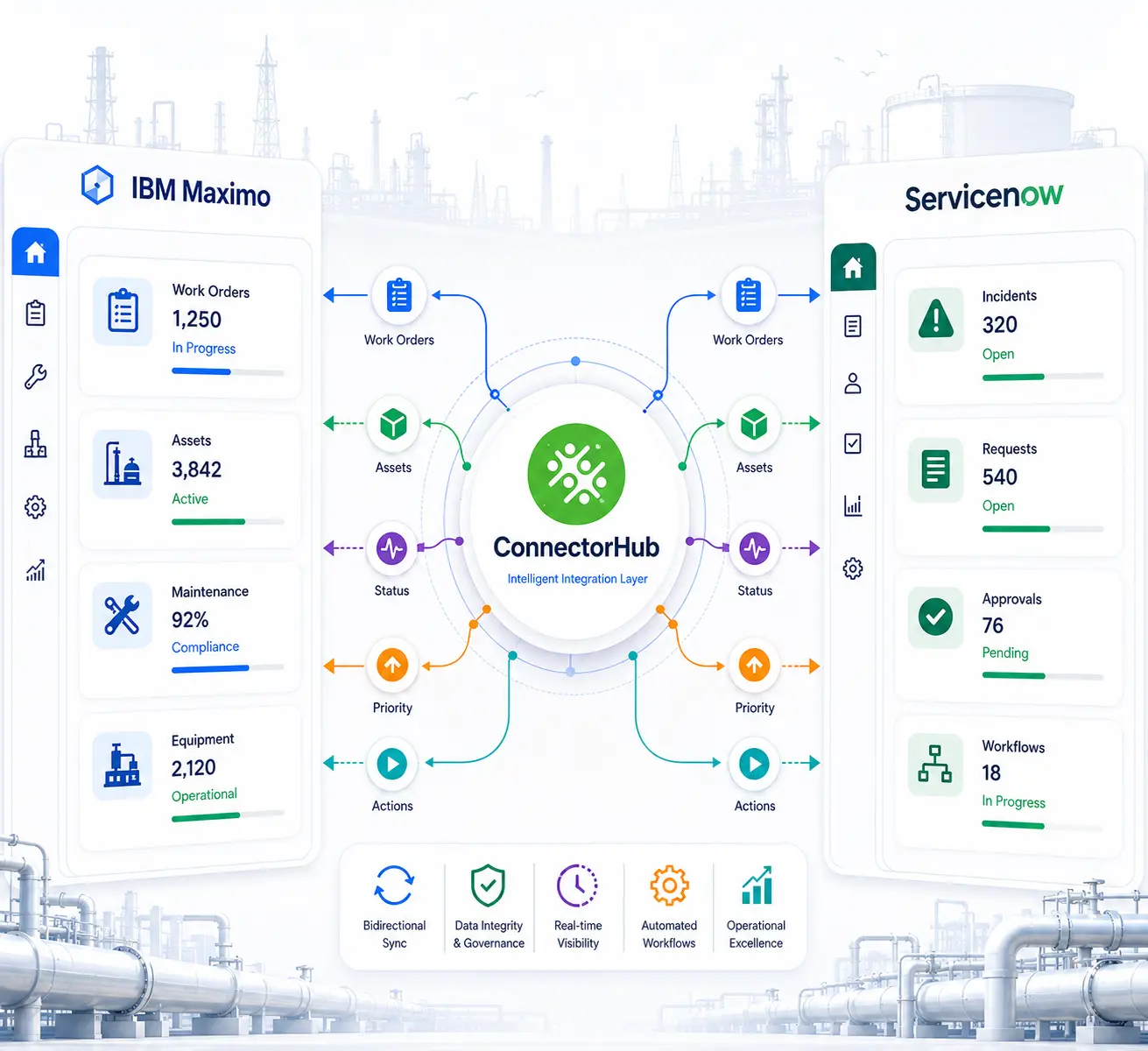
For teams looking to automate recurring maintenance tasks, native standardization in connecting to such solutions as Corrigo, FMX, Nuvolo, and ServiceNow will remove custom code, which is often difficult to understand and maintain in the long term.
Live dashboards surface SLA health and anomaly detection as they happen, closing the gap between seeing that something broke and understanding why. Because monitoring and support sit on one platform rather than split across vendors, the fragmented ownership described in root cause five becomes far less likely to delay a response.
None of this replaces process discipline. It does remove several structural gaps, undocumented CMMS work order automation logic, unowned integration points, one-way deployments, that create the conditions for a preventable outage in the first place.
Conclusion
System failures seldom provide explicit advance warnings. Instead, structural vulnerabilities quietly multiply between a platform’s launch and the eventual realization that previous architects left no detailed instructions, designated owners, or recovery procedures.
These common operational hazards include:
- Undocumented software
- Abandoned legacy applications
- Irreversible platform updates
- Unchecked external integrations
- Fragmented vendor responsibilities
These are not unusual disasters. They are what happens when an automated business process to expand significantly faster than internal governing bodies can maintain required system oversight.
The organizations that dodge the next preventable outage are not the ones running the most monitoring tools. They are the ones that can say, for every critical system, exactly who owns it, what changed most recently, and how to get back to solid ground if something goes wrong. Worth auditing for, before the next incident makes the case on its own.