.svg)
As the digital transformation era speeds up, facility management industry leaders find it challenging to coordinate daily operations. Teams rely on different software tools, each designed for a specific task.
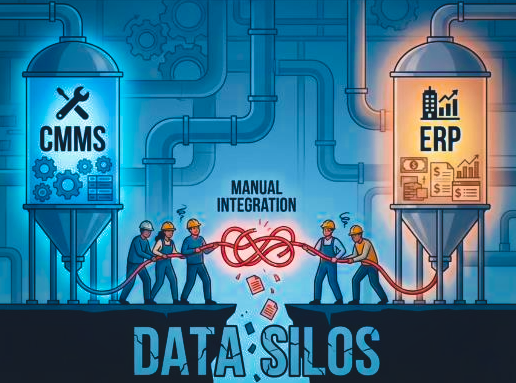
They bridge their CMMS system and ERP system through manual means. This creates isolated data pockets, i.e., data silos, hence affecting their workflow and efficiency. Data silos limit visibility, leading to inefficiencies in maintenance and resource management.
Working out these silos becomes critical as facilities evolve toward smarter, more connected environments. This has made organizations realize the importance of enabling seamless data exchange between their systems to address such limitations.
Integrated platforms are quickly becoming the norm for efficient facility management, and by 2026, the need for a CMMS integration solution is expected to keep growing.
ConnectorHub is here to assist you by exploring connectivity issues within your facility that you might not even be aware of. They work to establish an interconnected technology system, providing a practical plan to overcome these challenges effectively.
Conventional Mode of CMMS and ERP Interactions
CMMS is a specialized tool designed to manage, plan, optimize, improve, and control the maintenance of assets. It includes the record of work orders, asset health, and schedules of preventatives, which enable equipment operation at peak capability.
The ERP can also handle larger business activities, like finances, inventory, procurement, and supply chains, to illustrate the comprehensive nature of these activities, hence acting as a backbone to these activities.
In most traditional facility management systems, CMMS and ERP operate as different solutions that function independently. Most of the time, data exchange between them is done through certain manual operations like exporting reports from one system and into another using spreadsheets or email.
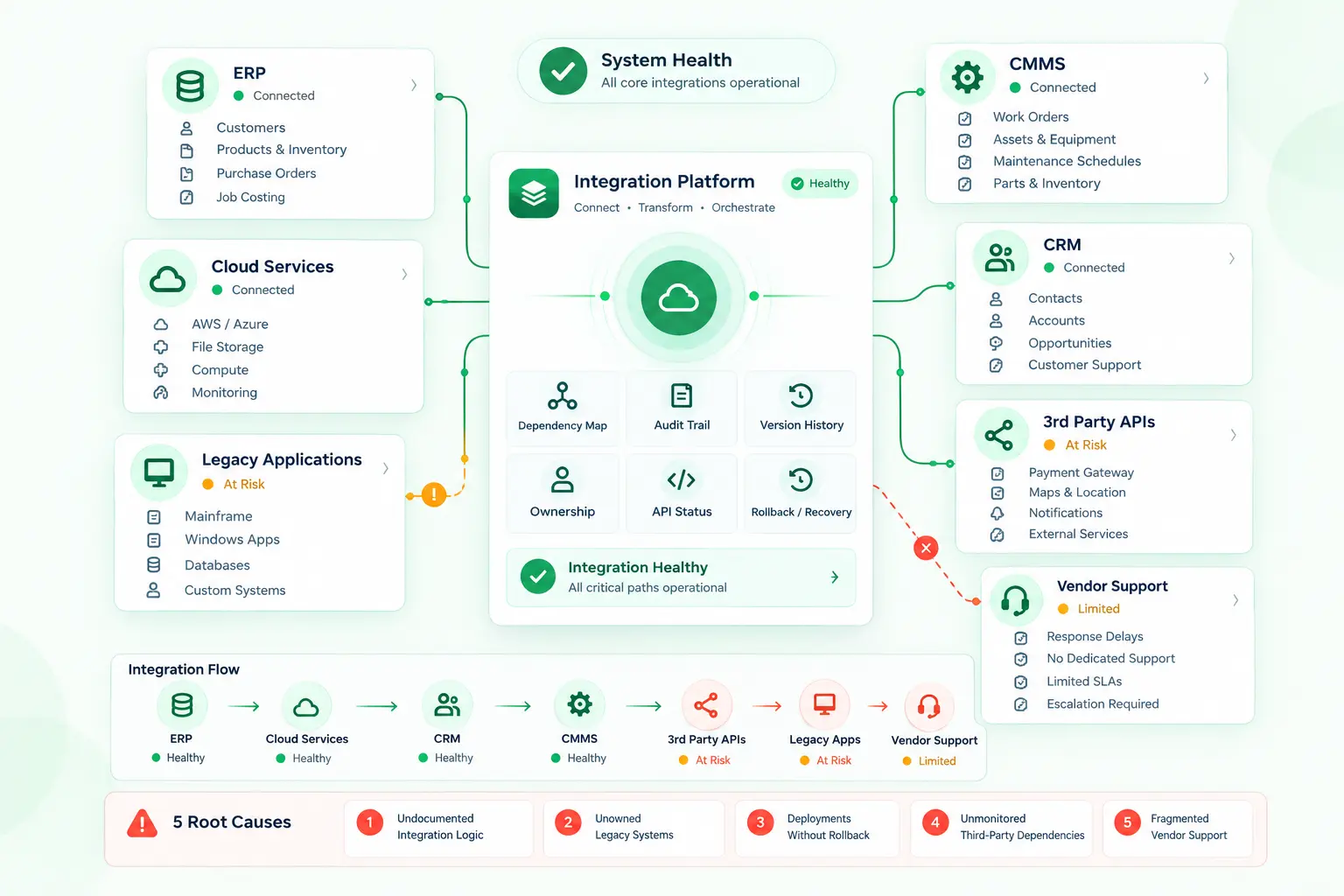
Beyond ERP, CMMS has traditionally interfaced with other facility management systems in piecemeal fashion. In isolation, these systems perpetuate information silos that impede cooperation. Popular CMMS platforms like FMX, Corrigo, and Nuvolo often start with these fragmented setups before organizations seek broader connectivity.
Integration of the CMMS with the applications provides a flow of information that is accurate, timely, and accessible. Integration of the CMMS into the wider applications provides organizations with the power to effectively run their organizations through the integration of a centralized asset management system.
Impact of Growing Data Silos in FM Processes
Data silos arise when important information remains confined within different software or departments, thus limiting the ease of information sharing. In facility management (FM), this issue frequently stems from the use of disparate tools without effective connections between them.
As facilities grow in size and particularly multi-site or multi-vendor environments, silos become more pronounced. A disjointed understanding of process creates persistent blind spots and a need for planning, execution, and budgeting occurs.
In the recent past, the problem of integration was put into perspective with a report that showed the average organization uses 897 applications, with 46% of the companies using 1000+ applications, while 71% of the applications remain unintegrated or disconnected.
Manual integration in conjunction with the lack of immediate information synchronization aggravates such information silos a great deal, given that such a process proves labor-intensive while, at the same time, the use of outdated information creates a waiting game, a result of a batch process as opposed to a real-time process.
Hence, this issue must be addressed thoughtfully to achieve the goal of unity by maximizing the full potential of the facilities.
Common Challenges Due to Manual Facility Setups
As facilities expand, manual handling becomes unsustainable, increasing administrative burdens. The challenges due to build up data silos compound over time, especially in multi-site facility operations.
1. Data Inaccuracy and Human Error: Manual data transfers are highly prone to mistakes like typos, misinterpretations, or omissions. Such errors result in incorrect reporting or maintenance activities and misinformed operational decisions that are eventually carriers of larger problems.
2. Limited Scalability: As long as the facility is growing, adding equipment and/or growing the team size, it will quickly grow beyond a manual management solution. Management overhead grows disproportionately and more and more time is wasted reconciling and updating data and coordinating systems.
3. High Level of Compliance Risks: In regulated industries, such as manufacturing, healthcare, or energy, improper or incomplete information may lead to a violation of regulations such as ISO, OSHA, or FDA regulations.
When there is no dependable auditing trail or documentation, in turn, compliance cannot be shown, and it may result in fines or restrictions.
4. Heightened Security Vulnerabilities: This would include, but is not limited to, sensitive information being shared through e-mails, shared media, or even spreadsheets, which in turn make it quite vulnerable to leaks or even cyber-attacks.
Paper forms may not have encryption, access controls, or versioning that may expose an enterprise to various kinds of threats, such as data breaches, hence affecting its security status.
These interconnected challenges highlight why manual setups hinder progress toward an autonomous, trusted, and conformity-oriented operations of a facility. Moving to automated integration is a solution to these issues at a root level.
Breaking the Barriers with Facility Asset Data Integration
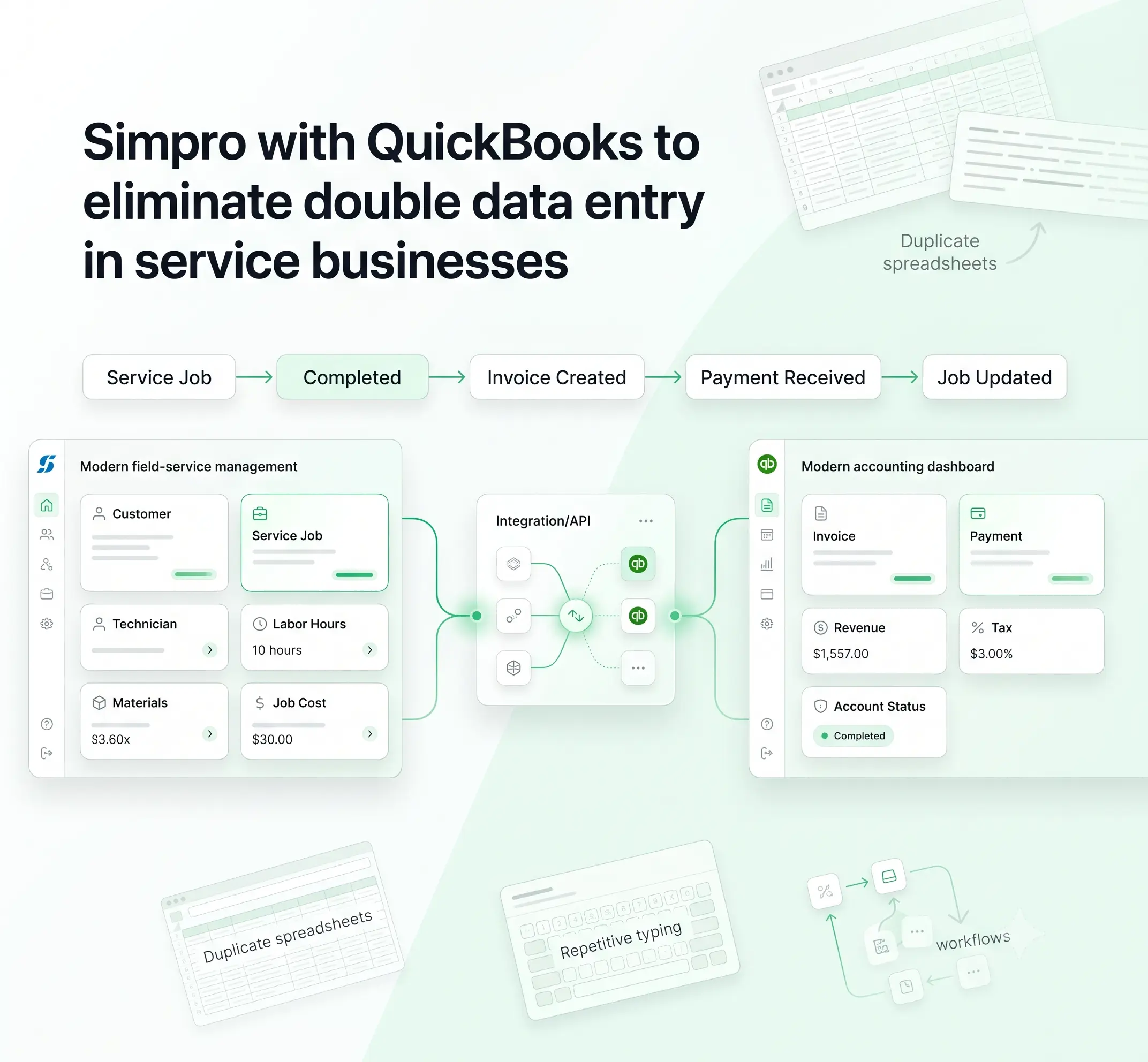
Facility asset data integration facilitates the establishment of a central platform by connecting CMMS with ERP systems and Building Automation Systems (BAS/BMS). This centralizes critical information such as maintenance histories, real-time asset conditions, inventory levels, procurement details, and operational costs into a single, accessible view.
Typically, maintenance tends to be treated as a cost center, as often considered by finance teams. Budget proposals are normally given a skeptical ear because of a lack of enough information, which has been confined in the CMMS system.
ERP has been effective in dealing with financials like purchases, vendor costs, and inventory valuation but lacks context on why parts are used or how maintenance impacts asset performance.
These datasets remain separate without integration, which leads to misaligned decisions. The same dynamic is transformed by real-time syncing.
Procurement workflows also become far more yielding. A high-priority need noted in a CMMS work order can trigger an automated purchase requisition in the ERP via APIs, cutting processing time from days to minutes. In turn, this will bring up technician "wrench time," reduce downtime from part shortages, and support just-in-time inventory practices.
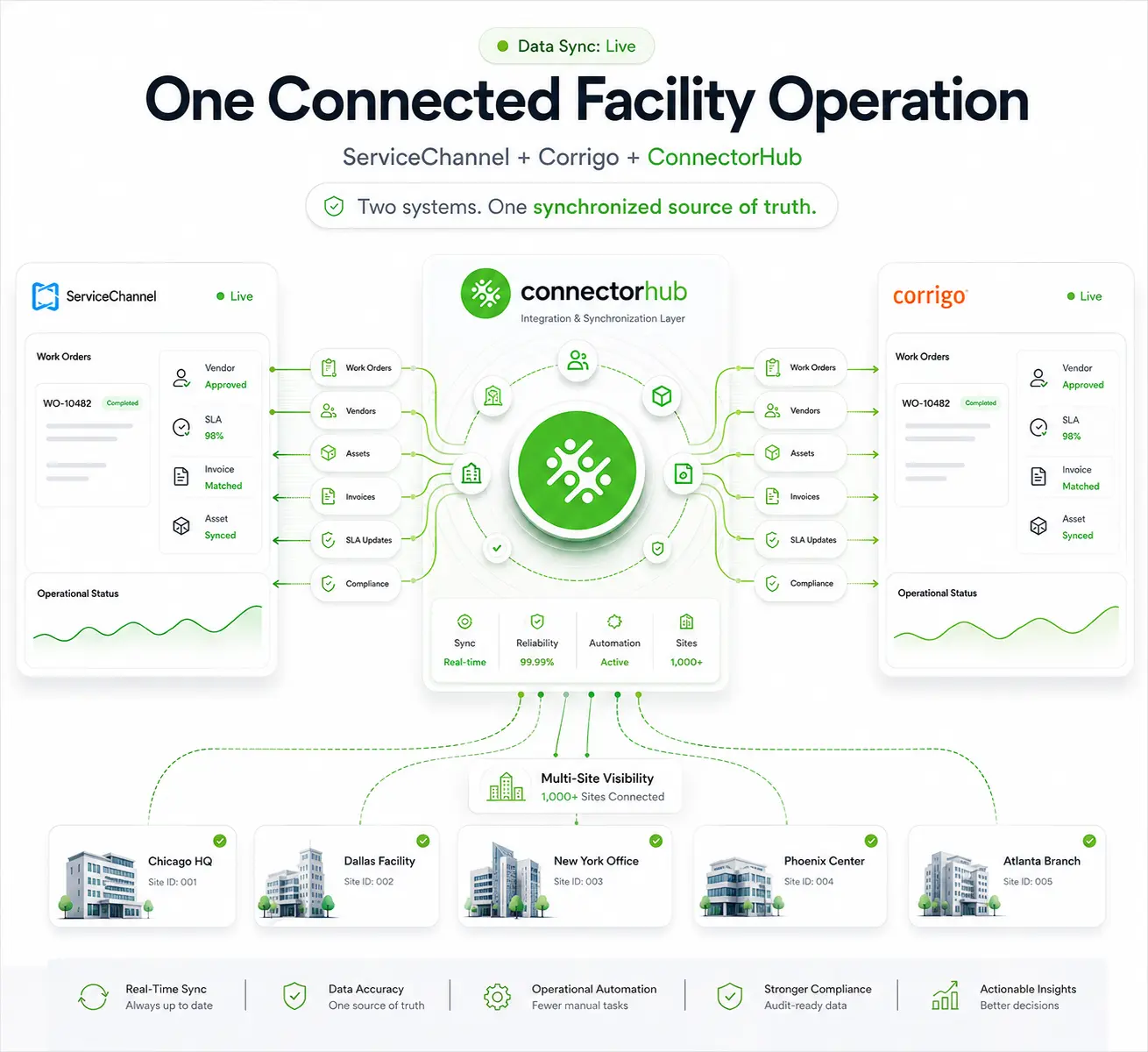
Corrigo and SAP Integration, for example, enables syncing of maintenance work orders with financial and procurement modules, providing appropriate cost tracking and compliance in enterprise environments.
The strategic payoff is in asset lifecycle costing and Total Cost of Ownership (TCO). By flowing CMMS data directly into ERP asset records, organizations gain precise visibility into true costs. Thus, such integrated systems facilitate a shift from reactive maintenance to a proactive one, enabling better repair-vs-replace decisions that could generate profits in the long run.
Apart from ERP integration, the integration of BAS/BMS provides an added layer of intelligent "condition-based" functionality. Alarms in non-integrated buildings typically are not generated until thresholds are exceeded; hence, trouble is already the case.
Integrated operations will provide the necessary data to trend in the CMMS to proactively monitor alarms, thus achieving condition-based maintenance. This creates efficiency in the usage of energy; prevents equipment failures; prolongs asset life; and optimizes occupant comfort or production assurance.
By positioning the CMMS as the intelligent hub, receiving BAS condition data, driving work execution, and feeding financial insights back to ERP, this integration creates a virtuous cycle:
i). Better preventive scheduling lowers reactive work
ii). Richer cost data informs strategic decisions
Overall operations grow smarter and more resilient.
With ConnectorHub, our AI-driven platform makes these connections easier by granting real-time awareness, workflow automation, and data-driven facility asset management that empower facilities to move beyond silos towards proactive, value-focused excellence.
Also Read: Top 5 Integration Challenges Draining Your Operations Team (And How to Fix Them)
Key Benefits of Connecting CMMS & ERP Systems Through Automation
Automated integration between the CMMS and ERP systems eliminates the handoff of data in a manual manner by providing a continuous, bidirectional flow while developing a joined maintenance and financial setting. The following is a concise overview of the main benefits and their direct business outcomes:
These drivers collectively provide overall operating cost savings, increased reliability in assets, no unplanned downtime, as well as increased strategic alignment with the enterprise.
How Large FM Enterprises Can Connect ERP & CMMS Without Heavy Custom Development?
Here’s a simple step-by-step roadmap for effective facility management integration:
1. Get Ready & Check Everything
- Pick 2–3 measurable and easy-to-achieve goals (example: cut repair time or improve preventive maintenance rate)
- Keep a clean master list of assets parts codes and units
- Decide who can see or change what in each system
- Look at your current CMMS and ERP, check if they can talk to each other and list the most important data that needs to move
2. Choose Your Integration Approach (FMX, Corrigo, Nuvolo Integrations)
- Native connector → quickest if it already exists (not always available)
- Open APIs → most flexible and real-time (takes a bit more work)
- iPaaS / middleware → fast and low-code (great for quick results)
- ETL → only for reports and history (no live updates)
Hard metrics that can range from thousands of hours to important percentages in operational expenses make concrete grievances compelling investment cases. These metrics significantly expedite approval by executives and provide concrete success parameters to the project.
3. Map the Data
- Make sure every asset has the same ID in all systems
- Use the same codes for work order status, failure types, and costs
- Agree which system is the “boss” for each piece of information (e.g., ERP owns suppliers, CMMS owns work orders)
4. Start Small with a Pilot
- Choose one important area (like a problem machine or line)
- Set up basic syncs and automatic triggers (e.g., high vibration → new work order)
- Let data flow back and forth regularly (every 10–30 minutes or daily)
- Show the first users how it works and ask what they think
5. Test and Fix Problems
- Check: Is the right data moving at the right time?
- Confirm: Are automatic actions correct? No mistakes or confusion?
- Fix any issues and improve the rules based on what you see
6. Train & Roll Out
- Train your team on the new way of working, explain how it saves time
- Share the benefits clearly so people feel comfortable
- Slowly add more machines, departments, or sites
7. Monitor & Improve
- Track your original goals (e.g., less downtime, more productive time)
- Add smarter rules like automatic alerts
- Review every month, adjust and connect more things as needed
This approach keeps risk low, delivers quick wins, and scales smoothly.
How ConnectorHub Facilitates Easy No-Code Integration for Your Facility Operations
ConnectorHub takes the complexity out of connecting your CMMS, ERP, IoT, and many other systems with its true no-code solution.
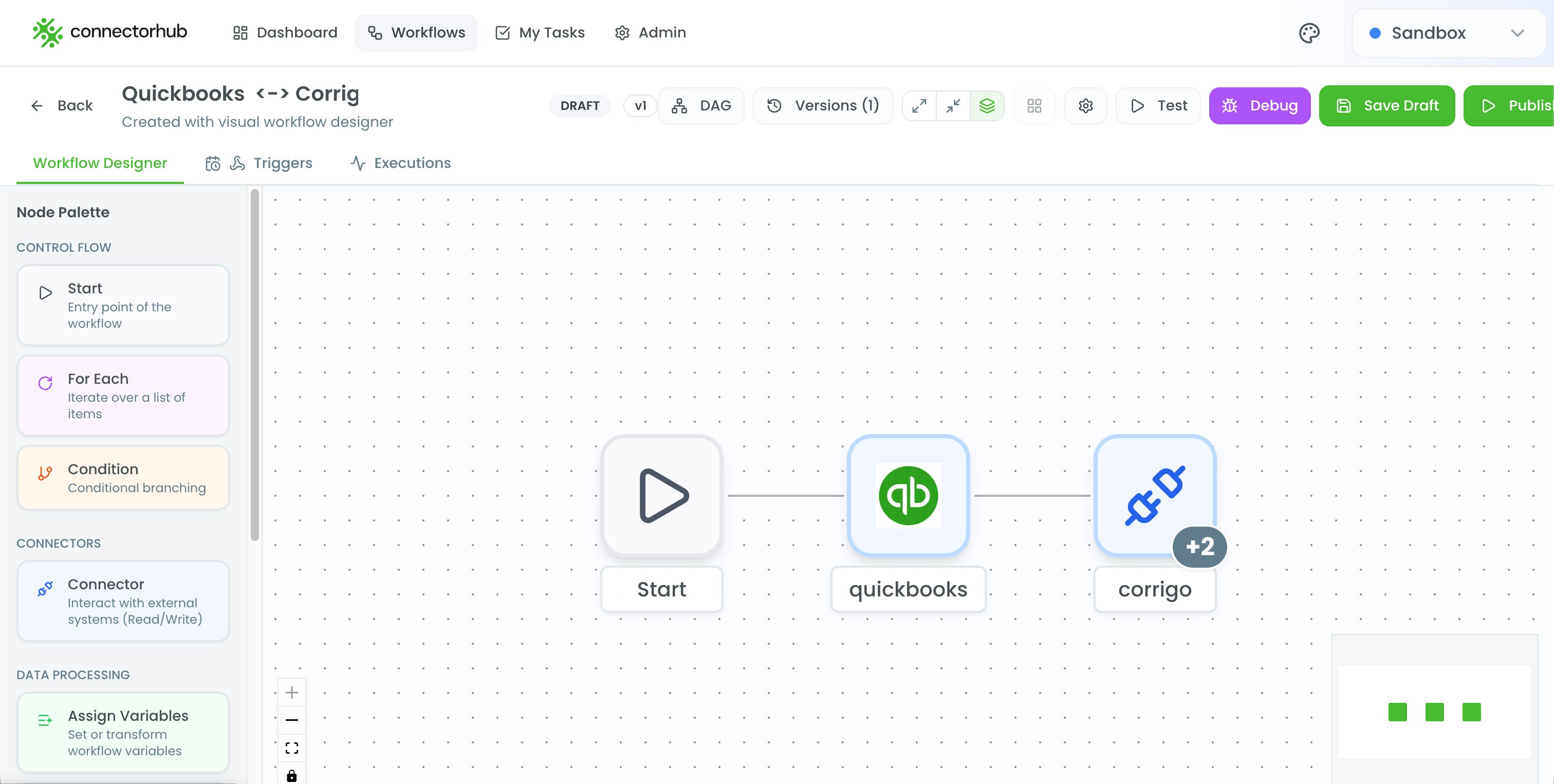
- It includes a visual drag-and-drop interface, which helps operations teams to develop their own workflows as well as a map of the data.
- AI assists by suggesting mappings, spotting errors, and optimizing rules automatically.
- Pre-built templates are available to cover general requirements such as work order sync to ERP for instant procurement or CMMS and CRM workflow automation for unified service delivery.
- Alerts from IoT are routed directly into the CMMS system to initiate associated preventive work.
- Real-time bidirectional sync means data is always current across all tools.
- Built-in monitoring dashboards allow for visualization of the applications, detection of issues, and SLA enforcement.
Overall, ConnectorHub strives to deliver fast, business-focused integration with measurable results.
Future Outlook for FM Integration Systems
In the post-2026 era, CMMS-ERP interoperability will incorporate sophisticated AI to support autonomous operations, such as the use of agent AI to carry out tasks like predictive maintenance operations. This would enable facilities to operate on their own through real-time data patterns to be optimally efficient.
There would also exist enhanced pressures with regard to regulations, which would result in an increased focus on security with AI governance and privacy standards included as integral components.
Global markets will need highly flexible cloud native platforms to support easy management across multiple sites by facilitating easy collaboration with the help of cloud technology.
Sustainability will further increase the depth of integration with tools monitoring real-time metrics such as carbon footprint, energy consumption, or waste to support ESG objectives or green operationalization more directly.
Conclusion
In a world where facilities should have precise, agile, and sustainable operations, holding onto manual CMMS-ERP integration is a competitive disadvantage. Data silos make companies lose efficiency, create increased costs, lead to delayed decisions, and put maintenance organizations in the perpetual state of fight or flight while their competitors shift to the future of connected operations.
The imperative of the interoperability reality of 2026 is quite clear—interoperability is the new table stakes. Facilities that approach integration as a strategic priority realize consolidated visibility, faster workflows, precise asset costing, and set up the foundation for AI-driven insights. The blueprint here provides a practical, low-risk path to get there.
ConnectorHub exists to make that journey easy. With no-code workflows integration, AI-assisted mapping, real-time sync, and purpose-built templates for facility use cases, we help you find the hidden gaps in connectivity and replace fragmented tools with a single intelligent ecosystem.
In fact, the future simply belongs to facilities that stop managing data and start letting data manage them.