.svg)
The expensive part of bad enterprise data isn't the bad value itself. It's how many systems consume it before anyone notices.
It may be virtually free to rectify at the data entry level that an asset ID doesn't match, a field is missing, or a part number is in valid. However, if that record gets through into the business as 'accepted' and is passed into synchronisation and across to downstream systems it ceased to become a data entry issue and is now an integration issue.
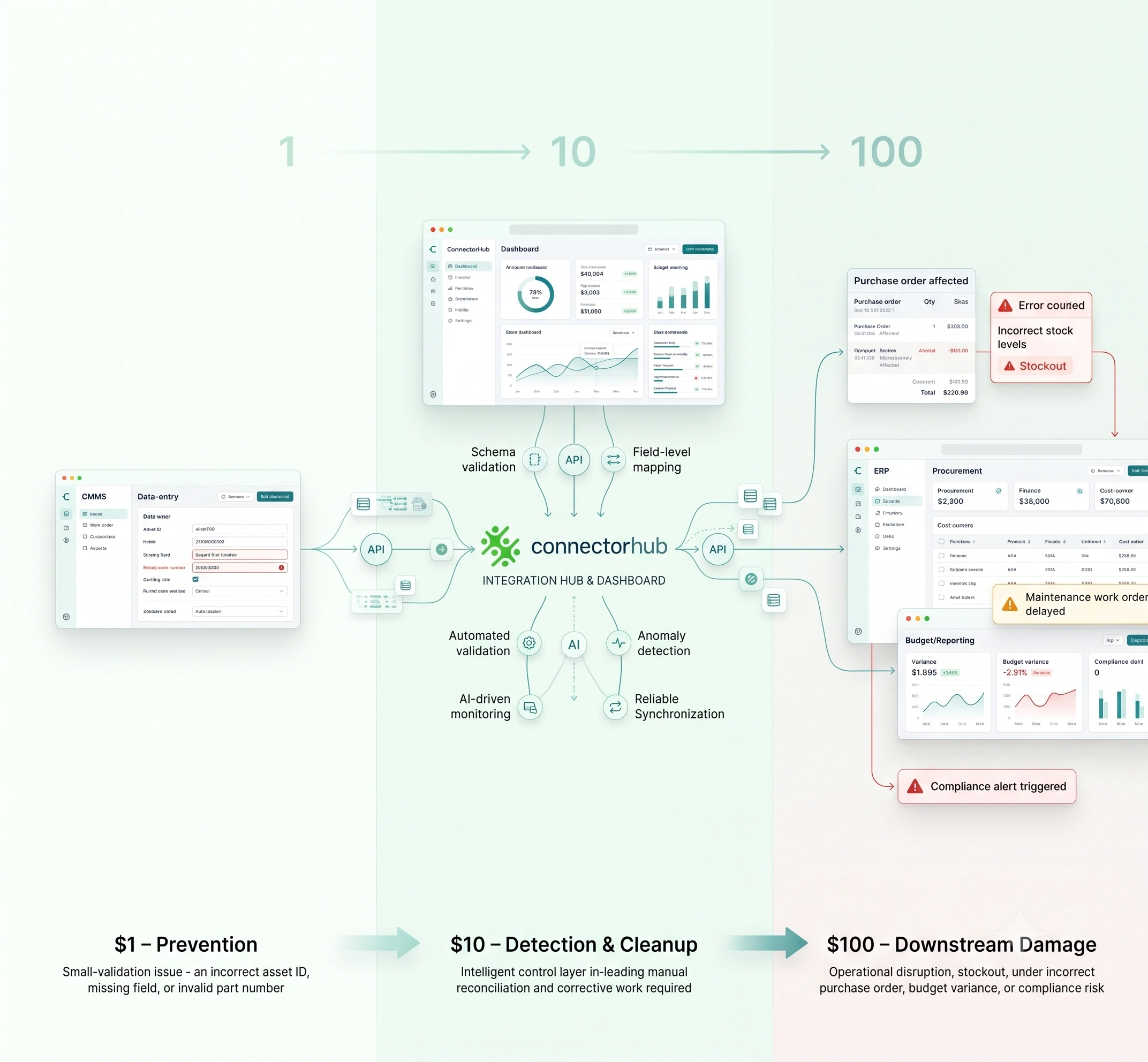
This logic underpins the concept of the 1-10-100 rule; it costs infinitely less to prevent data quality at the source than to correct it at a later stage, and still more if the error is actually feeding business operations or decisions.
For executives running a data integration platform, this is not theory. The pattern holds for a simple reason. Most enterprise platforms were built to run their own domain well first. Enterprise data automation got added later, often through manual exports or scripts nobody fully documented.
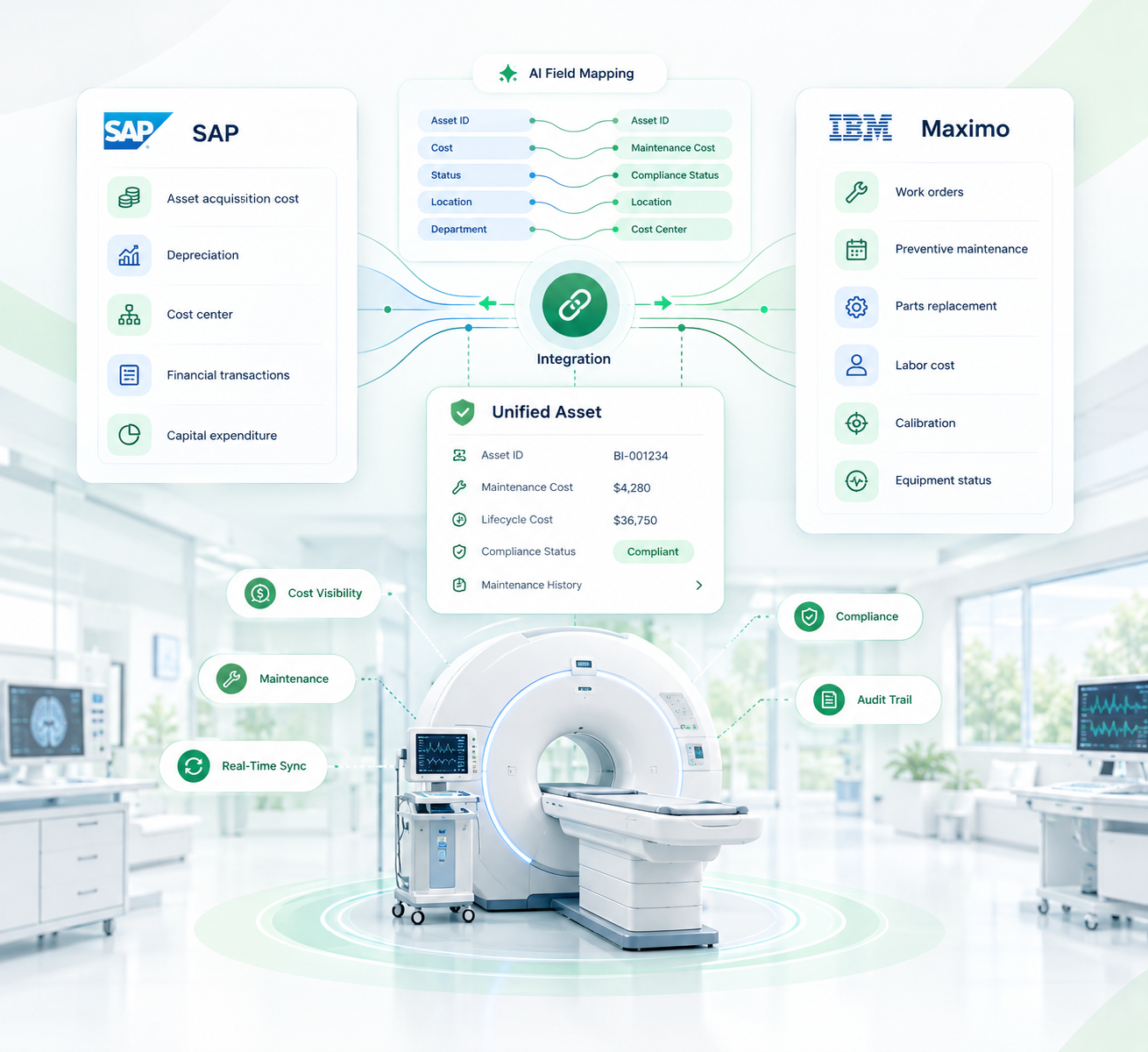
Data synchronization between CMMS and ERP changes where the error actually gets caught. Validation happens the moment data moves between platforms, not three systems downstream. A data integration platform for AI applications, built with field-level mapping and type checking, is designed to catch exactly that kind of small, silent error, doing the same job across CRM, procurement, and finance data.
Where Bad Data Actually Enters and Spreads
Common entry points look like this:
- A technician logging a work order from a phone on a noisy plant floor, guessing at an asset tag
- A procurement clerk retyping a vendor name that already exists, spelled three different ways across three systems
- A CRM record updated by a sales rep but never pushed back to the ERP that finance depends on
- A CMMS field mapped to the wrong ERP cost center during a rushed system go-live
None of these look serious on their own. The damage starts once the record moves.
Application to application integration built on manual exports or one-off scripts has no consistent way to check a value before it lands in the next system. A blank CMMS field can get auto-filled with a default value inside the ERP. Nobody notices until an audit or a stockout forces the question.
Sync failures make it worse. A few common triggers:
- A schema change on one side breaks a mapping without any visible error
- A new field added to a vendor's API goes unmapped
- A routine version upgrade shifts a value quietly, with no alert
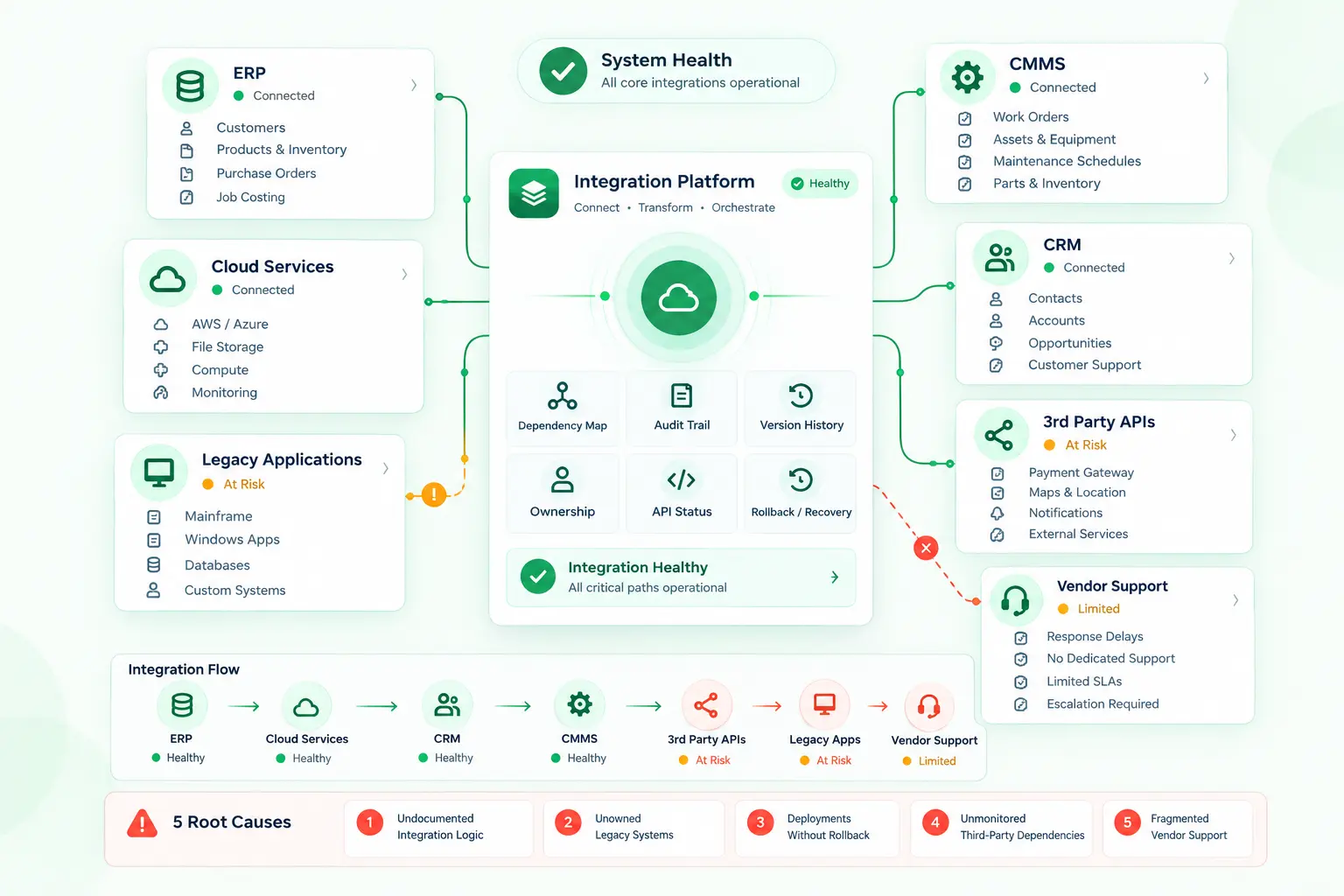
When CMMS, ERP, and CRM connections are stitched together ad hoc, this happens often. The data still moves. It just moves wrong. A properly governed approach treats data integration as a monitored pipeline with validation rules built in.
The Real Business Impact at Each Stage of the Rule
The exact dollar figures in the 1-10-100 rule are illustrative. But independent research on data quality keeps landing in the same territory:
- The average organization loses millions of dollars a year to poor data quality
- Across U.S. businesses combined, the annual cost runs into the trillions
- Unplanned downtime tied to bad maintenance data costs manufacturers tens of billions of dollars a year
Mapped onto a CMMS and ERP environment, the three stages break down like this:
At the $1 stage, prevention mostly comes down to disciplined API integration design. Systems that exchange data through defined, validated interfaces reject obvious errors before they ever reach a database.
At the $10 stage, the cost stops being just labor. It becomes opportunity cost. Every hour a planner spends reconciling spreadsheets is an hour not spent on preventive maintenance planning or vendor negotiation, and it is exactly the kind of manual effort data automation is meant to remove.
At the $100 stage, the damage turns operational, and sometimes reputational:
- A wrong part number becomes a stockout during a critical repair
- A missed cost allocation becomes a budget variance nobody can explain
- An automated business process meant to remove manual work instead bakes the error into every transaction that follows
Why Traditional Fixes Fail to Contain the Cost
Most organizations are not ignoring this problem. They are usually treating the symptom rather than the source.
Point solutions and periodic data cleansing projects. A vendor gets brought in once a quarter, or once a year, to scrub duplicates and standardize formats. This helps briefly. The connections between CMMS, ERP, and CRM stay manual or fragile underneath, so the same errors reappear within weeks.
Manual reconciliation in high-volume workflows. Spreadsheets get built to cross-check CMMS work orders against ERP cost centers. That works when volume is low. It falls apart in a plant running hundreds of work orders a week, because reconciliation becomes a full-time job instead of an occasional exception.
Both options do not address the actual transition point between the systems at which the mistakes propagate. Generic and horizontal enterprise integration software designed to serve as an off-the-shelf solution is inclined to treat CMMS-specific data such as asset hierarchies and PM schedules simply as plain text. In addition, most iPaaS solutions on the market today are geared toward big IT departments implementing tens of integrations rather than one operations manager implementing three to four.
Integration Patterns That Shift Detection Earlier
A few patterns show up consistently in organizations that have actually cut their downstream error rate:
- Schema-aware field mapping. Data moves field by field between CMMS and ERP, with type and format checks applied automatically.
- Validation at the point of transfer. Values get checked against business rules, such as whether an asset ID exists, before they are allowed to move.
- Continuous monitoring across operational systems. Sync activity is watched close to real time, with alerts firing when a mapping fails or a field arrives empty.
Reusable connectors are suited for standard integration use cases such as SAP to CMMS or CRM to ERP, as these scenarios are encountered consistently within many organizations. This kind of connector eliminates the need to reinvent the wheel and re-engineer custom solutions every time.
Cloud integration makes this much more feasible than it did a decade ago. The connector is centrally managed when the vendor updates the API, instead of each organization fixing their own script.
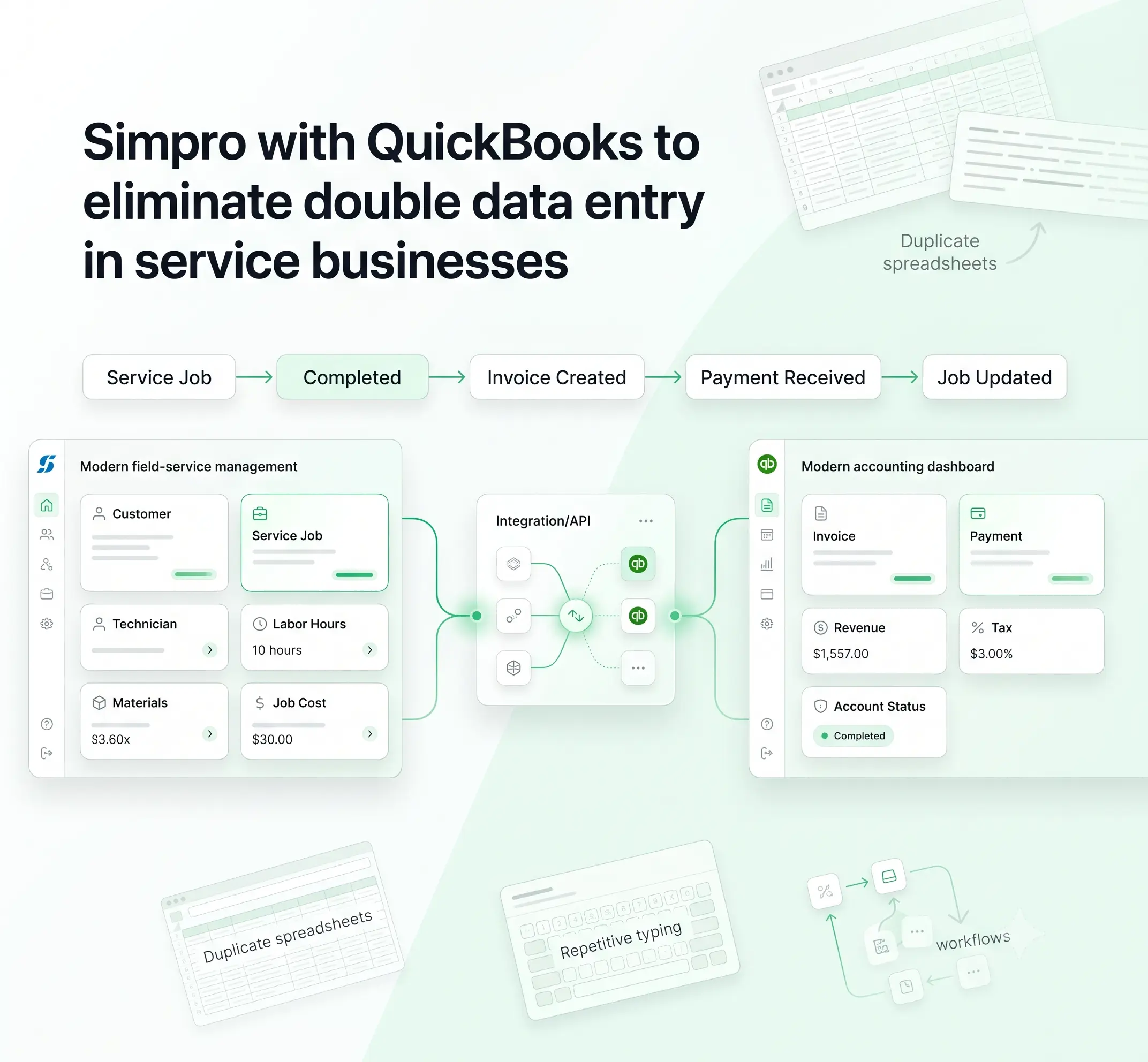
This also changes the ownership of the process. Basic workflow automation between ERP and CMMS gives operational and IT teams configuration capabilities, rather than having to bring in a developer for each little change.
How ConnectorHub Helps Organizations Catch Issues Earlier
This is the specific problem ConnectorHub is built around: making the connection layer between CMMS, ERP, and CRM systems reliable enough that catching an error at the $1 stage becomes the default, not something that depends on who happens to be paying attention that day.
For teams running these systems directly, that shows up as:
- Pre-built connectors for popular enterprise combinations, such as SAP, NetSuite, Microsoft Dynamics 365, and CMMS systems like eMaint and CorrigoPRO
- AI-driven mapping and anomalies identification that detects an outlier like a non-existent cost center before it becomes part of the downstream flow
- Performance monitoring with SLA notifications, so when there is an issue with synchronization, it will be visible on a dashboard, not in month-end surprises
- Multi-tenant architecture with SOC 2, HIPAA, and GDPR compliance controls, which become important when integration deals with sensitive data
There is a second audience this matters to just as much. Connecting CMMS, ERP, and CRM systems is not only an operations question. It is a growth question for the software platforms that serve those operations teams.
For a CMMS or facilities software company whose clients keep demanding an SAP interface, there is an option available, either develop the connector in-house or use one that has already been developed. Instead of spending engineering hours developing a connector for each client that requires it, the platform company can:
- License an embeddable integration layer instead of building one from scratch
- Offer connected workflows as a native product feature
- Let a partner carry the ongoing maintenance as APIs and system versions change
Conclusion
The exact multiplier in the 1-10-100 rule matters less than the shape of the curve. Some estimates go even higher once reputational damage and compliance exposure get factored in.
What holds steady is the direction. Every stage a data error travels through without being caught adds cost, and most of that cost stays invisible until someone goes looking during an audit, a budget review, or a failed compliance check. For executives deciding where the next integration budget goes, the real question is not whether bad data is expensive. It clearly is.
Questions about which vendor fits a CMMS environment usually come down to focus, not feature count. A large, generic enterprise integration platform can technically do almost anything, but that flexibility often means months of implementation for a need that is really just CMMS, ERP, and CRM data staying in sync. Positioning connectors as integration as a service, priced around the systems a team already runs, tends to get an organization to the $1 stage faster than a platform built for every possible use case at once.