.svg)
What happens when your CRM lists a customer account as active, while your ERP shows the same account closed an hour earlier? Neither system is technically wrong. Nobody ever sat down and decided which one gets the final say, and that gap is usually where the trouble starts.
That's really the question sitting under every integration decision. Not whether two systems should talk to each other, but what kind of data synchronization engine sits behind that connection, and whether information should flow one way or both. Get that right, and updates move through the business cleanly, without anyone giving it a second thought. Get it wrong, and you end up with two systems, each one convinced it's correct, quietly contradicting each other in the background.
Executives weighing multi-system integration run into this more often than they would probably like to admit. The decision determines which system gets treated as the truth, how conflicts get sorted out, and how much risk the business is comfortable carrying. Get it wrong on a high-volume data sync, and the fallout is not theoretical. Invoices go out to accounts that were already closed. Work orders land on equipment that is no longer in service. A sales rep spends a whole morning chasing a lead that already closed somewhere else.
In the end, it becomes evident that the real problem is one of figuring out how to automate data synchronization, when one-way synchronization is enough, when two-way synchronization is worth its complexity, and what success really means.
Why the Old Integration Project Model Is Breaking
System integration used to feel so much simpler. You hired a developer, wrote direct code linking two programs, tested everything, launched, and moved forward. That straightforward approach worked beautifully when businesses relied on just two or three core platforms, and technology rarely shifted.
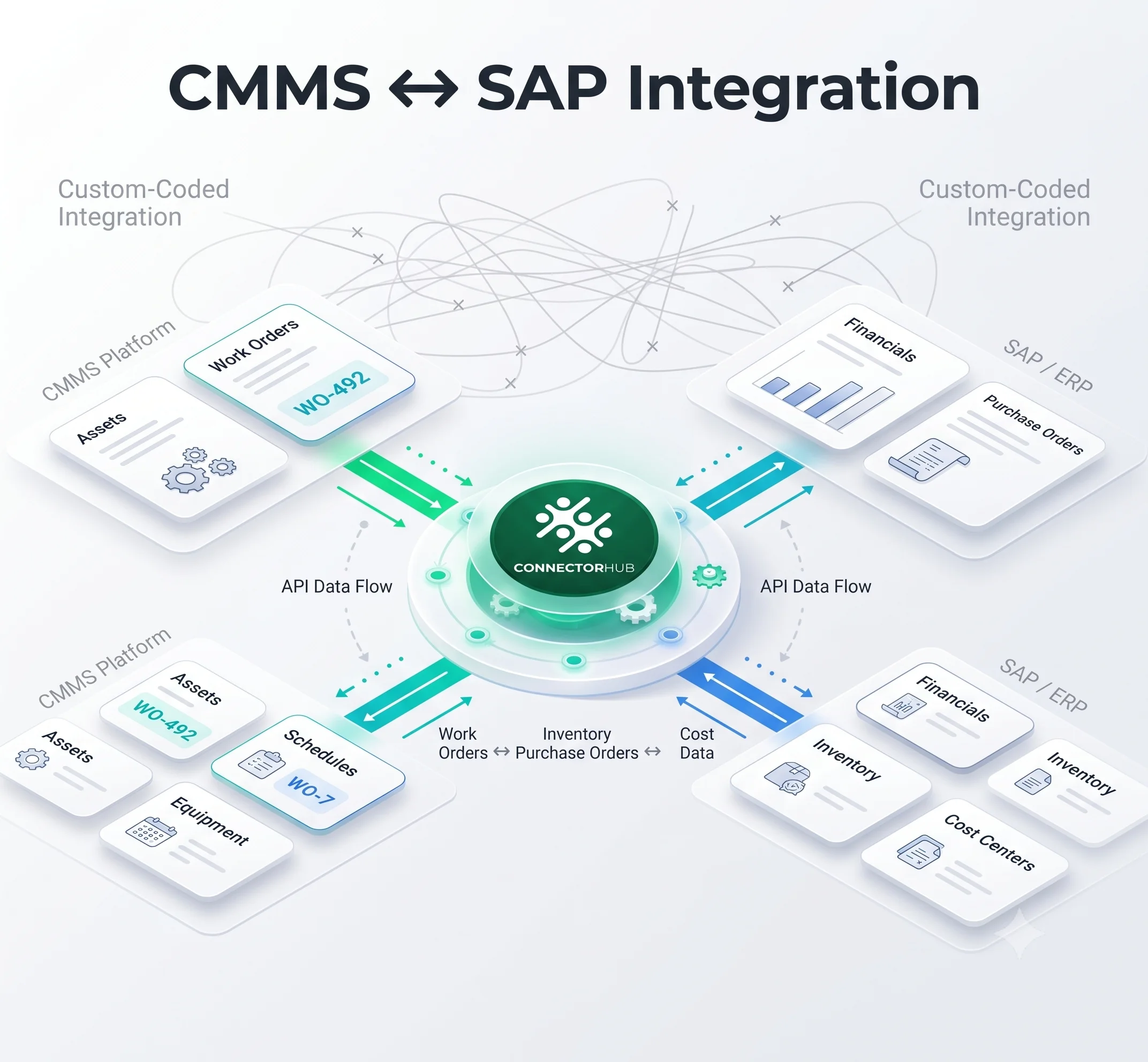
That isn't true anymore. Today, growing and large companies balance eight, ten, or sometimes fifteen active platforms simultaneously, spanning CRM, ERP, field service, accounting, and IoT networks. Those older, hand-coded digital connections instantly become heavy liabilities the second any software provider updates an interface or a daily workflow subtly shifts.
The pattern that follows is almost always the same. A backlog of "temporary" fixes builds up that nobody ever circles back to repair properly. IT ends up spending more hours patching old connections than building anything new, and every additional system in the stack makes the maintenance load worse, not just bigger. Usually there is no single person accountable when a sync quietly stops working, either.
The Rise of Integration-as-a-Service and What It Actually Means for SIs
Integration-as-a-service changes this picture entirely. Instead of treating connectivity as a finite project with a start and an end date, it turns integration into an ongoing, managed business resource — something that functions like a utility rather than a deliverable.
That shift matters a lot for system integrators and consultants. Rather than billing for a project that eventually wraps up, they can package integration data flow, monitoring, and support as a recurring service, the same way managed IT support turned into a standing offering years back.
Clients tend to like this better too, and it is easy to see why. There is no one left to hold on to that unsupported custom code when the project team packs up and leaves. There is someone who owns the connection, someone who looks for failure, and someone who modifies as the systems underneath change.
Why Building Your Own Integration Platform Rarely Makes Sense
Some organizations look at building their own connector layer in-house. On paper, it looks cheaper than licensing a data integration platform. In practice, once you factor in what it actually costs to maintain, it usually is not.
Owning a homegrown layer is a full-time engineering job, not a side project squeezed in between other work. Someone has to manage authentication and credentials for every connected system. Someone has to handle errors and retries when calls fail. Someone has to update schemas every time a source system changes a field. None of that work ever really stops.
The teams who follow this route usually find themselves stuck on maintaining the infrastructure rather than developing the business logic that is required by the customers. Companies that deal exclusively with connectors have to track API changes across hundreds of applications at once, for every client they serve — which is simply too much for any single internal team to handle.
A Practical Framework for Delivering Integration-as-a-Service
A workable framework really comes down to four stages. Assess comes first: map out every system involved and pin down the system of record for each type of data. Architect comes next: decide sync direction, frequency, and conflict rules before anyone writes a single workflow. Then configure, building connections with pre-built connectors wherever that is possible instead of custom code. And finally, monitor, tracking sync health, failures, and data drift on an ongoing basis, not just in the first week after launch.
Most projects stumble right at the start, during assess. Skip that step, and nobody has clearly named the authoritative source for customer data, inventory levels, or billing status. That ambiguity does not disappear on its own. It just resurfaces later, usually as conflicting updates nobody can explain.
One-Way vs Two-Way Data Synchronization: Choosing the Right Model
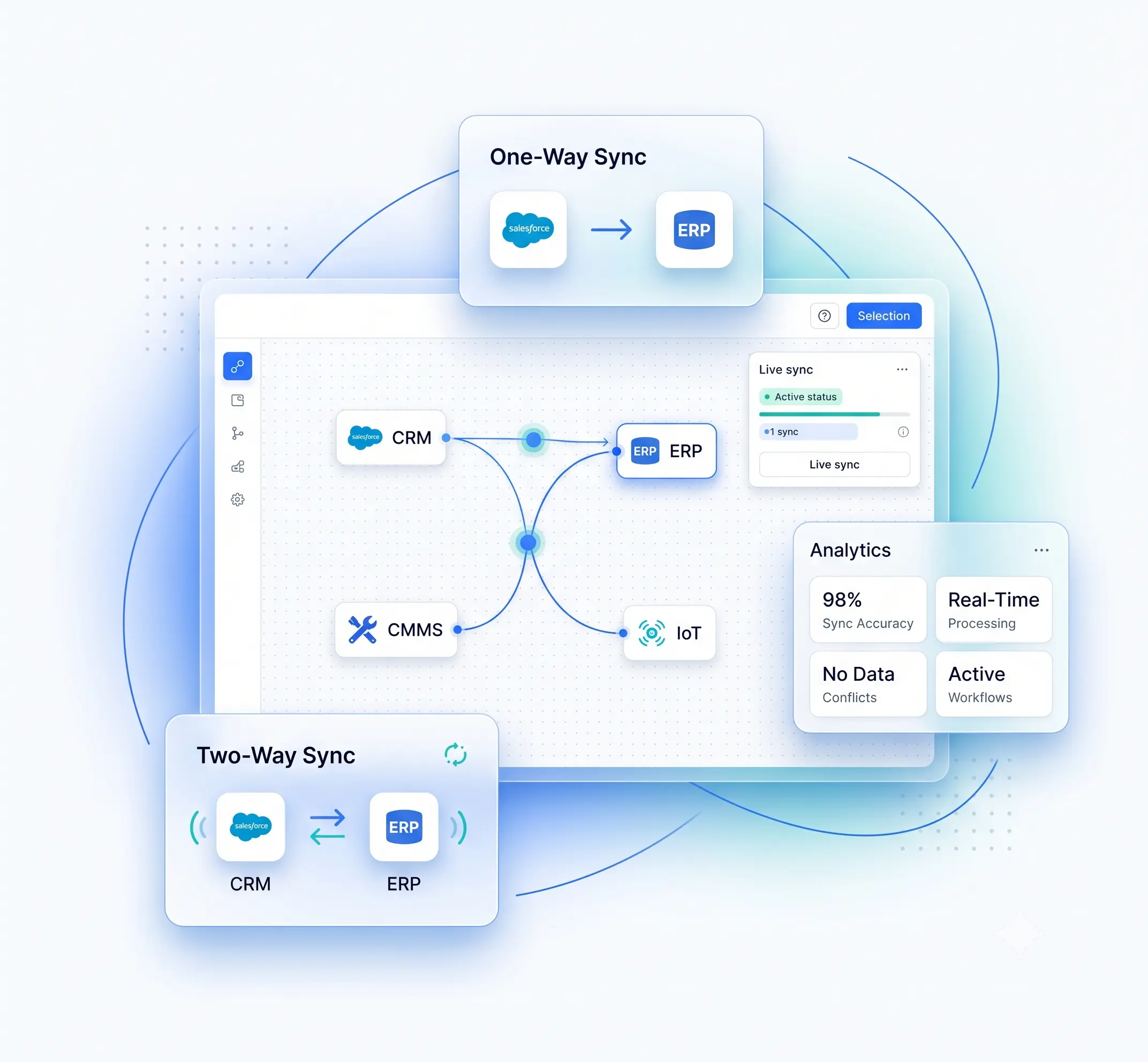
This is the decision that determines whether data synchronization between systems stays reliable for years or turns into a source of support tickets for months. The table below breaks down how one-way data synchronization and two-way data synchronization compare, along with where real-time data sync fits into the picture.
The decision on which model to use does not actually revolve around which model is the "better" one. Rather, it involves matching your strategy in a sensible way to the way your team uses their tools on a daily basis and evaluating which processes require constant communication from one-way communication.
Implementation Considerations and Common Pitfalls
Even the right sync model can fail if a few operational details get overlooked.
Cloud integration creates unique time constraints: API rate limitations, throttling, and sudden outages which are not common in traditional on-premise solutions. It is crucial to design robust retry capabilities and alerting from the very beginning. Do not rely on the assumption that all requests will be successfully made.
A handful of pitfalls tend to show up again and again:
- No conflict resolution rule. Two-way sync without a clear "last write wins" rule, or a field-level priority, quietly loses data and nobody notices right away.
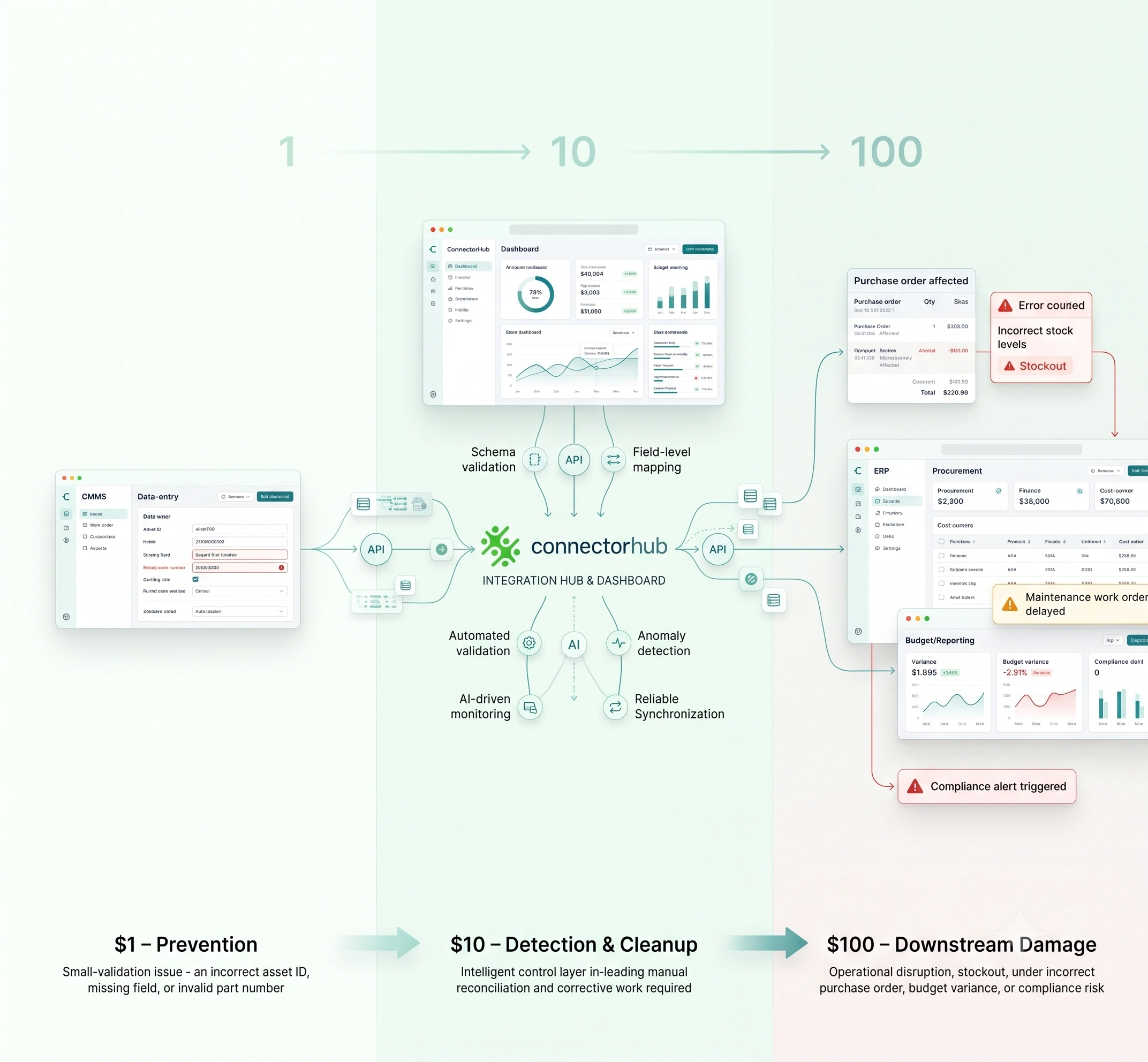
- Unwatched schema drift. When a source system adds or renames a field, an unmonitored sync just keeps mapping the old structure, until something breaks downstream.
- Monitoring treated as optional. A failure caught within minutes costs far less to fix than one that sits unnoticed for days.
- Underestimated volume growth. An architecture built for thousands of records can behave very differently once it is processing millions.
None of this is exotic, honestly. It is the same handful of issues showing up across nearly every integration program, regardless of industry.
How ConnectorHub Enables System Integrators to Productize Integration-as-a-Service
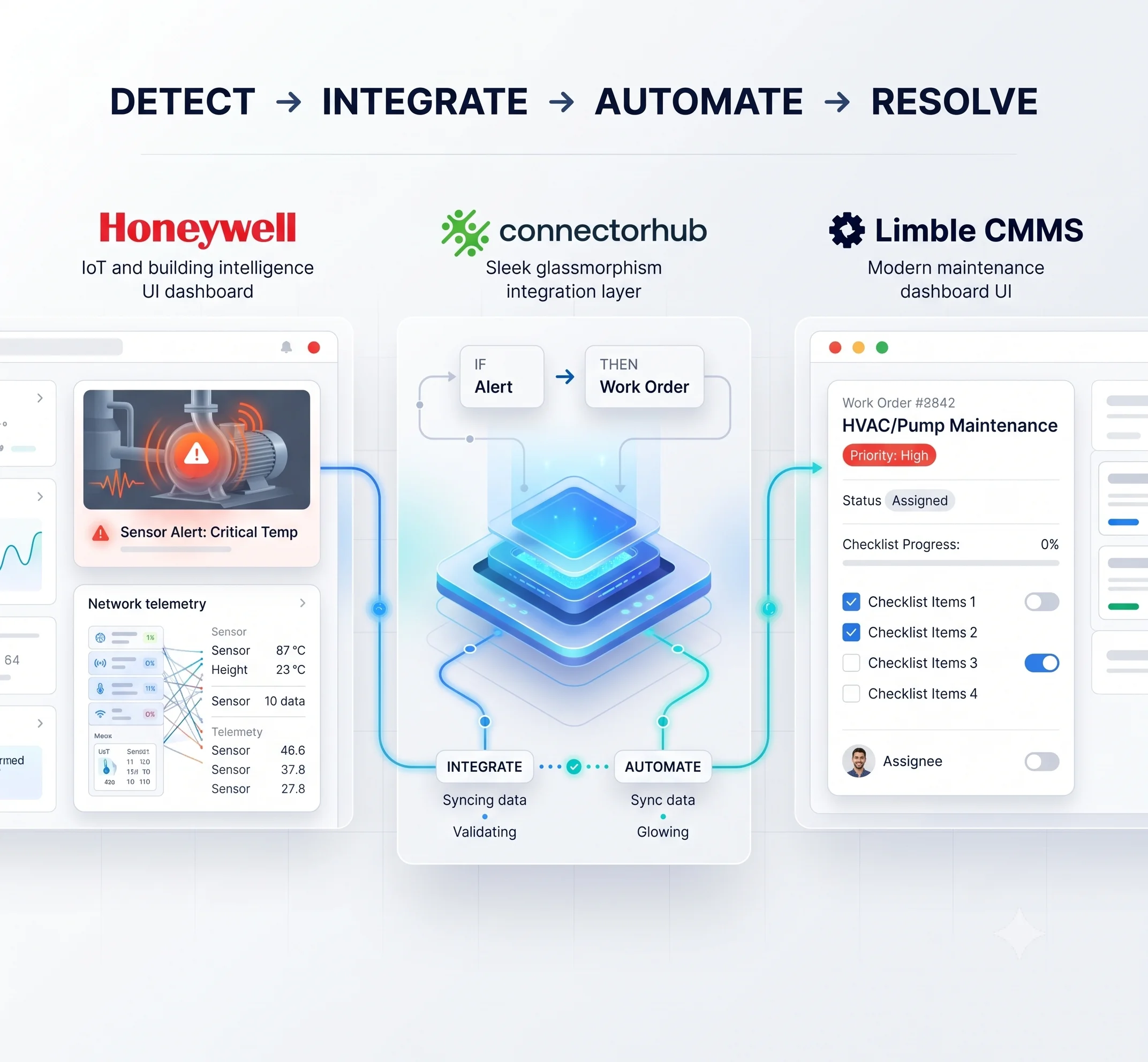
This is where the above-discussed framework transitions into the real-life solution that can be shipped by the team. With the help of ConnectorHub, the team will get access to the platform for both types of sync models and, thus, will be able to create one-way and two-way syncs between CRM, ERP, CMMS, EHR, SCADA, and IoT systems using more than 100+ pre-built connectors. Configurations are done using a visual interface instead of coding. It means that business users will be able to configure syncs themselves without bothering IT department anymore.
The platform is a reference architecture that enables system integrators to configure it client by client without having to develop a new solution from scratch, thus reducing the time taken to deliver solutions and making the integration process a recurring service that can be monetized. Organizations that use the ConnectorHub platform for their work order and asset synchronization have reported SLA failures by 30 to 40 percent, while their data accuracy remains above 98 percent.
The infrastructure behind it is SOC 2, HIPAA, and GDPR-aligned, with encrypted credentials and tenant isolation baked in — details that matter a great deal to SIs serving healthcare, facilities, and industrial clients, where compliance isn't optional. There's a path in for software providers too. A licensable integration layer lets them embed pre-built connectors under their own brand instead of standing up a connector team from scratch.
Also Read: How SaaS Companies Scale Integrations Without Engineering Bottlenecks?
Conclusion
The decision of whether to push information in one direction or sync it in both directions is not a technical issue that can be delegated and then forgotten. Instead, it is the issue of where the truth lives in the organization, and what level of risk the leadership is prepared to take with conflicting systems.
Executives do not need to write the sync logic themselves, of course. But they do need to ask the right questions before a project even starts. Which system holds the authority? Does this linkage have to happen in real-time, or is it okay to delay until some scheduled time? What if both systems attempt to modify the record simultaneously?
In practice, that means one-way sync when a single system is clearly authoritative and everything else just needs an accurate copy. It means two-way sync only when multiple teams genuinely need to edit the same data independently, with conflict rules worked out well in advance.
It also means matching sync timing to how urgent the data actually is, not to whatever sounds more impressive in a pitch deck. And it means treating integration as an ongoing service with real monitoring, not a project that quietly ends the day it goes live.
Get this right the first time, and it costs a lot less than untangling duplicate records and conflicting updates six months down the road.