.svg)

Here's an odd fact about the oil and gas industry: the systems that generate the most valuable operational data are often the ones nobody in finance ever looks at.
SCADA platforms record pressure, flow, and equipment health around the clock. Almost none of it reaches the people who write the checks, plan the maintenance calendar, or file the compliance reports, not until someone manually moves it there.
That's the real story behind SCADA ERP integration. It isn't really about technology for its own sake. It's about closing the distance between what a field engineer already knows at nine in the morning and what an ERP system knows by end of day, sometimes end of week. Shrink that distance to seconds, and a company reacts differently to a pressure anomaly, a compressor limping toward failure, or a compliance deadline creeping closer than anyone realized.
Connect supervisory control systems directly to enterprise resource planning platforms and something genuinely shifts. Oil and gas operations software stops behaving like two separate toolkits bolted together out of habit. Telemetry turns into maintenance tickets on its own. Procurement gets triggered without a phone call. Compliance reports assemble themselves instead of getting stitched together the week before a filing deadline.
That's what a working automation system in oil and gas industry operations actually looks like, not the patchwork most companies are still running.
The High Cost of Disconnected SCADA and ERP Systems in Oil & Gas
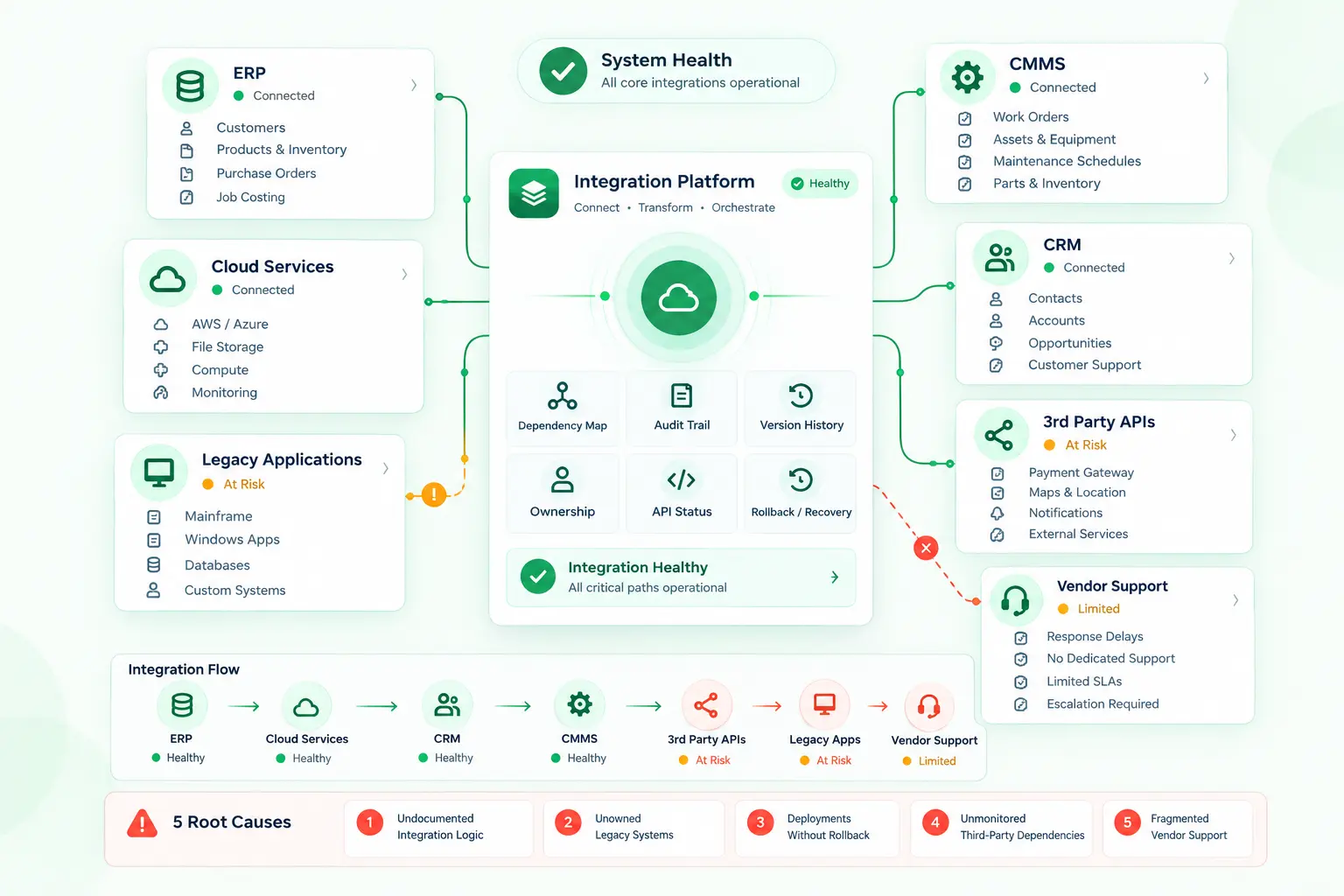
Nobody at these companies decided to run disconnected systems on purpose. It happened gradually. A SCADA platform gets installed to keep pipelines under control. Years later, finance rolls out an ERP system to handle everything else. Nobody builds the bridge between them, mostly because nobody realized they'd need one.
The result shows up in friction operations teams already know by heart:
- Delayed visibility: Field engineers watch pressure readings and flow rates in real time, but that information sits in the historian until someone manually pulls it into a spreadsheet or a maintenance request.
- Late work orders: Tickets get written hours or days after an anomaly first appeared, instead of the moment it happened.
- Inventory drift: Stock counts in the ERP system stop matching what's actually on hand at the wellsite, because consumption data never makes it out of the control room.
- Slow compliance cycles: Teams spend days reconciling operational logs against regulatory templates instead of hours, since the two data sets were never built to line up.
Looked at individually, none of this seems like much. Stack these up across dozens of wells and processing units, though, and it starts to look like lost revenue, spread thin enough that it never shows up as a single number anyone has to explain.
Why Traditional Integration Approaches Fall Short
Solving this in-house feels like the obvious move, and it's exactly where a lot of projects run into real trouble. Security tends to be where the real damage happens. Oil and gas infrastructure counts as critical infrastructure in most countries, and connecting an OT network to an enterprise IT network without enterprise-grade data security built in from day one opens a door nobody wants opened. Convenience scripts rarely include proper encryption, access controls, or audit trails, and adding those after the fact costs far more than building them in.
Scale is its own headache. A script that connects one well pad to one ERP instance rarely survives contact with fifty well pads and three regional deployments. What looked like a clean proof of concept turns into a tangle of one-off connections, each one more fragile than the last.
Hidden beneath all of this is a deceptively simple problem – your SCADA and ERP systems simply don't understand each other at all. One operates in a universe defined by Modbus, OPC UA, or WITSML and concerned with fast tags and timestamping. The other needs transactional data linked up with cost centers and vendor identification.
Without a properly implemented translation service, which can be either cloud middleware or an intelligent connector, the entire system is going to collapse as soon as the next firmware update silently changes some undocumented tags.
Shift Toward Modern SCADA-to-ERP Integration Architectures
The teams who sidestep these pitfalls share one crucial, early breakthrough: they stop treating integration like a software project with a strict deadline. Instead, they embrace it as a integration as a platform, an ongoing capability rather than a single launch, and their entire risk landscape completely transforms.
Instead of a script only one engineer understands, the organization gets a data integration platform built to manage the relationship between operational and enterprise systems for years, not months: version control, monitoring, and a way to roll back when something breaks, because something eventually will.
A few technologies are responsible for doing most of this work. The APIs that connect and translate between the OPC UA, Modbus, and whatever protocol is expected by the ERP systems do not require manual coding any more.
Event driven architectures have made polling redundant, allowing processes to be triggered immediately if there is an anomaly in the pressure. Cloud and hybrid deployment models let operators centralize data from assets scattered across states, sometimes countries, which matters when wells, pipelines, and processing facilities aren't next door to each other.
AI workflow analytics is the newest piece of this stack, and arguably the one changing what "integration" means the fastest. Modern platforms spot unusual patterns in the data stream itself, connect equipment behavior across systems that used to have nothing to do with each other, and flag a maintenance recommendation before anyone's opened a dashboard.
SCADA-to-ERP Integration Checklist for Oil & Gas Operators
A successful integration project almost never fails because the technology was wrong. It fails because a step got skipped somewhere early, and nobody noticed until deployment was underway and the fix cost far more than it would have in week one.
The checklist below covers the five phases most oil and gas integration projects move through, and the questions worth answering each one before anyone tries to automate data integration across OT and IT.
Miss any one of these steps and it is likely that you will see it pop up again, most likely at the worst possible time. Operators who have a clean integration three years after the “go live” date have invariably put the same focus on governance and discovery as the actual build.
Implementation Considerations & Common Pitfalls
Even the well-planned projects run into the same handful of problems. The big challenge is in doing too many things at once. Teams which try to integrate all well pads and ERP modules into a single project tend to waste valuable months dealing with scope creep and edge cases which were not accounted for initially. A single pilot site, given enough time to work out the kinks, wins over an ambitious big launch every time. Think of it as a phased automated business process that earns its way outward, not a switch flipped overnight.
There's also a communication problem that has nothing to do with software. Field engineers and IT teams describe the same issue in different vocabulary, and a project that only consults one side tends to miss requirements the other side would have caught immediately.
Then there's the aspect that everybody misses: Who is going to own this application once it is launched? A perfectly integrated system that works well during the launch phase can silently start falling apart in the next six months due to failed synchronization, drifting of tags due to a firmware update, and even a missing connector. It is critical that somebody takes up this role from day one.
How ConnectorHub Enables Reliable SCADA-to-ERP Integration
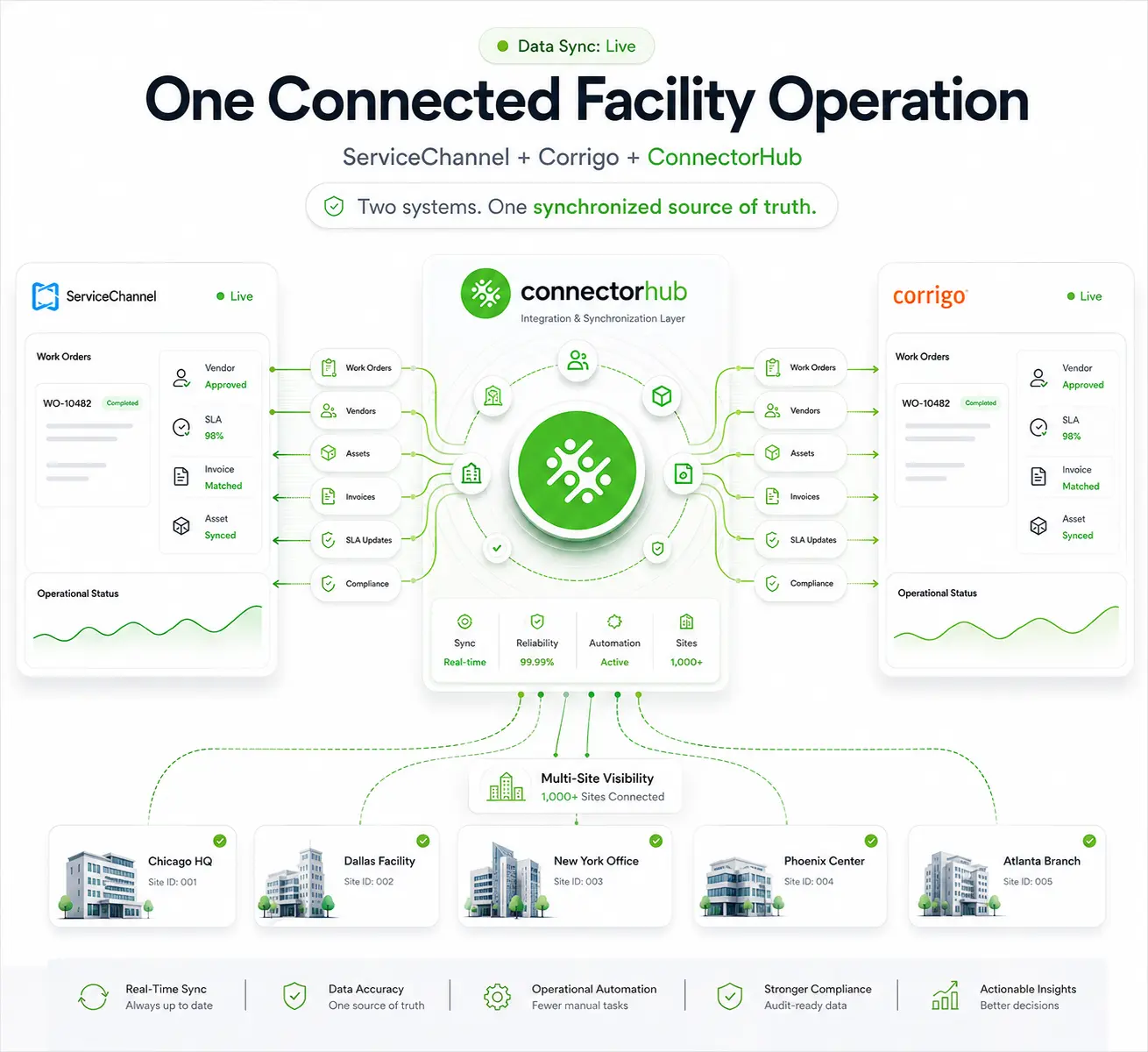
ConnectorHub was built to close this exact gap. Instead of forcing your operations teams to code custom middleware for every SCADA vendor and ERP module they run, we offer pre-built connectors that naturally speak industrial protocols like WITSML, OPC UA, and Modbus, while smoothly connecting with enterprise systems like SAP PM and Maximo.
Real-time field telemetry and historian data translate into business-ready formats instantly, eliminating the tedious, manual cleanup that drains valuable hours from your production accounting and maintenance teams.
That translates into measurable outcomes rather than abstract promises. Operators using ConnectorHub for drilling data integration have seen non-productive time drop by 10 to 20 percent, alongside a 90 percent reduction in manual data preparation.
None of this comes at the expense of governance, which matters given how sensitive operational networks are. Our system lives in a highly secure, actively guarded cloud built around strict SOC 2 and GDPR rules, keeping a transparent log of all data moving between field and office.
When pursuing enterprise level automation across drilling, production, maintenance, and safety compliance, combining tailored templates with strong governance is vital. That is what separates a truly valuable integration platform from a generic tool retrofitted for industrial use. Best of all, most setups go live in two to four weeks, bypassing the months of custom development.
Conclusion
The gap between what a SCADA system knows and what an ERP system acts on isn't a technology problem anymore. The tools to close it, from event-driven middleware to AI-assisted anomaly detection to platforms purpose-built for industrial environments, are mature and proven across upstream, midstream, and downstream operations. What separates operators who benefit from those tools from the ones still reconciling spreadsheets is discipline in how the project gets planned, not just what gets purchased.
Executives evaluating this kind of investment don't need to become integration architects. What they require is a checklist that ensures that discovery, security, and governance are not overlooked due to time pressures, and an implementation partner who can transform that checklist into actual enterprise automation capabilities. These operators no longer respond days after the issue arises; they run their business based on data received on time.