.svg)
Can a system integrator realistically offer integration-as-a-service without spending a year or two, and a serious budget, building a platform from scratch? Yes, and the firms doing it well aren't writing platform code at all. They license the technology and put their energy into delivery instead.
That distinction is becoming the deciding factor in this market. Integration has stopped being a one-time project a system integration consultant wraps up and hands off. Clients now expect their systems to stay connected as their software stack keeps changing, which calls for a scalable integration framework built for ongoing change rather than a single build.
The firms scaling fastest are pairing a no-code integration builder with data mapping automation to deliver integration as a running service, without ever building the underlying platform themselves.
Why Integration Is Becoming an Ongoing Service Requirement?
A decade ago, a typical mid-market client ran just three or four core systems. Today, it’s common to see a CRM, an ERP, field service tools, a finance platform, and a handful of specialized apps, with all expected to share data seamlessly in real time.
Every component that is layered into that stack is an additional point of failure. Updates are pushed out by vendors, APIs alter their schema, and field names change. A perfectly good connection from go-live can break down without anyone noticing during some software release.
This is why integration as a service has become the expectation rather than the exception. Clients think of it the way they think of cloud integration software generally: something that should keep running, get monitored, and get fixed before it causes a downstream problem, not something with a fixed end date.
For consulting firms, this shift is an opportunity. Recurring integration work carries more long-term value than one-time builds, provided the team can deliver it without turning into an internal engineering department.
The Problem with Selling Continuous Integration as a Series of One-Off Projects
Many SI firms still sell integration the way they did a decade ago: scope a project, quote a fixed fee, build a custom connector, hand it off. When the client's environment changes, and it always does, that becomes a brand-new statement of work.
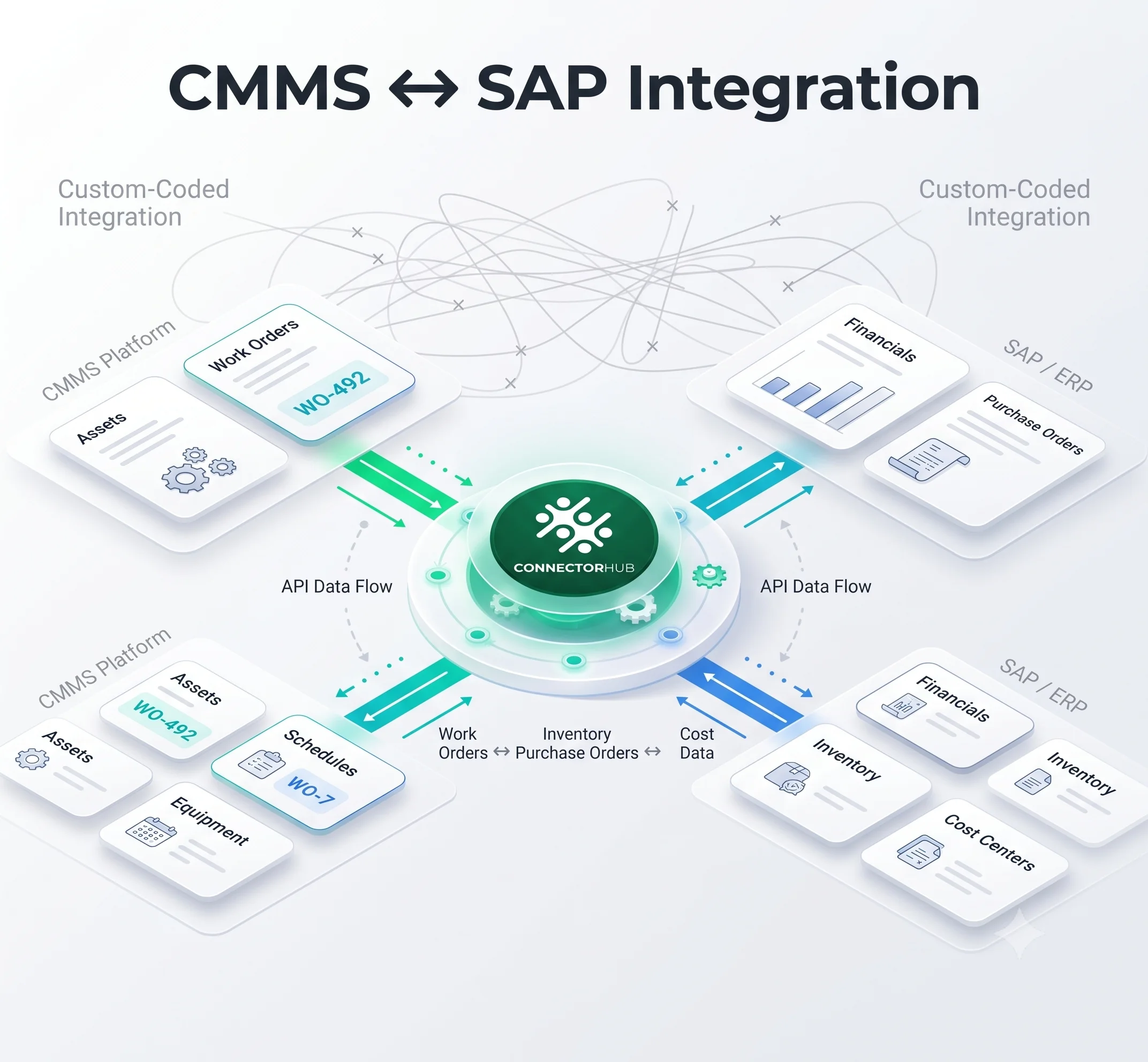
This model has a structural flaw. Each project resets the clock, with no reusable code library, no shared field mappings, and no consistent way to monitor what's already live in production. The difference shows up clearly when you compare the two delivery approaches.
Custom integration work is engineering-heavy, and engineering hours don't scale well. A team that spends 40 hours building a one-off connector for one client can rarely reuse that work for the next, because the code was never designed for reuse. Selling integration project by project puts a hard ceiling on how much recurring revenue a practice can realistically generate.
Why Building Your Own Integration Platform Is Usually the Wrong Expansion Strategy?
Some companies address this challenge by choosing to construct their own integration platform internally. This seems to be the logical progression from the outside because they would have ownership and would not need to rely on any third party for it.
This does not always happen according to plan. Developing an enterprise integration platform with all of the necessary elements such as authentication, scheduling, error management, retries, versions, and security into an enterprise system takes more than a year's worth of engineering effort.
Most consulting firms don't have spare engineering capacity sitting idle, and the people skilled enough to build it are usually the same people billing hours on active engagements.
The hidden cost isn't the building. It's what the build delays. Every month spent developing internal platform infrastructure is a month not spent capturing the recurring integration revenue that platform was meant to generate.
There's also the ongoing cost after launch. A homegrown platform needs patching, monitoring, connector updates whenever a client's software changes its API, and security hardening to satisfy client compliance requirements. None of that generates billable hours. It's overhead competing directly with the client-facing work that actually pays the bills.
The Better Model: Separate the Integration Platform from the Integration Service
The firms scaling integration-as-a-service successfully have made one decision differently. They treat the platform and the service as two separate things.
The platform consists of the underlying technologies: the connectors, the workflow engine, the hosting, and the security. The service consists of everything that a consultant offers to his or her clients: from discovery and design through relationship building and management.
Once you separate those layers, the platform stops being something you need to build. It becomes something you license, the same way you'd license a CRM rather than build one from scratch. A low code automation tool built by a dedicated integration vendor gives consulting teams a visual way to configure connections, without writing and maintaining custom code for every client.
This mirrors how most successful services businesses operate. An accounting firm doesn't build its own accounting software. A marketing agency doesn't build its own analytics platform. They license proven technologies and compete based on knowledge and relationships. Integration as a service follows the same principle: the value lies in the implementation and the services provided, not in the underlying infrastructure.
How Integration-as-a-Service Changes the Economics for System Integrators?
Once integration is delivered through a licensed platform instead of custom code, the economics shift in a consultant's favor.
Configuration work moves faster than development work. A connector that could have taken days to create would be a mere fraction of that when it was already there to begin with. That saving of time is margin straight away.
Reusability compounds the effect over time. A workflow configured for one client's CRM-to-ERP sync becomes a template you can adapt for the next client running similar systems. A consulting practice slowly builds a library of these reusable patterns, turning software integration services into a repeatable offering rather than a series of custom, unrelated projects.
There's also a licensing angle worth understanding. Some integration platforms offer OEM licensing for integrations, letting consulting and technology partners embed the platform under their own brand and resell it as part of their service catalog.
Combined, this transforms integration from a background expense companies quietly absorb into a genuine growth engine: faster execution, healthier margins, and steady recurring revenue that frees you from constantly relying on winning new project work every quarter.
What System Integrators Should Look for in an Integration Platform?
Not every integration platform out there was actually built with a consulting business in mind, and that gap tends to show up fast once you start putting one to real use. A handful of things are worth checking before you commit to any vendor.
Here's what to look for:
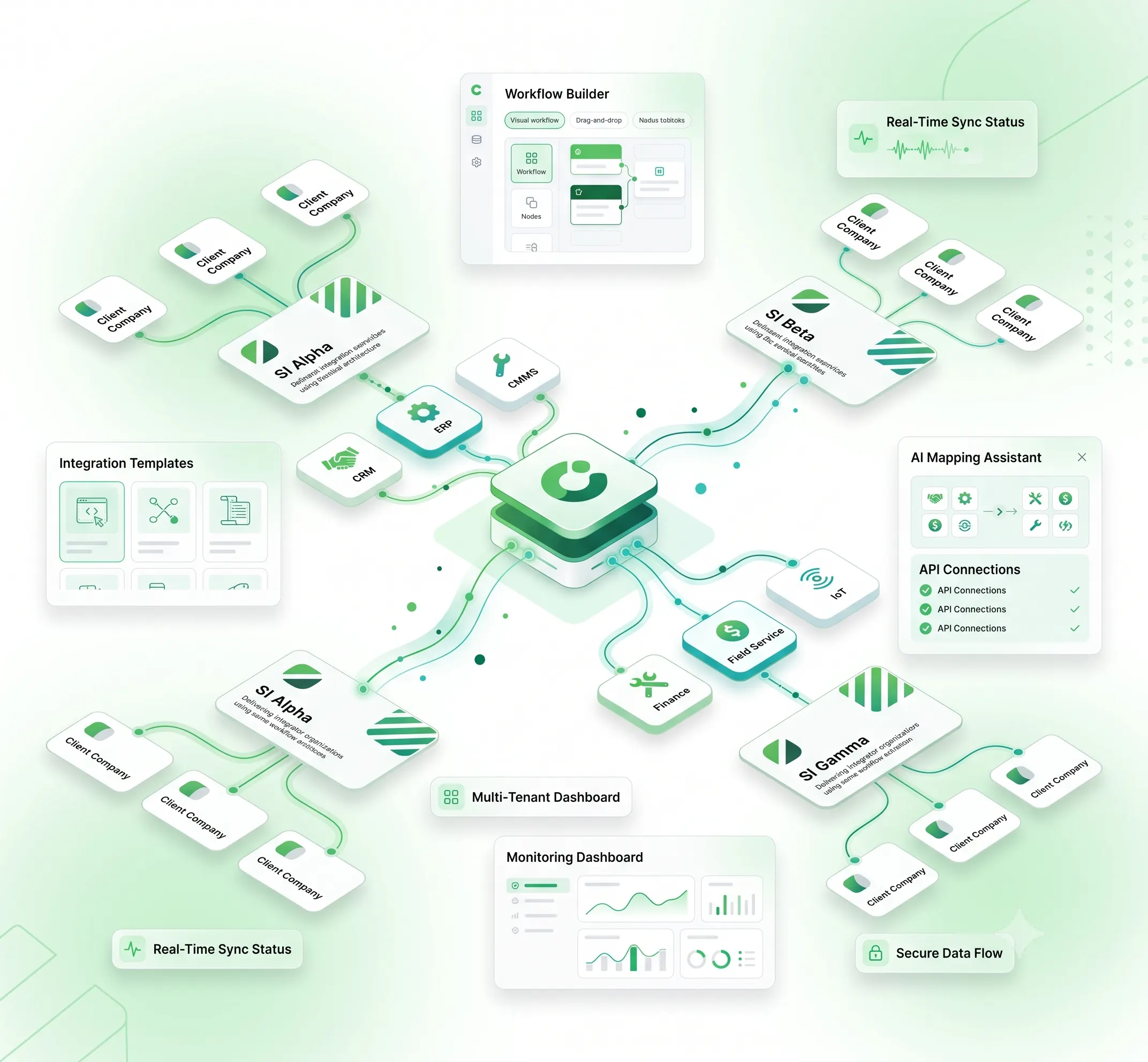
- Multi-tenant architecture that lets you to operate all clients under one account and their data and processes are well segregated from others.
- A visual, no-code or low-code builder so easy to use that you don’t have to rely on a developer every time you want to make changes.
- Prebuilt connectors for whatever your clients actually run day to day, whether that's a CRM, an ERP, a CMMS, or a finance platform.
- Solid security fundamentals, including encryption for integrations both in transit and at rest, role-based access control, and compliance audit logs that hold up against your clients' SOC 2, HIPAA, or GDPR requirements.
- Reusable templates, to ensure you can repurpose a workflow you created once for another similar client rather than building from scratch.
- White-label or branding options, which will allow the platform to remain anonymous and instead showcase your company name to the client.
Most credible platforms can check several of these boxes individually. What matters for a consulting practice is whether the underlying API integration platform was designed with multi-client delivery in mind, rather than retrofitted for it. A tool built for a single enterprise's internal IT team often lacks the tenant isolation and reusable templating a services firm needs.
Before signing a contract, always ask your vendors how they handle multi-tenancy, audit logging, and template reuse. These three questions distinguish platforms built for internal teams from platforms built for delivery partners.
Pointers to Get Right Before Scaling Integration-as-a-Service
Before rolling integration-as-a-service out across the full client base, a few fundamentals are worth getting right early.
- Standardize your delivery process. Document a repeatable discovery-to-launch workflow, so every consultant delivers integrations the same way, regardless of who's running the engagement.
- Create your template library sooner rather than later. Start by taking the three or four client situations that you see the most often and create templates from those.
- Set your pricing strategy. Will the integration be charged as a project, subscription, or some combination of both? Remember, it must be for management as well as development.
- Set clear SLAs. Clients expect uptime and response commitments once integration becomes an ongoing service. Put those commitments in writing early.
- Train the team on the tooling. Consultants need hands-on familiarity with your chosen ipaas solutions, not just a general grasp of integration concepts.
Getting these fundamentals right prevents the most common failure mode in this business model: signing more integration clients than your delivery process can actually support.
Build and Scale Integration-as-a-Service with ConnectorHub
This is where that earlier framework takes shape. For consultants and system integrators, ConnectorHub provides a purpose-built platform to deliver reliable, repeatable integration solutions at scale.
Configuring a connection across CRM, ERP, CMMS, or finance systems shouldn't require a developer on standby. With ConnectorHub, teams work through a visual builder, and AI-assisted field mapping handles most of the tedious matching that used to slow down every implementation. Partners running their delivery through ConnectorHub report cutting integration timelines by roughly 60% and engineering effort by around 40%, numbers pulled from the company's published case studies.
For firms managing multiple client accounts, ConnectorHub allows for tenant-specific roles with template reuse capabilities so that any workflow template made for one client can be used on another with no extra effort. This is because security comes in by default and includes such features as encrypted credentials storage, comprehensive logging, and SOC 2, HIPAA, and GDPR compliance, something which becomes especially important when one has a regulated customer interested in data security.
Also Read: From APIs to Automation: Building End-to-End Connected Business Workflows
Conclusion
Companies are steadily shifting from isolated setup projects toward efficient, continuous operations. Today, your clients expect their systems to remain perfectly synchronized as they grow, change vendors, and implement new technology. This creates a strong growth opportunity for firms ready to provide integration as an ongoing service.
The mistake to avoid is building the underlying technology in-house. Consulting practice doesn't need to become a software vendor to compete here. It needs a reliable platform to license, a repeatable delivery process, and the judgment to configure integrations correctly for each client's environment.