.svg)
When a hospital's finance department pulls equipment spend from SAP and clinical engineering pulls maintenance history from Maximo, the two reports almost never agree.
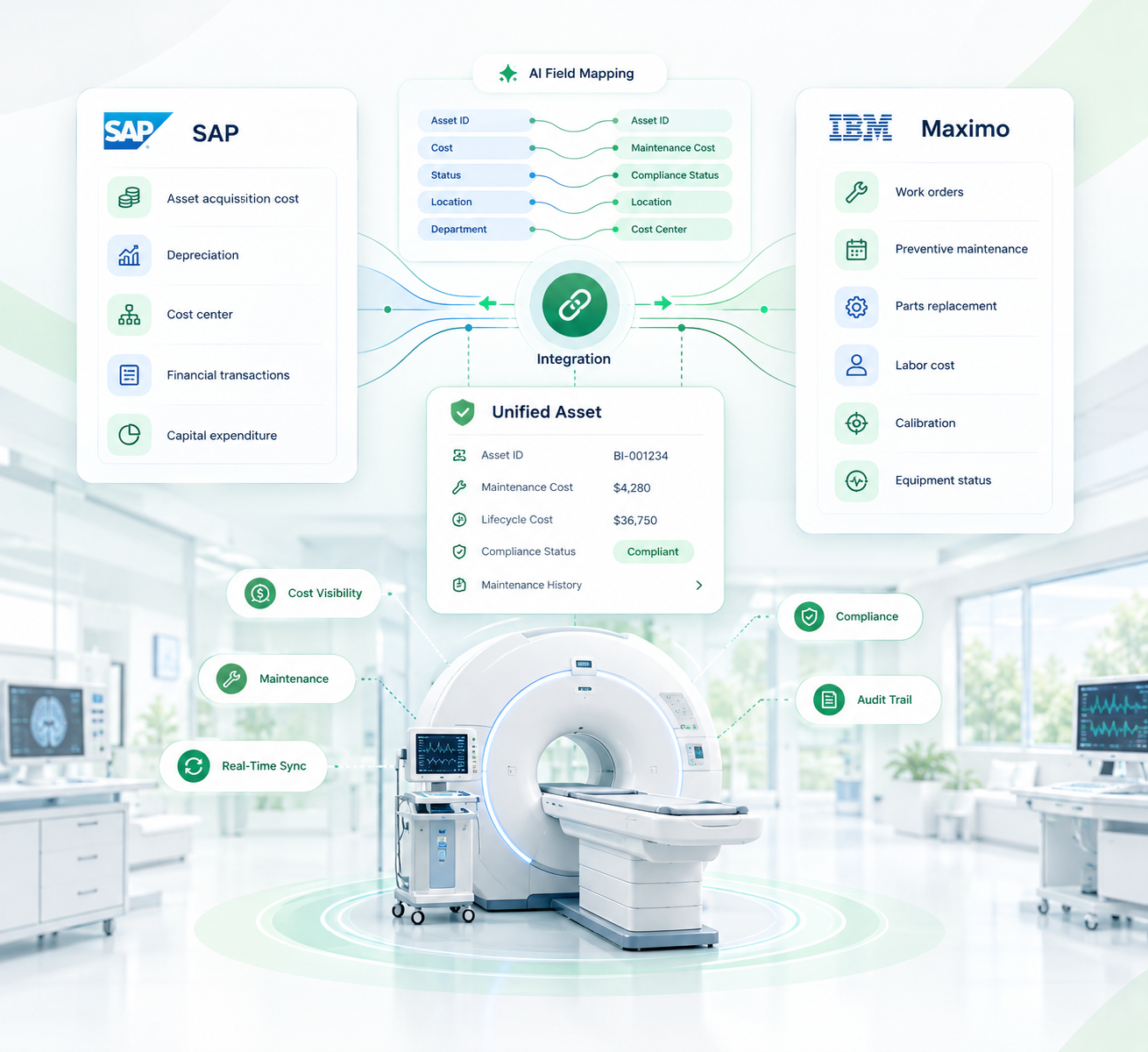
That mismatch comes from running the platforms separately with no dependable bridge between them. The disconnect is structural, not a data hygiene issue. Finance sees acquisition cost, depreciation, and ledger postings for every infusion pump, ventilator, and imaging system — but nothing about whether it was serviced on schedule. Clinical engineering sees every work order and parts replacement but rarely has clean total-cost-of-ownership visibility because labor and parts postings don't always land against the right cost center in SAP. This is an architecture problem, and it's what an integration layer between SAP and Maximo is built to solve.
Closing it is exactly what proper healthcare CMMS ERP integration via a healthcare integration platform accomplishes: linking Maximo work orders, parts, and labor to SAP cost objects and asset records, and giving executives genuine medical equipment tracking integration across a fleet that can run into the tens of thousands of assets.
The Price of Keeping SAP and Maximo Separate
When the two records from SAP and Maximo only get reconciled by hand — usually quarterly or right before a survey — three problems compound at once:
- Budget blind spots. Capital planning prices replacement decisions off SAP acquisition values that ignore real maintenance spend in Maximo.
- Incomplete maintenance pictures. Clinical engineering can't always tell finance which asset classes quietly consume a disproportionate share of the service budget.
- Compliance exposure. When a surveyor asks for one ventilator's full cost and maintenance history, someone has to manually stitch two systems together under time pressure.
Where Cost Visibility Breaks Down Across the Equipment Lifecycle
Cost visibility fails at three points across the equipment lifecycle:
Industry benchmarking gives a sense of scale.
A survey of large hospitals found the average ratio of annual equipment repair cost to original acquisition cost sits around 7.4%. Meanwhile, cost-of-service benchmarking used across biomedical engineering shows manufacturer full-service contracts running 12% to 20% of asset value a year, dropping to 8% to 12% under a shared in-house and vendor model.
Multiply either figure across a mid-size hospital's biomedical fleet and the dollars at stake are not trivial. Yet most finance teams cannot see this ratio at the individual asset level, because Maximo's service cost data and SAP's acquisition data were never designed to talk to each other automatically.
This is where healthcare operations data integration earns its keep.
A properly built API integration doesn't just move a file overnight. It maps Maximo's equipment number to SAP's asset master, keeps depreciation and maintenance spend visible against the same asset ID, and lets both departments work from one record instead of two approximations of it.
Compliance Tracking Failures That Surface Only During Audits
The Joint Commission's EC.02.04.01 standard requires a complete, current inventory of medical equipment with documented inspection, testing, and maintenance — and accredited organizations are expected to complete essentially all scheduled PM.
Many FDA-regulated devices also carry calibration records built on 21 CFR Part 11 principles — audit trails, access controls, electronic signatures — and biomedical teams increasingly model their own record-keeping on that standard even where it doesn't strictly apply, because surveyors now expect timestamped, technician-attributed documentation.
Three failure points recur during audits:
- PM and calibration records that live outside SAP — Maximo holds history, SAP holds budget, and matching them for one asset means exporting two reports by hand.
- Documentation split across regulatory frameworks — Joint Commission, CMS, and FDA requirements each want slightly different evidence, so teams rebuild the same report three ways.
- Broken audit trails — when a work order closes in Maximo but the matching SAP posting lands on a different date, under a different reference number, or not at all.
Reactive repairs also cost more in emergency labor, expedited parts, and downtime than the same work done on schedule, making siloed data expensive twice: once in the audit finding, once in the repair bill. A cloud integration layer that keeps the two systems synchronized removes the manual export-and-match step, turning real-time compliance reporting into something a compliance officer can pull on demand.
Integration Patterns That Create a Unified View
Three patterns hold up in production.
First, bidirectional sync of core objects: asset master data flows from SAP into Maximo so a newly capitalized ventilator carries one identifier across both systems, while work orders and their cost objects flow back so spend posts to the right budget line. IBM's Maximo Enterprise Adapter supports this via RFCs or web services, and S/4HANA Cloud now exposes purpose-built CDS interface views as a more governed alternative to old batch transfers.
Second, near-real-time posting — because downtime on a life-support device isn't something finance can wait for a nightly batch job to surface. Labor, parts cost, and downtime should reach SAP within minutes of a work order closing.
Third, automated capture of compliance evidence, often bolted on last but shouldn't be. Every PM, calibration, and corrective action in Maximo should link back to the SAP transaction it generated, so one query returns both the maintenance record an auditor wants and the cost record finance wants.
This is what hospital asset management integration looks like in practice: several categories of data moving on different cadences — some real-time, some batch — all mapped to the same asset identifiers, maintained as ongoing enterprise automation rather than a one-time project.
Practical Data Flows for Faster Decisions
- Work order to cost posting. A technician closes an MRI coil replacement in Maximo; within minutes, labor and parts cost post to the correct SAP cost center, so finance sees the real cost same-day instead of at month-end.
- Capital prioritization by criticality and spend. With utilization, failure frequency, and repair spend visible against one asset record, planning committees can rank replacements by actual risk and cost rather than age alone.
- Audit-ready reporting on demand. A linked data model lets a compliance officer generate one report — by asset, department, or facility — that already ties maintenance evidence to its financial trail, instead of reconciling two exports by hand.
This is what compliance automation in healthcare IT delivers: evidence that assembles itself continuously instead of getting reconstructed under deadline pressure. Many hospitals get there using ipaas solutions purpose-built for healthcare data rather than a general file-transfer tool retrofitted for a regulated environment.
Technical and Operational Considerations
Reliability is less about the initial build than what happens after go-live.
- Master data needs ongoing ownership. Equipment numbers, cost centers, and location hierarchies drift as hospitals add facilities or upgrade SAP; without a defined update process, integration accuracy degrades quietly until a report stops reconciling.
- Error handling has to be visible, not silent. A failed IDoc or rejected web service call should trigger an alert with a clear retry path — not sit in a log nobody checks. Near-real-time updates raise the stakes, since even a few hours of backup can leave cost and compliance data out of sync exactly when an auditor samples it.
- Security and governance go beyond encryption in transit. Access controls need to reflect who can see cost data, close work orders, or modify calibration records, with every change logged to regulatory retention standards. Generic healthcare IT systems integration tools not built around HIPAA, GDPR, or HITRUST tend to fall short here.
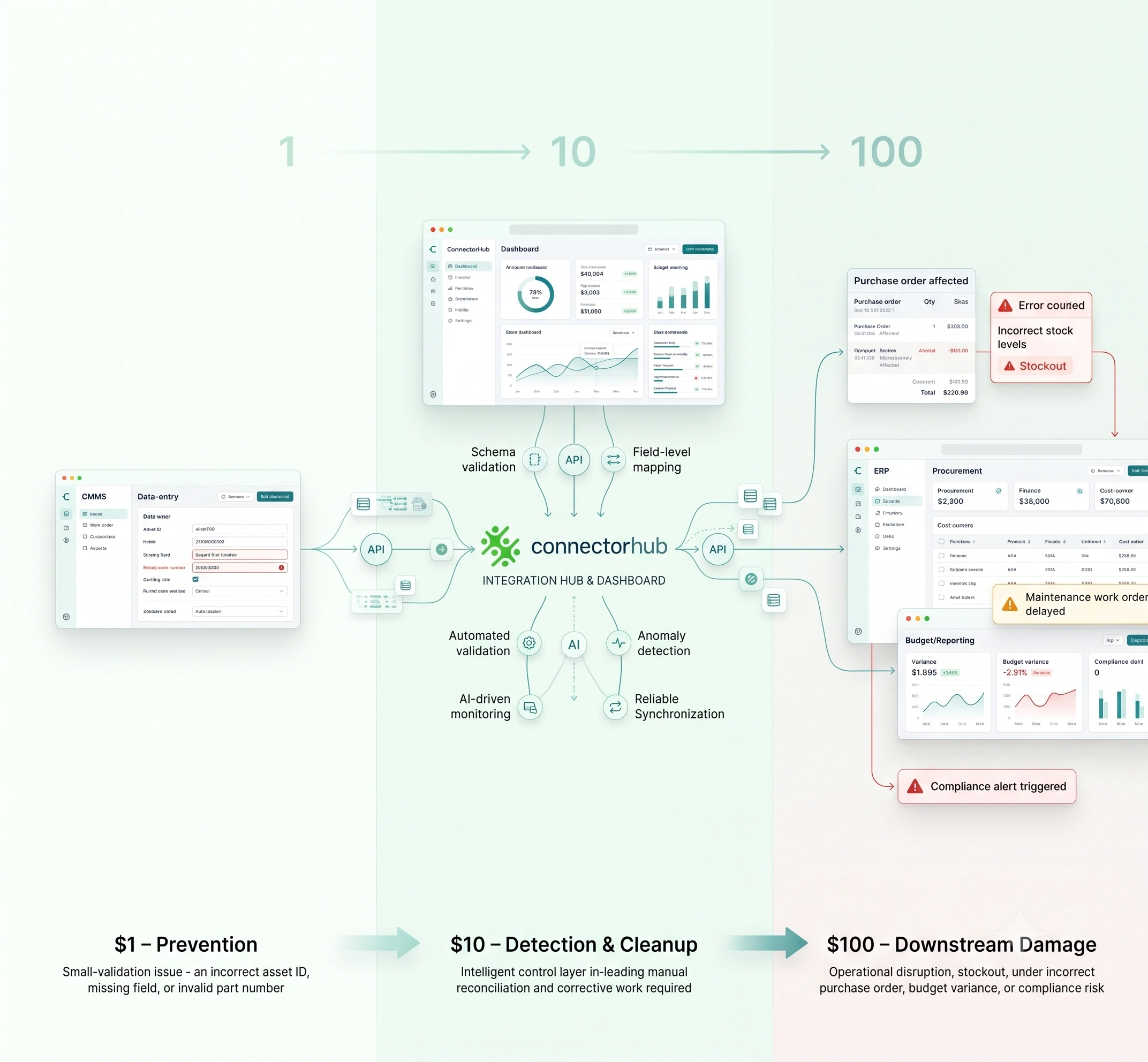
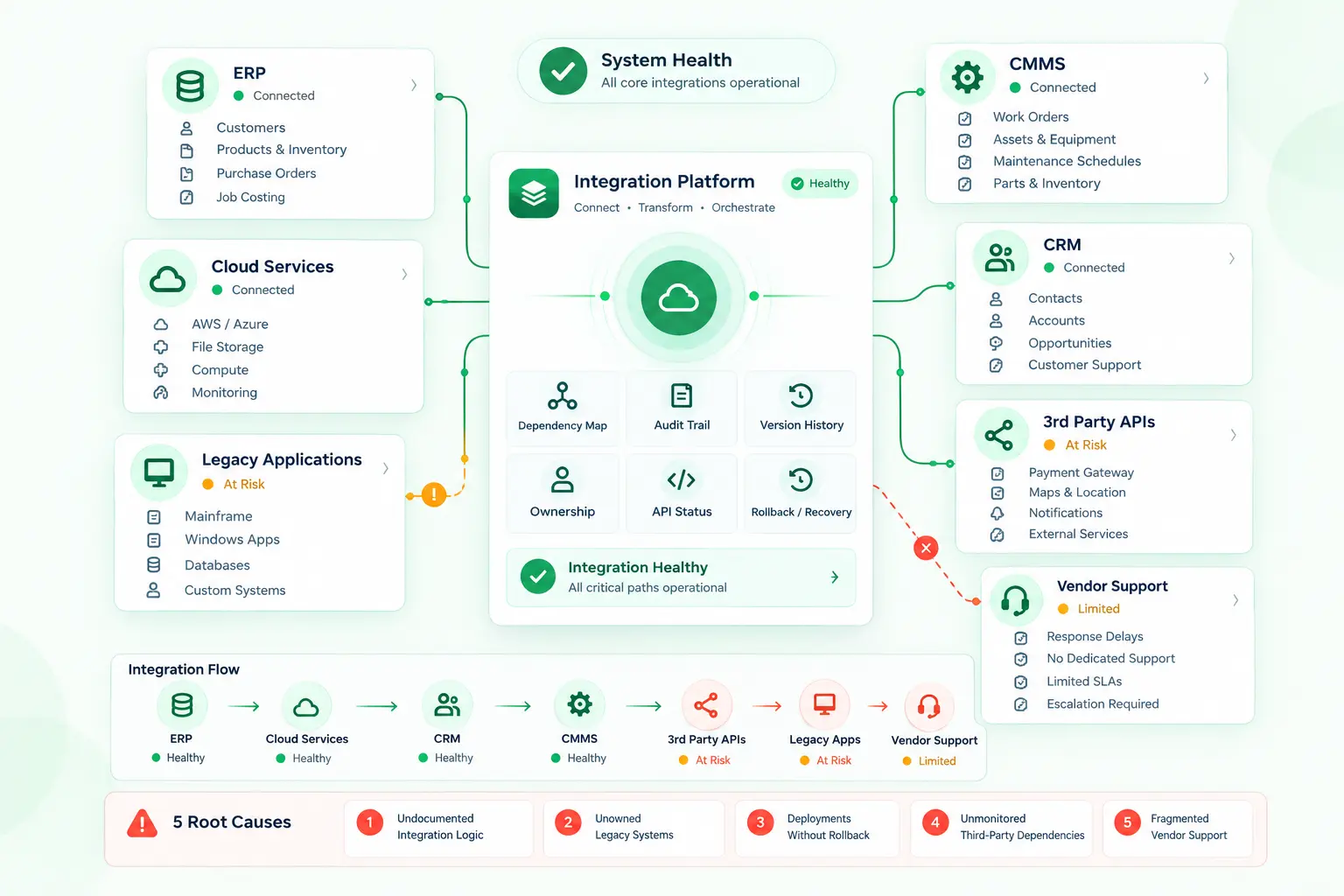
Point-to-point custom middleware is the most common pitfall. A script that moves data from Maximo to SAP works fine for a year — then its author leaves, SAP gets upgraded, and nobody knows why records are dropping. It usually looked like the fastest option at the time, which is exactly why it's so common. Application integration solutions built for reuse, with documented mappings and monitoring, hold up far better over a five- or ten-year lifecycle than code that depends on institutional memory.
How ConnectorHub Enables Synchronized Tracking
This is the exact problem ConnectorHub was built to solve for hospitals running SAP alongside a CMMS like IBM Maximo. Instead of a blank-slate integration project, it works from pre-built connector templates — including ServiceNow-SAP, Oracle ERP-CMMS, and EMR-to-compliance-dashboard patterns — with AI-assisted field mapping, since most of the effort in these projects is mapping and testing fields and status codes, not writing code.
On governance, ConnectorHub's healthcare deployments run under SOC 2, HIPAA, and GDPR-aligned controls, with encrypted data flow and full audit logging built into every connector, plus a live performance dashboard with SLA alerts for ongoing monitoring.
None of this replaces clinical engineering or finance leadership's judgment — it removes the manual reconciliation that keeps both teams from trusting the same number, turning a two-system, two-spreadsheet process into one automated business process both sides can rely on.
Conclusion
SAP and Maximo do different jobs, and neither gives hospital executives the full picture alone. The organizations that close this gap aren't necessarily the ones with the biggest IT budgets — they're the ones that treat cost and compliance tracking as one problem, connect the systems holding each half of the answer, and keep that connection maintained as both platforms evolve by SAP And Maximo Integration. For leaders weighing whether to fix this now or wait for the next audit, the cheaper path is almost always the one taken before the surveyor shows up.