.svg)
Supported by statistics, the global PropTech market turned to $40.19 billion in 2025. If we skip ahead, the industry is projected to increase from $44.59 billion in 2026 to $104.57 billion in 2034. Growth like that, around 11.9% each year, shows what happens when tech reshapes real estate tasks.
Faster use of property technology pushes companies to rethink how they manage a swelling collection of digital systems, tools for managing buildings, tracking money, organizing client details, pulling market numbers, studying trends, among others.
Though helpful, juggling so many pieces stretches teams thin, testing their ability to stay organized without slipping up. Information often gets stuck in isolated spots, split across different systems. Traditional tools often get called out for creating information hold-ups that protect market share but slow down collaboration.
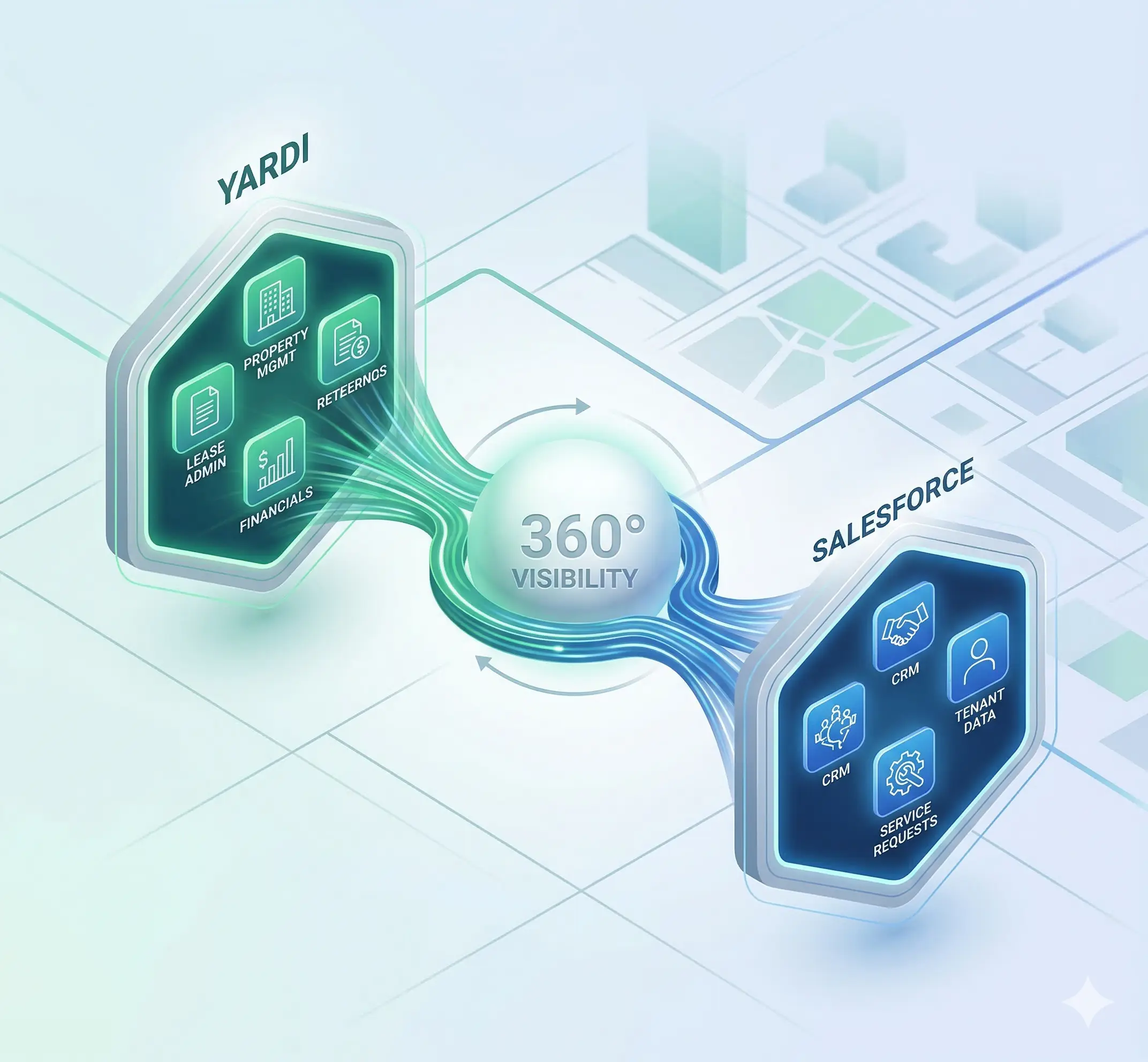
This is where automated integration platforms pick up pace to set up high yielding real estate workflows. At the core of this shift is Yardi Salesforce integration, which merges Yardi's comprehensive property management tools with Salesforce's CRM prowess to exchange vital information like prospects, tenants, properties, and financials automatically and instantly.
At ConnectorHub, we specialize in no-code solutions to make these connections effortless, allowing you to enhance the overall productivity of your real estate operations.
Role of Yardi and Salesforce in Lease Management Lifecycle
Yardi is one of the leading property management software programs, with solutions such as Yardi Voyager for enterprise-level accounting and operations, Yardi Breeze for smaller operations, and Yardi Elevate for advanced analytics. Lease administration, rent collection, financials, and reporting are done efficiently by the software.
Salesforce is an advanced CRM platform that manages customer relationships, lead, tenant data, service requests, and communications. It empowers teams to foster stronger connections and automate interactions.
The usage of both the systems together lays out the groundwork for a successful technology framework that unites back, middle and front-office functions in the real estate industry.
Need for PropTech ERP–CRM Integration in Today’s Market
Core property management systems, which are typically an ERP solution, will have functionalities around managing the finances, leasing, and property-related activities, while the CRM solution will handle activities around prospects, leasing pipelines, and customers. When these systems operate in silos, firms face data fragmentation that leads to several shortcomings.
Leasing teams often find themselves working with old or incomplete info, while finance and operations have little clue what’s happening in the pipeline or what tenants are thinking.
That gap slows everything down, decisions drag, tenant experiences feel inconsistent, and the whole operation gets less efficient. As companies grow, those problems start costing real money.
When systems link through ERP–CRM integration, information moves fast, almost instantly between platforms. Data like property details, tenants, leases, and finances travel smoothly from ERP into CRM, while prospect activity, deal stages, and customer interactions enrich operational and financial workflows.
That kind of connected up-to-date data is becoming essential. The industry is leaning hard into automation, and AI-driven analytics and none of that works well without clean, linked information across the board.
Key Benefits of Yardi Salesforce Integration
Integrating Yardi and Salesforce offers substantial advantages for real estate professionals.
Collectively, these benefits align with industry trends showing that integrated PropTech platforms improve operational productivity and tenant retention.
Exploring Methods for Property Management Integration
The process of Property Management Integration between Yardi and Salesforce can contain a variety of techniques, each applicable to specific purposes. Based on existing practices, let’s explore the major ones:
- ETL (Extract, Transform, Load) is solid for handling big batches of data. You pull it from Yardi’s nightly backups, tweak it so it fits Salesforce properly, then load it in. It’s cost-effective and dependable for scheduled syncs, perfect for reports or moving historical data but it won’t give you real-time updates.
- API-based integration gives you speed and two-way flow. With tools like integration middleware (ConnectorHub is a good example), data moves instantly in both directions. Change a lease in Yardi, and it appears right away in Salesforce. Yardi’s integration of APIs come with some restrictions, so you have to plan around them. This approach really pays off when you need instant updates, like during tenant onboarding.
- Robotic Process Automation (RPA) steps in when APIs aren't enough. Bots basically imitate a person, navigating Yardi’s interface to grab or send data. It works well for older systems or specific tasks like processing invoices, but it can struggle with very large volumes.
- No-code platforms make everything simpler and faster. You just drag and drop to set up the connection, no coding at all, which gets you live much quicker.
Which one you pick depends on how much data you’re moving, how urgently you need it fresh, and what kind of tech support you have available, ensuring a tailored property management integration. The right fit makes the whole integration work smoothly for your team.
Handling the Key Challenges in Yardi-Salesforce Integration
Integrating Yardi with Salesforce or other PropTech tools comes with some real hurdles that can mess up your operations if you don't handle them.
Challenge 1: Yardi's pretty closed-off system means you often can't get direct access. You're stuck with approved options like periodic backups or limited APIs, which makes real-time syncing tough. The result? Data gets outdated fast, and decisions slow down.
Challenge 2: Then there's the headache of data mapping. Data mapping is also another challenge that one faces while working with Yardi, especially when it has very detailed fields related to properties, but these properties do not easily map with Salesforce’s CRM by default.
Challenge 3: Privacy and compliance are non-negotiable, and with the information you get from your tenants, security is a requirement, not a choice.
Challenge 4: Portfolio growth may be obstructed by scalability issues. For example, with a growing portfolio, more transactions would be generated, and an integration is expected to scale up in volume without crashing. If this cannot be achieved, then it becomes a bottleneck issue leading to cost increase.
Challenge 5: Finally, a lack of technical know-how can drag projects out or derail them completely, racking up extra expenses.
The good news? You can avoid most of these problems by working with experienced partners, leaning on no-code tools where possible, and rolling things out step by step.
Step-by-Step Guide to Implementing Yardi Salesforce Integration
Implementation of the Yardi Salesforce integration solution necessitates a structured approach. This is a comprehensive guide to the process and considerations involved in Yardi Salesforce integration.
1. Kick off by nailing down what you actually want to achieve
Don’t jump into code or APIs yet. Determine whether you're seeking to speed up lease-to-cash, get a better view of renewals, remove manual reconciliations, or improve reporting. Then, pinpoint the critical data, leads, leases, tenants, and payments, and ascertain whether they need to flow one way or need to sync in real time.
2. Really understand how your Yardi and Salesforce setups are structured
Every organization is different. Map out how properties, leases, and tenants exist in Yardi and how they need to show up in Salesforce. This is where you’ll spot gaps, like missing fields, weird naming, or permission problems, that can quietly sabotage the whole thing if ignored.
3. Pick the integration approach that fits your situation
No single approach works for every organization.
- ETL is great for bulk data and reporting
- APIs handle real-time updates for leasing and tenants
- RPA can bridge gaps where APIs aren’t available
- No-code platforms reduce complexity and time to value
The right choice for an integration method depends on how fast your teams need updates and how much technical overhead you can support.
4. Set up Salesforce as your main daily hub
Most teams live in Salesforce day-to-day, so make it the reliable front office. Create a dedicated integration user, turn on API access, and build out custom objects or fields that match Yardi data properly. That way, leasing and operations people get accurate, current info without switching apps.
5. Make sure Yardi data access is rock-solid
Set up a dependable way to pull data from Yardi, whether through backups, approved queries, or ETL tools. Reliability here is everything. Spotty or incomplete feeds kill trust and make people avoid using the integration.
6. Map data accurately
This is where integration quality is decided. Align Yardi primary keys with Salesforce external IDs so records update correctly instead of duplicating. Define validation rules early to protect data integrity as information flows between systems.
7. Build, test, and stress the integration
Connect the systems and test with real scenarios, such as new leases, renewals, tenant changes, and payment updates. Early testing surfaces edge cases that only appear in real operations, not sample data.
8. Automate how data actually moves
Set things up so updates flow automatically, no manual copying or re-keying. Whether it’s scheduled jobs or event-triggered syncs, automation keeps everyone working with fresh data and cuts down on mistakes and busywork
9. Go live carefully, with eyes wide open
Don’t push to production until everything’s been tested end-to-end. In the first few weeks, keep a close watch on performance, logs, and any errors so you can catch and fix issues fast.
10. Treat integration as a living system
As your portfolio grows or processes change, revisit the setup. Update data mappings, add new flows, and expand reporting over time so it stays useful and keeps delivering better results.
When done right, a solid Yardi-Salesforce integration makes a real difference day to day. The lead-to-lease process speeds up, prospect info from Yardi can instantly create or update leads in Salesforce. You get sharper visibility into trends like occupancy or revenue potential through better property portfolio analytics.
Automation further simplifies routine tasks. For example, lease management automation handles automated lease renewals, reminders, and compliance checks, saving time and reducing slip-ups. Teams can manage deals and pipelines right in Salesforce while investment data stays in sync with Yardi, giving everyone clearer oversight across the business.
Build a Trusted Data Pipeline for Real Estate Operations With ConnectorHub
ConnectorHub makes Yardi–Salesforce integration straightforward. It offers ready-made, no-code connectors built exactly for property management. You get smooth syncing of tenant details, leases, and financials, so leasing, operations, and finance teams stay on the same page, no messy development required.
It handles bidirectional, real-time updates: new leases, renewals, tenant changes, and payment statuses stay consistent across both systems. Automated workflows take care of onboarding tenants, updating leases, triggering billing, and generating reports. Plus, built-in audit logs give you clear traceability for compliance and oversight.
Compared to building a custom integration, which can drag on for months and need constant upkeep. ConnectorHub gets you up and running in 2–4 weeks with a simple drag-and-drop setup.
Real estate companies using it see up to 30% faster processes, way less manual data entry, and solid ROI within 3–6 months. They also save more than $50K a year on integration and day-to-day overhead.
Conclusion
Yardi–Salesforce integration is a catalyst for operational excellence and true 360-degree visibility for property managers and asset owners. Through PropTech ERP–CRM integration, firms streamline leasing and finance workflows, unlock actionable analytics, and deliver more consistent tenant experiences.
Whether you go with ETL, APIs, or no-code PropTech integrations, the direction is clear: cut through complexity. When it starts feeling overwhelming, ConnectorHub clears the path for faster rollout, less risk, and room to grow.
Ready to integrate? Contact us and take the next step toward the future of real estate operations.