.svg)

More often than realized, service provider technicians in the field routinely open mobile work orders that lack any service history or past repair details for the equipment they are facing.
At the same time, dispatchers and inventory staff are forced into manual searches, digging through email threads and checking whiteboards just to figure out where the replacement parts are currently stocked. It’s chaotic, stressful, and unfortunately, it's a daily reality for a lot of service teams struggling with proper building maintenance integration.
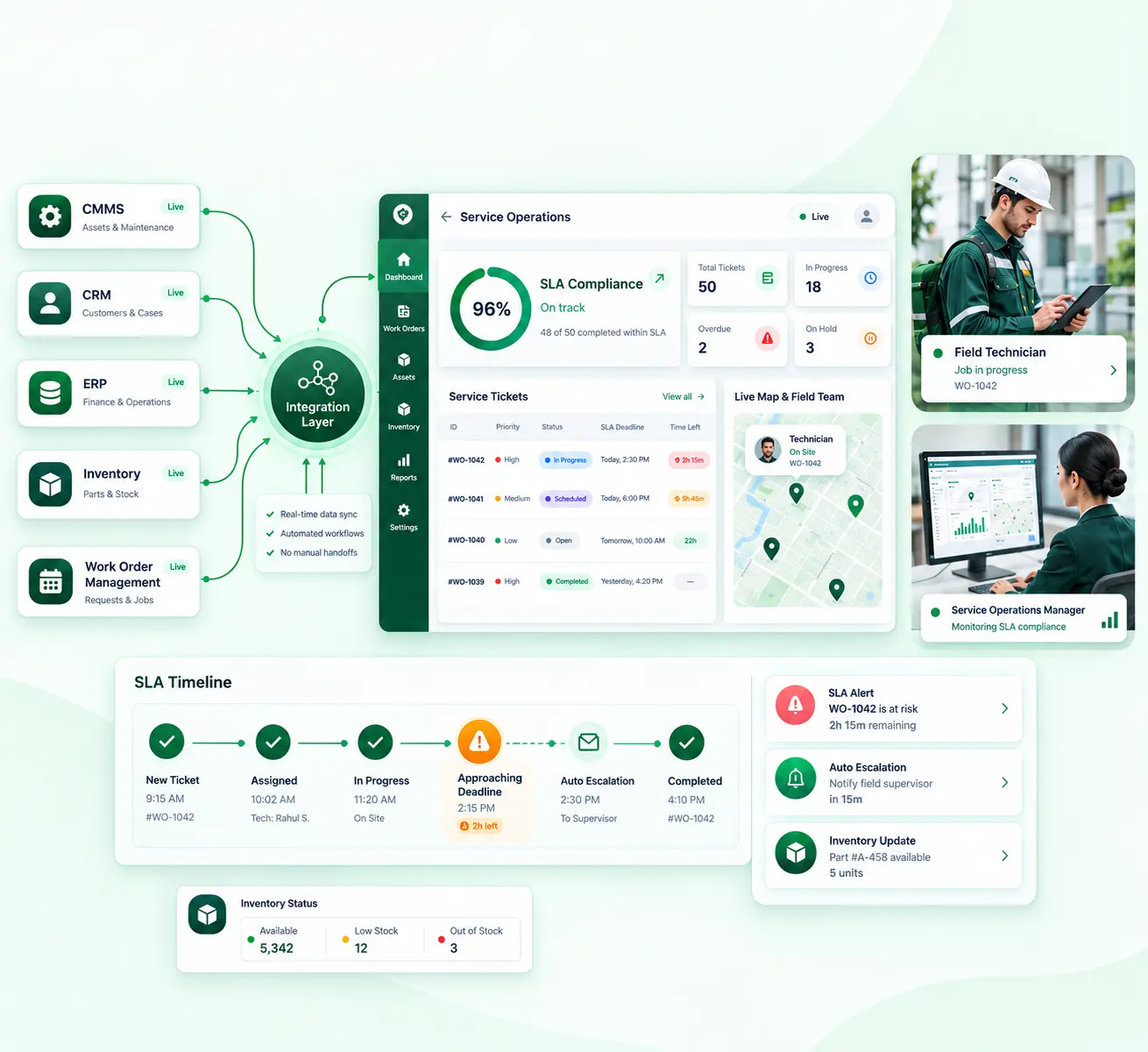
Without ERP-CMMS-CRM integration, commercial service and maintenance teams operate with fragmented data that creates daily friction across the board. More importantly, this data disconnect is quietly eating away at your profit margins.
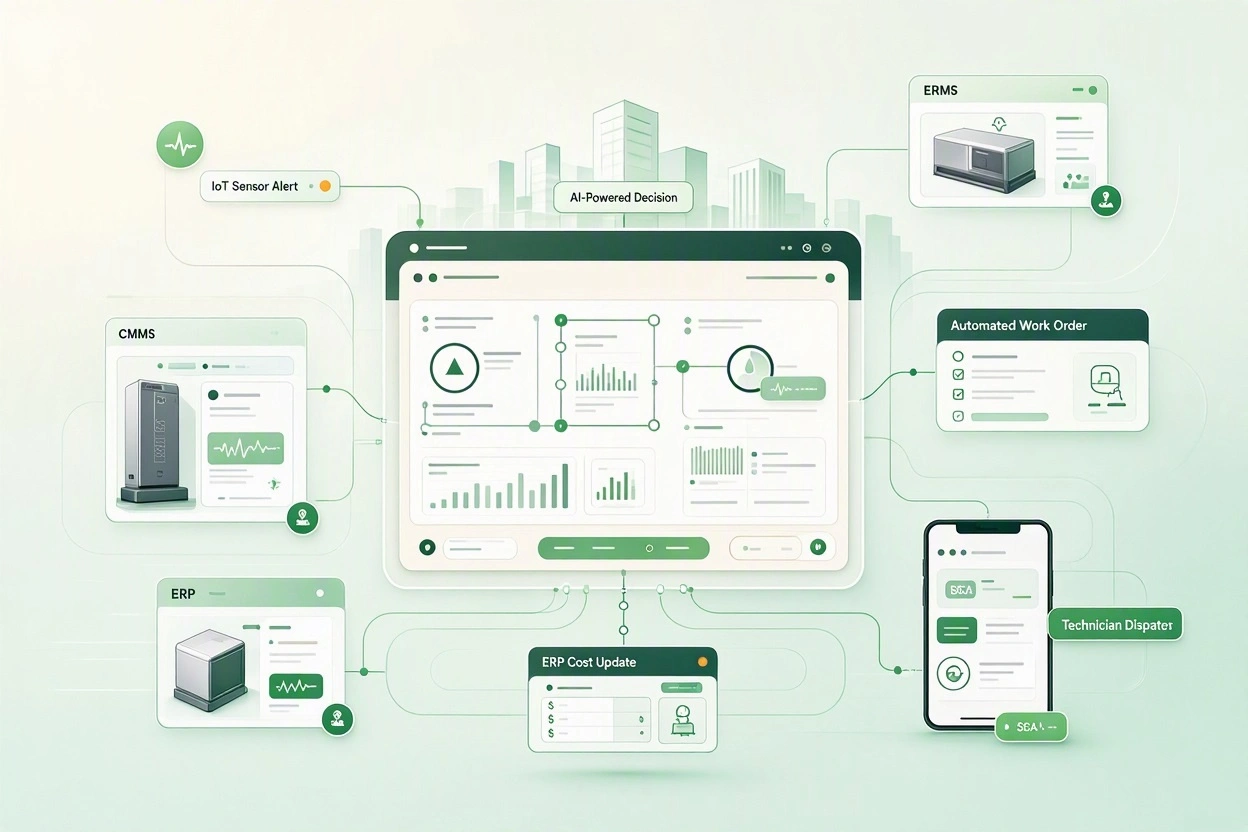
This is where no-code field operations automation steps in. It bridges your CMMS, ERP, and CRM so your teams work from a single source of truth. Technicians see complete asset history on their mobiles, dispatchers know exactly what parts are available, and the daily struggle finally disappears, operations becoming faster and more accurate, directly translating into strong ROI through reduced costs, minimized downtime, and improved profitability.
Delving into ROI Expectations of Field Work Automation for Service Providers
Return on investment in this sector is not just a corporate buzzword reserved for quarterly board meetings. It is the absolute lifeblood of your service margins, daily operational survival, and long-term scalability. Without a crystal-clear view of your financial returns, you are flying blind in an incredibly unforgiving market.
For instance, a study on modernizing service operations and how they delivered profound financial benefits to the bottom line had researchers track a staggering $42.65 million in operational benefits over a three-year period. That translates directly to a massive 346% return on investment for the businesses involved.
Even better, businesses typically see a return on these software investments in under six months. Once you automate those core workflows, the improvements to your daily operations are immediate.
When your technician arrives on site equipped with the right parts, the exact asset history, and the correct billing data, the customer notices immediately. According to a recent state of service survey, 86% of decision-makers firmly believe field service is critical to scaling their business. Furthermore, 84% see major, measurable returns from their field software investments.
Overall financial performance relies entirely on knowing your exact operational numbers. You must track your first-time fix rates, eliminate unnecessary truck rolls, and drastically cut administrative overhead. Taking a definitive stance on tracking these metrics is the exact architecture that works best for protecting your bottom line.
What Makes Your Field Operations Inefficient & What Can You Do?
Inefficient operations bleed your revenue silently every single day without you noticing.
Common leaks include:
- Technicians making unnecessary trips back to the warehouse for missing parts or information.
- Dispatchers and back-office teams spending hours manually searching emails, whiteboards, or spreadsheets.
- Repeated data entry between field apps and accounting/ERP systems, which introduces errors and delays billing.
These issues waste valuable billable hours, increase overtime and fuel expenses, and reduce overall technician productivity.
Key improvements include:
- Optimized routing and dispatching: Dispatchers can instantly assign the closest, most qualified technician with the right tools and parts of information, cutting wasteful transit time.
- Mobile access to complete asset history: Technicians view full-service records, past repairs, and inventory levels directly on their devices, reducing guesswork and repeat visits.
- Automated workflows and data sync: Field data flows automatically to accounting for faster, more accurate invoicing and revenue recognition.
- Real-time visibility: No more manual reconciliation, everything updates instantly across systems.
When your software architecture is perfectly aligned using service pros integrations, service deployments happen rapidly and predictably. Consequently, your central systems talk to your field mobile devices instantly via proper digital alignment and smooth facility data synchronization. In turn, service teams shift from reactive chaos to predictable, efficient performance, directly supporting the ROI of automating field work.
Cost Savings Service Providers Need to Capture First
First, you must aggressively tackle the direct cost savings that are hiding in plain sight within your current workflows. Manual ticketing and paper-based tracking are severe, unnecessary financial drains on your business.
By deploying service ticket automation alongside intelligent maintenance scheduling automation, you immediately eliminate the manual process of routing, scheduling, and invoicing. It reduces the unnecessary paperwork involved, allowing your current back-office staff to manage a growing customer base without needing to hire additional help.
Look closely at the dramatic reduction in unnecessary overtime pay when daily technician schedules are intelligently optimized. Review the sharp, undeniable drop in fuel costs resulting from smart, automated vehicle routing.
The immediate areas to be focused on for cost reduction include:
- Moving away from paperwork orders and manual dispatching.
- Reducing preventable overtime expenses.
- Saving on fuel costs with better route planning.
- Scaling service volume without increasing administrative headcount.
ConnectorHub fixes this at the source with native no-code integrations between your field tools, CMMS, ERP, and accounting systems. Using our embedded integration capability, field updates flow automatically into the back office, cutting out redundant administrative work, and ensuring your technicians have the context they need for a successful service call.
Productivity Gains That Follow for Faster Revenue
After the operational leaks have been identified and fixed through appropriate integration and automation, baseline productivity rises significantly. The technicians do not need to spend extra time searching for information or performing administrative activities, thus being able to perform more repair services each day.
Some of the main contributors to improved productivity will be:
- Ability to obtain information about all the past repairs and related documentation while working directly from the mobile device, improving the chances to fix the issue during the first visit.
- Scheduling and dispatching processes improved to eliminate manual processes causing delay.
- Elimination of manual data entry and paperwork through real-time synchronization.
With real-time service reporting available on mobile phones, technicians experience less daily frustration and adopt the tools faster because the system genuinely simplifies their work. Strong adoption ensures the productivity gains stick and translate into consistent performance.
Ultimate Returns on Digitizing Field Operations
The ultimate return on technology is about bulletproof client retention. A happy commercial customer renews their annual service contract without a second thought.
When you consistently reduce SLA violations in field service, clients begin to trust you without second guessing, because you show up when you say you will and deliver what you promise. Over time, that reliability becomes something clients depend on, not just expectation.
The connection between smooth backend operations and front-end customer satisfaction is undeniable. When you establish a flawless CMMS and CRM workflow, your digital infrastructure handles the heavy lifting of advanced workflow routing, your team can focus entirely on relationship building and service quality. The customer experience is always the direct, visible beneficiary of this operational upgrade.
By fully embracing enterprise automation, your clients get significantly faster service, perfectly accurate invoices, and zero operational excuses.
Implementation Costs, Timelines and Integration Factor That Accelerates ROI
Let’s talk frankly about the realities of modern implementation costs and timelines. Traditional software deployments used to take years to finish and cost a fortune in external consulting fees, custom coding, and complex integrations. That is no longer an acceptable standard in the fast-paced B2B service landscape.
Modern API orchestration tools are designed for rapid configuration rather than endless, custom coding cycles. Fast, automated operational data processing means you get your initial financial investment back swiftly. You do not have to wait years to see your profit margins meaningfully improve.
The underlying economics of connected platforms are clear, undeniable, and highly profitable. You need software tools that connect instantly without requiring a massive team of expensive, full-time backend developers. This is exactly where no-code integration for service providers changes the financial game entirely.
Key implementation cost factors to consider include:
- Subscription fees and per-user licensing costs
- Implementation and configuration services
- Training time for administrative staff and field technicians
- Mobile device requirements and data plans
- Integration costs with existing business systems
- Ongoing support and maintenance expenses
- Customization and workflow modification costs
Connected platforms remove the need for large teams of expensive backend developers. ConnectorHub enables instant connections with your existing OSS/BSS, accounting, and other business systems, enhancing data flow in real time. As a result, ConnectorHub’s unified approach lets you cut technical implementation timelines to a fraction of the industry average, letting you hit your targeted ROI metrics several quarters ahead of your original schedule.
How to Create a Strong ROI Business Case with ConnectorHub’s Smart Integrations?
Creating an effective business case that will win approval from management requires hard data instead of mere assurances about improved efficiency. Management expects you to give them realistic projections based on your present situation.
To begin, set up metrics that reflect your real performance prior to implementing ConnectorHub. Write down your performance levels in various critical factors such as jobs per tech per day, first pass fix, scheduling and dispatch time, cost of fuel and days for payment.
Employ conservative figures to enhance credibility. The average field service organization sees productivity improvements of 15-25%, cost savings of 10-20%, and revenue increases of 5-10% in the first year.
Divide the projected ROI into timelines: short-term ROI is seen in weeks via reduction in administrative time and improved scheduling, mid-term ROI comes between 2 and 3 months from route optimization and improved efficiency among technicians, while long-term ROI can be seen in 6 to 12 months' time.
The source of return on investment differs in each industry. The HVAC and plumbing industries get more out of improved response times and the ability to handle seasonal demands. Organizations engaged in facilities management are able to gain from preventive scheduling and managing multiple locations. Installation and equipment rental firms will get more return on investment from efficient asset tracking and utilization.
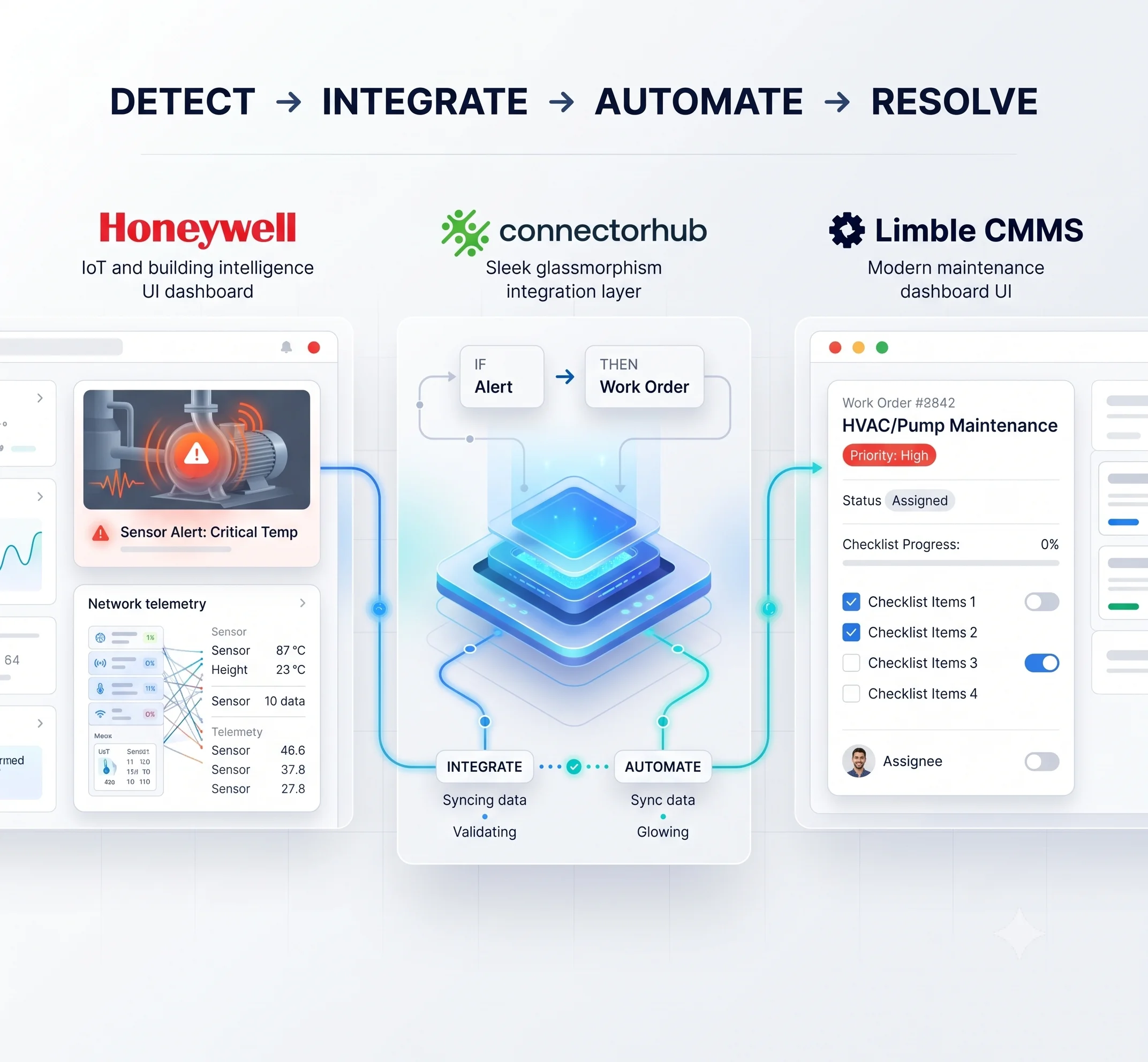
ConnectorHub automates data exchange between your mobile and desktop processes by providing secure integration to connect CMMS and ERP systems in real-time.
ConnectorHub makes it easy for businesses that use SAP and eMaint to connect their enterprise planning and field execution in a way that is seamless and automatic. Important information like parts inventory, purchase orders, and vendor information goes straight from SAP to eMaint.
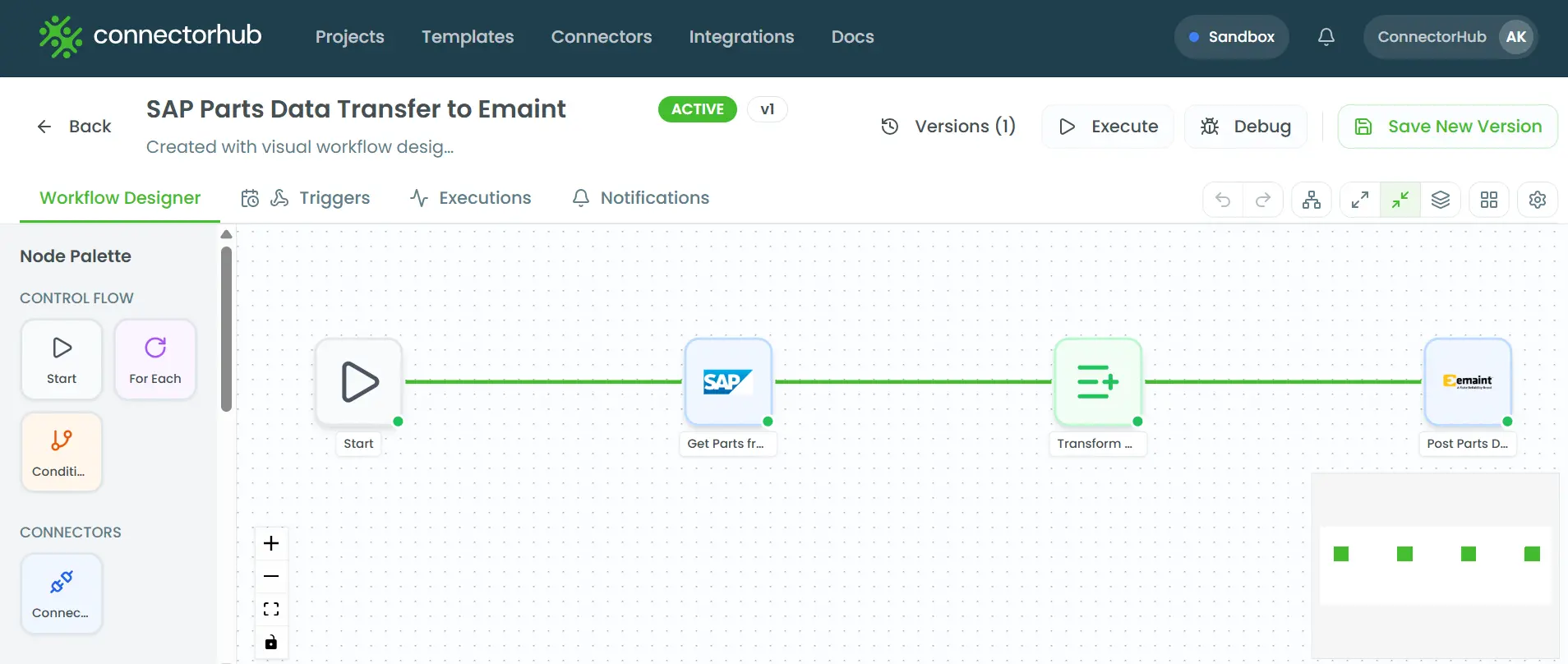
This makes sure that technicians always have access to accurate, up-to-date information about material availability and asset context. At the same time, eMaint's maintenance updates, work order consumption, and equipment status are instantly sent back to SAP.
This gets rid of the need for manual reconciliation and speeds up the process of buying things and reporting on finances.
This two-way synchronization not only increases the number of first-time fixes and lowers the number of stock discrepancies, but it also speeds up billing cycles and makes operations more visible.
This leads to a measurable return on investment through better cost control and faster service delivery.
The key to obtaining the highest benefit from this platform lies in recognizing integration as an important aspect right from the start. Use the potential of AI technology provided by ConnectorHub to make predictive scheduling and resource allocation more efficient. Involving your field workers and office employees in the configuration process from the beginning will help you achieve higher adoption rates.
Also Read: How HVAC Workflow Automation Improves Technician Productivity?
Conclusion
We know the exact technical architecture that works best for driving massive field service profitability. You simply cannot rely on manual data handoffs, lost paper tickets, or disconnected apps if you want to dominate your local market. Taking a definitive, uncompromising stance on modernizing your workflows is absolutely required for basic business survival.
Connecting your operational software systems is the only reliable, proven path to scalable and highly sustainable financial growth. The standard benchmarks, the massive return figures, and the real-world industry case studies prove this definitively. The underlying financial data simply does not lie.
Do not let poor software alignment drain your hard-earned profit margins for another consecutive quarter. Connect your essential tools, deeply empower your technicians with real-time data, and watch your daily operational costs plummet.
This type of modernization has become the absolute baseline standard for the modern, highly profitable service provider. Take full, uncompromising control of your digital infrastructure with ConnectorHub starting today.