.svg)

Every operations leader has lived the same story. A new system gets added, data sits in silos, and teams spend half their week pushing information from one screen to another. What should move automatically turns into an endless relay of exports, imports, and late-night fixes.
Let’s have a quick look at the numbers that tell us the problem: the average enterprise now uses 897 applications, with 46% of organizations using over 1,000 applications. Yet 71% of these applications remain unintegrated or disconnected, forcing employees to bridge the gaps manually. This costs U.S. businesses an average of $28,500 per employee annually in manual data entry alone.
This is why ConnectorHub has decided to come up as a reference point for operations teams trying to clean up integration debt. It connects facility, asset, and service platforms without code and without waiting months for development. While many vendors promise "integration made easy," ConnectorHub was built for the actual grind of operations, unpredictable data, mixed legacy systems, and constant SLA pressure.
Challenge #1: Fragmented Data Pipes
Most organizations run dozens of systems. Work orders in one, assets in another, invoices in a third. Each platform serves its purpose but none speak fluently to the rest. When data doesn't flow, people fill the gap. That's where errors creep in, costs rise, and time evaporates.
The impact extends beyond inconvenience. According to IBM, poor data costs the US economy about $3.1 trillion per year. Error rates in manual data entry can be as high as 4% in some industries. A 4% error rate would result in 400 errors that need to be fixed for a business handling 10,000 transactions each month, which could result in avoidable costs of $20,000 per month or $240,000 per year. Now, do the calculation for your enterprise and see the ROI you gain through a powerful integration strategy.
How to Fix
A proper data integration platform removes all that noise. It keeps each system focused on its job while creating a single channel where transactions sync automatically.
Start by mapping every source and destination system. Then replace manual exchange points with automated handshakes inside a stable no-code platform. It cuts hours of duplicate work and keeps the data clean.
What ConnectorHub Does to Fix it for You:
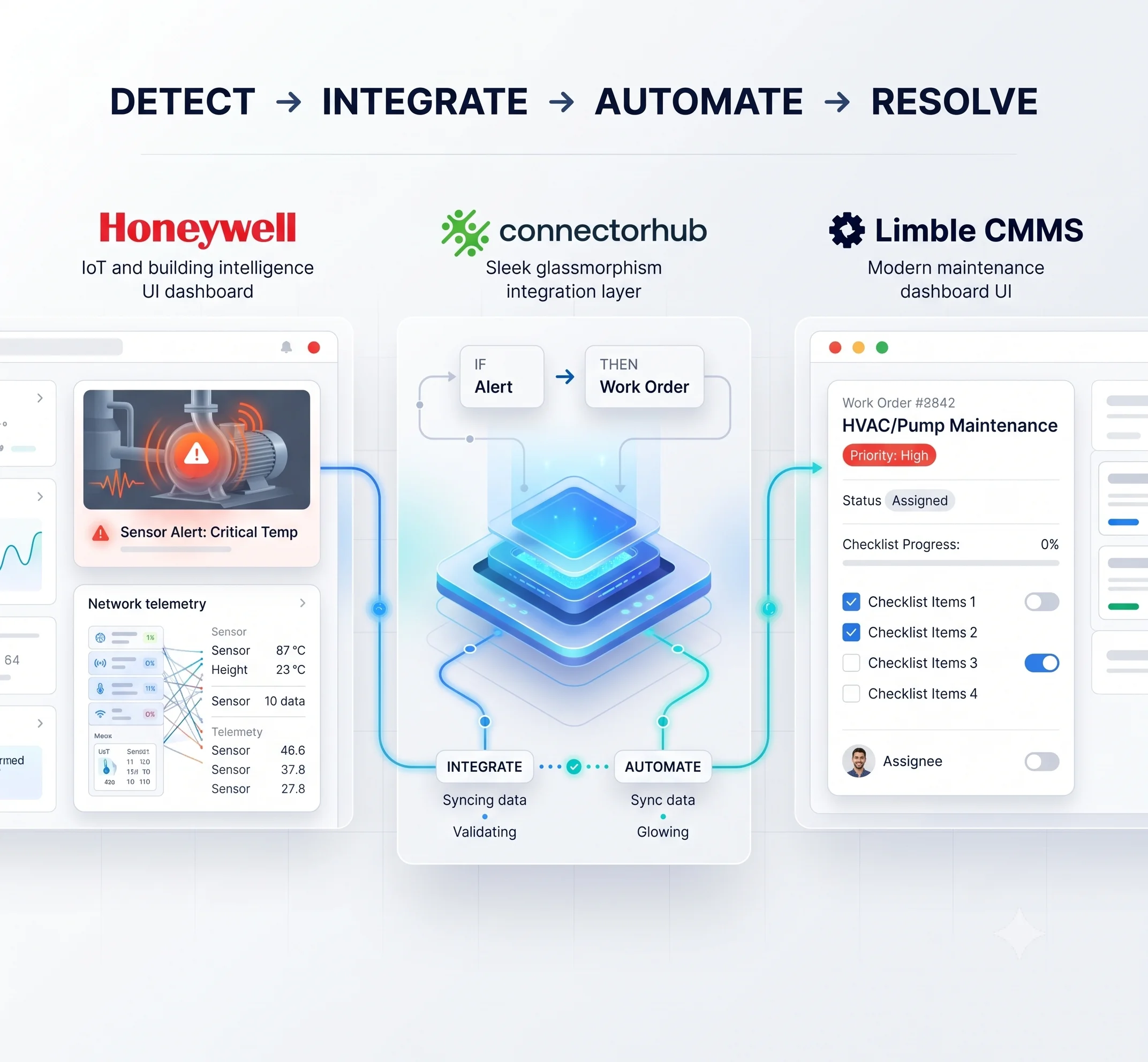
ConnectorHub was designed to handle this kind of manual data dependency without so much tech expertise required. Instead of coding each connection, operations teams build data flows in a visual interface.
- Move from setup to "live" in a fraction of the time required by traditional methods
- Protect your data quality by removing manual file dependencies
- Replace batch processing with real-time automated workflows
- Maintain a clear, "birds-eye" view of all active data processes
- Free your team from repetitive tasks to focus on high-value initiatives
Challenge #2: Slow Custom Builds
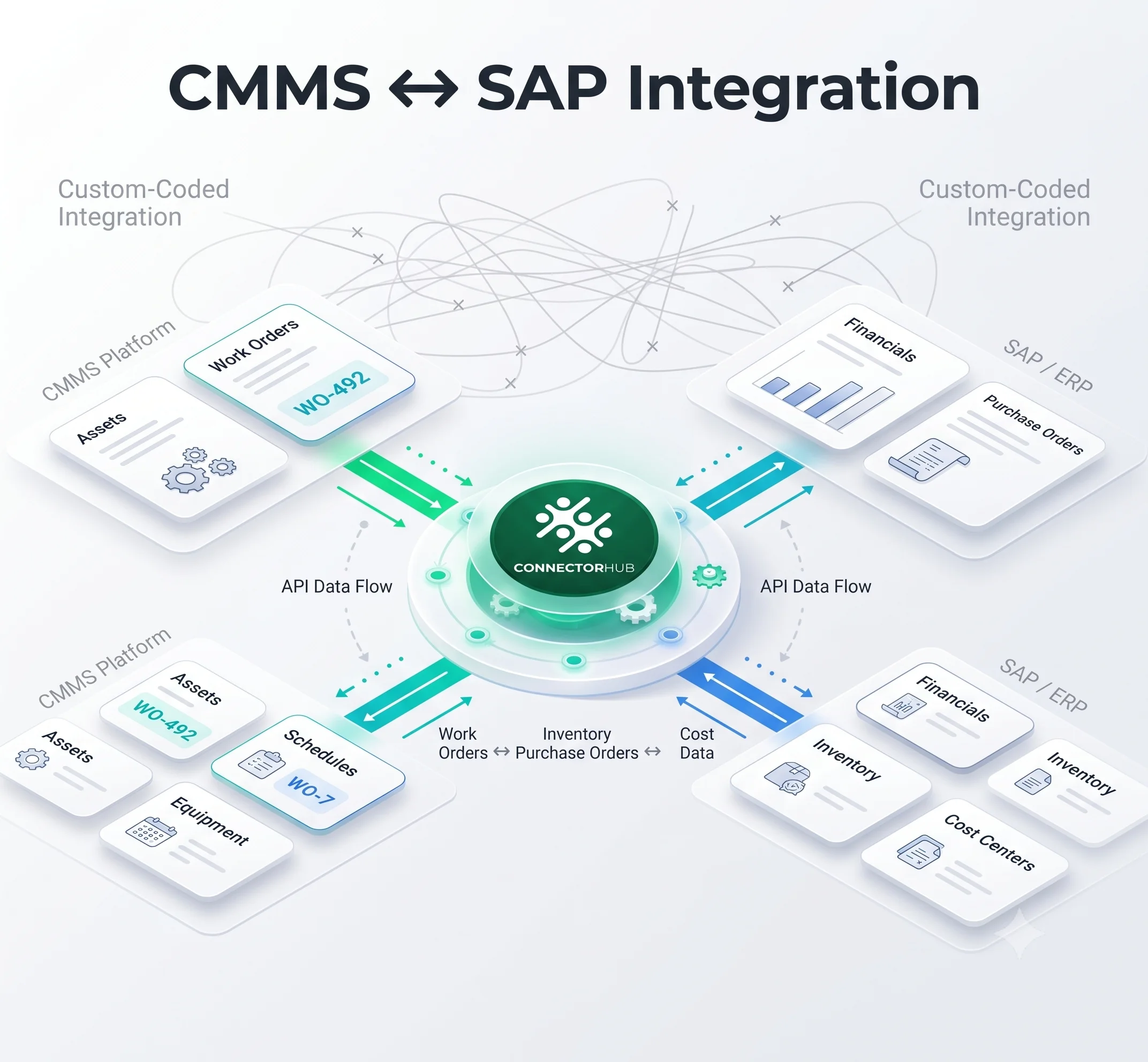
Every organization has tried the “we’ll build it ourselves” path. It starts as an experiment and ends as a long-term burden. Developers build scripts to push data from ERP to maintenance, from maintenance to finance, and from finance back to dashboards. Each change in one system triggers a domino of fixes in the others.
By the time the workflow stabilizes, the business has already shifted. New regulations, new contracts, new formats. The code doesn't keep up, and small changes cost big money.
The market reflects this challenge. 77% of organizations report being impacted by IT skill gaps, making it difficult to maintain custom integrations over time. Meanwhile, deployments are 26% more likely to be delayed than delivered early, costing organizations an average of $131,000 per year.
How to fix it:
The fix is to reposition integration as part of day-to-day operations. With an operations-first integration layer, workflows can evolve as frequently as your business does, without creating technical drag or long change queues.
What ConnectorHub Does to Fix It for You
ConnectorHub removes integration from the realm of custom development and places it directly in the hands of operations teams. Instead of hard-coded connectors, teams assemble logic visually, triggering actions across systems the moment something changes.
- Turns technical cycles into process changes, that are fast, visible, and reversible
- Replace fragile, custom-built connections with configurable logic flows
- Enable non-technical teams to manage and modify integrations confidently
- Reduce long-term maintenance effort while increasing process resilience
Challenge #3: Unreliable System-to-System Integration
Many operations teams still depend on spreadsheets, file drops, and API scripts that run overnight. When those fail, nobody notices until reports show mismatched numbers. That silence costs time, credibility, and money and steadily wears down employees who are forced into constant monitoring, manual fixes, and after-hours firefighting just to keep systems aligned.
The prevalence of manual processes compounds the problem. In 2025, 66% of US employees experienced some level of burnout from repetitive data tasks.
How to fix it:
Reliable system-to-system integration needs three things: stability, observability, and rollback control. Hence, use a platform that treats system-to-system integration as a core service. Choose tools with live error logs and simple rollback features instead of complex scripts no one wants to touch.
What ConnectorHub Does to Fix It for You
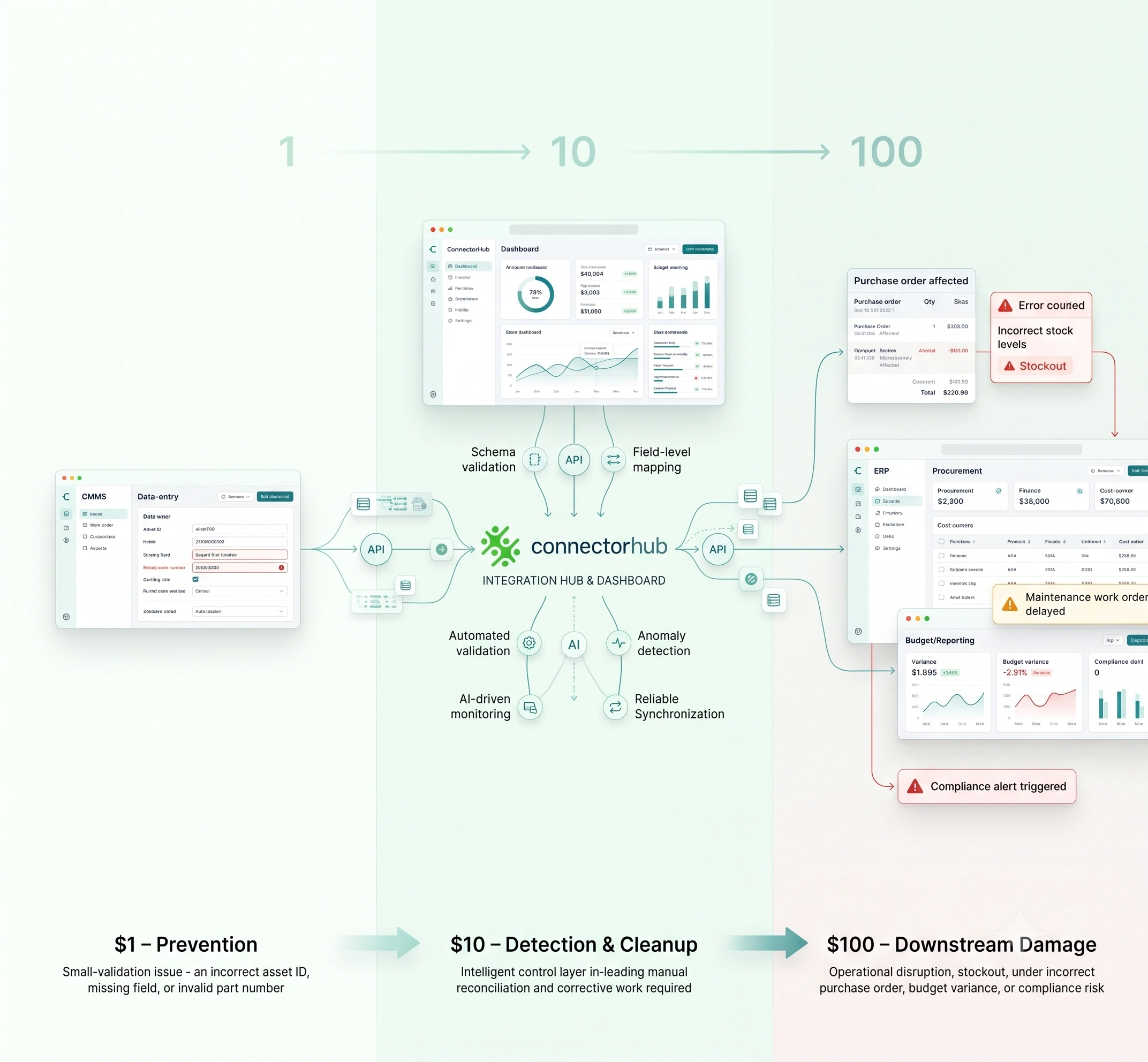
Connectorhub’s every connection has built-in monitoring and error tracking. If a data push fails, the system flags it instantly, so teams always know what’s happening across connected systems and can act quickly.
- Capture detailed transaction logs so teams can trace what data moved, when it moved, and what triggered it
- Support time-sensitive operational workflows proactively
- Reduce uncertainty by surfacing errors immediately
Challenge #4: Enterprise Software Integration at Scale
As organizations expand, integration turns political. Each department owns its own system, its own priorities, and its own data structure. IT tries to mediate, operations tries to move forward, and projects stall.
The scale of this challenge is significant. Despite heavy investment in the enterprise application integration market, only 2% of IT leaders report their organizations have integrated more than half of their applications. Large-scale enterprise software integration fails when governance becomes heavier than delivery.
How to fix it:
The fix isn't more layers of oversight, it's transparency and autonomy. Let departments manage their own data flows inside a shared no-code platform. Keep rules tight but tools open.
What ConnectorHub Does to Fix It for You
Connectorhub's dashboard tracks every data connection across the enterprise. Auditors see lineage and flow without reading code. This model fits modern governance: central visibility, local control.
- Expose complete data lineage and connection status through a consolidated dashboard
- Enforce governance standards through shared rulesets
- Reduce cross-team dependency on IT by enabling secure, no-code integration ownership at the business-unit level
Challenge #5: Maintenance Debt and Emerging Costs
Getting the integration running isn't a big deal; keeping it stable is. Every change upstream rattles the connections underneath. Over time, technical debt piles up. Old connectors break quietly, and entire processes depend on one employee who knows the patchwork by memory.
Custom builds rarely reach that maturity. The maintenance cost eats any initial savings. Generic iPaaS platforms offload some of that pain but still expect internal teams to manage updates manually. That's why automation and self-healing matter.
How to fix it:
Don't stop at the setup price; measure what it takes to keep it running. Select systems that sustain themselves instead of breeding more dependencies. Complex integration layers require specialized knowledge. A no-code integration workflow removes that burden. Teams handle routine adjustments themselves.
What ConnectorHub Does to Fix It for You
ConnectorHub keeps every workflow versioned and logged. When an API endpoint changes, it alerts the user and recommends a fix. Historical data stays intact, and replacements happen without downtime.
- Maintain a complete version history of every workflow
- Detect API changes automatically and notify users with guided recommendations
- Apply updates without disrupting live data flows, preserving historical records and operational continuity
Comprehending Integration Challenges By Industry
Across sectors such as facility management, manufacturing, healthcare, retail, and energy, the hurdles to system interoperability extend beyond simple data exchange, they encompass legacy systems, security concerns, compliance requirements, and real-time visibility demands.
Facility Management
In facility management, integration challenges often emerge when core operational systems such as work orders, financials, and maintenance logs reside in separate platforms or data silos. Effective integration in this space requires solutions that bridge these divides, creating unified views of asset performance, financial data, and service histories to support timely decision-making and contractual compliance.
Manufacturing
Manufacturers face one of the most complex integration landscapes due to the variety of specialized systems involved, including Enterprise Resource Planning (ERP), Manufacturing Execution Systems (MES), and quality-control platforms. Compatibility issues, real-time data synchronization challenges, security concerns, and legacy technology constraints can impede information flow, leading to production downtime, planning errors, and inefficient maintenance cycles. Overcoming these barriers often requires robust middleware, standard data models, and orchestration layers that unify asset data across the factory floor and enterprise systems.
Healthcare
Healthcare integration is uniquely impacted by stringent regulatory requirements, heterogeneous data formats, and complex clinical workflows. Systems such as Electronic Health Records (EHR), laboratory information systems, and billing platforms frequently struggle to share information, presenting integration challenges that can slow patient care delivery, disrupt revenue-cycle processes, and increase audit risks. Ensuring standardized protocols, governed data exchange frameworks, and automated logging are common approaches to mitigate these challenges.
Energy (Oil & Gas)
In the energy sector, field service operations and performance tracking systems are critical to maintaining infrastructure reliability. However, integrating mobile data capture from field systems with enterprise databases and performance dashboards can be challenging, especially in geographically dispersed operations. Without reliable integration, performance data can be lost, hindering predictive maintenance and operational planning. Mobile-enabled data capture and real-time sync strategies help ensure that field insights are preserved and actionable at the enterprise level.
Below is a snapshot of common integration pain points faced by different industries, the typical impacts of these breakpoints, and ways targeted solutions, such as modern connectors and integration platforms, help address them:
Why Choose ConnectorHub
ConnectorHub was built around how operations teams actually work. Facility management, field service, asset control, these domains move fast, rely on mixed systems, and run under tight SLAs.
The integration market is evolving rapidly. There are now over 900 integration software solutions available in the market, with approximately 270 specialized iPaaS solutions. This proliferation makes it increasingly difficult for organizations to select the right approach.
Unlike standard data integration platforms, ConnectorHub comes preloaded with ready connectors for FM systems like Nuvolo, Corrigo, and FMX. The platform also includes SLA monitoring and a live ROI calculator, features purpose-built for operations teams. Traditional tools take months to deploy and still require coding. Connectorhub goes live in weeks.
Quick Comparison
ConnectorHub combines the reliability of an enterprise software integration suite with the agility of a no-code platform. The result is cleaner operations data, faster decision loops, and measurable savings across departments.
Operations success depends on motion, data, tasks, and people all moving in sync. Most teams already have good tools, what they lack is connection. ConnectorHub aims to give you this connection. Explore how we can make this possible for you — start today.
Closing Perspective
Integration challenges are no longer background noise in operations. They are a measurable drag on speed, accuracy, and morale. What once felt like an unavoidable byproduct of growth is now recognized as a fixable structural issue.
Modern operations are shifting away from point-to-point fixes and toward integration as shared infrastructure. Facilities, finance, maintenance, IT, and field teams are no longer working in isolation. As this shift takes hold, integration stops being a technical afterthought and becomes a core operational capability.
This pattern is consistent across industries. The goal is the same everywhere: reduce friction, surface truth faster, and keep people focused on decisions rather than corrections.
Platforms like ConnectorHub make this transition practical. They do not replace existing systems or demand long rebuild cycles. Instead, they connect what is already in place, stabilize data movement, and give operations teams direct control over how work flows across the enterprise.