.svg)

Walk past any premium commercial high-rise, and you see absolute precision. Glass, steel, and a flawless lobby operating like clockwork. But if you look closely at the teams running that building, reality often looks completely different. Behind the scenes, the digital foundation is cracking.
Consider the daily routine of an asset manager trying to build a quarterly performance report. To find the true net operating income of a single property, they have to pull occupancy data from the leasing software. Then, they extract utility metrics from a local building management system. Finally, they cross-reference all of this with expenses logged in a separate accounting suite.
When these systems fail to communicate, teams burn out, and asset value drops. To stay competitive, real estate enterprises must stop relying on these manual workarounds as the market demands a reliable, automated data pipeline for real estate operations.
This guide explores why disparate systems are slowing real estate businesses down and provides a practical roadmap for orchestrating a truly connected enterprise through no-code PropTech integrations.
Why Data Integration Is Now Table Stakes in the Real Estate Industry?
Property technology was introduced to modernize a traditionally paper-heavy industry. The goal was to replace physical ledgers and filing cabinets with dynamic cloud solutions.
Software emerged for every specific operational need. Companies bought dedicated applications for lease administration, portals for investor relations, and platforms for tracking building maintenance.
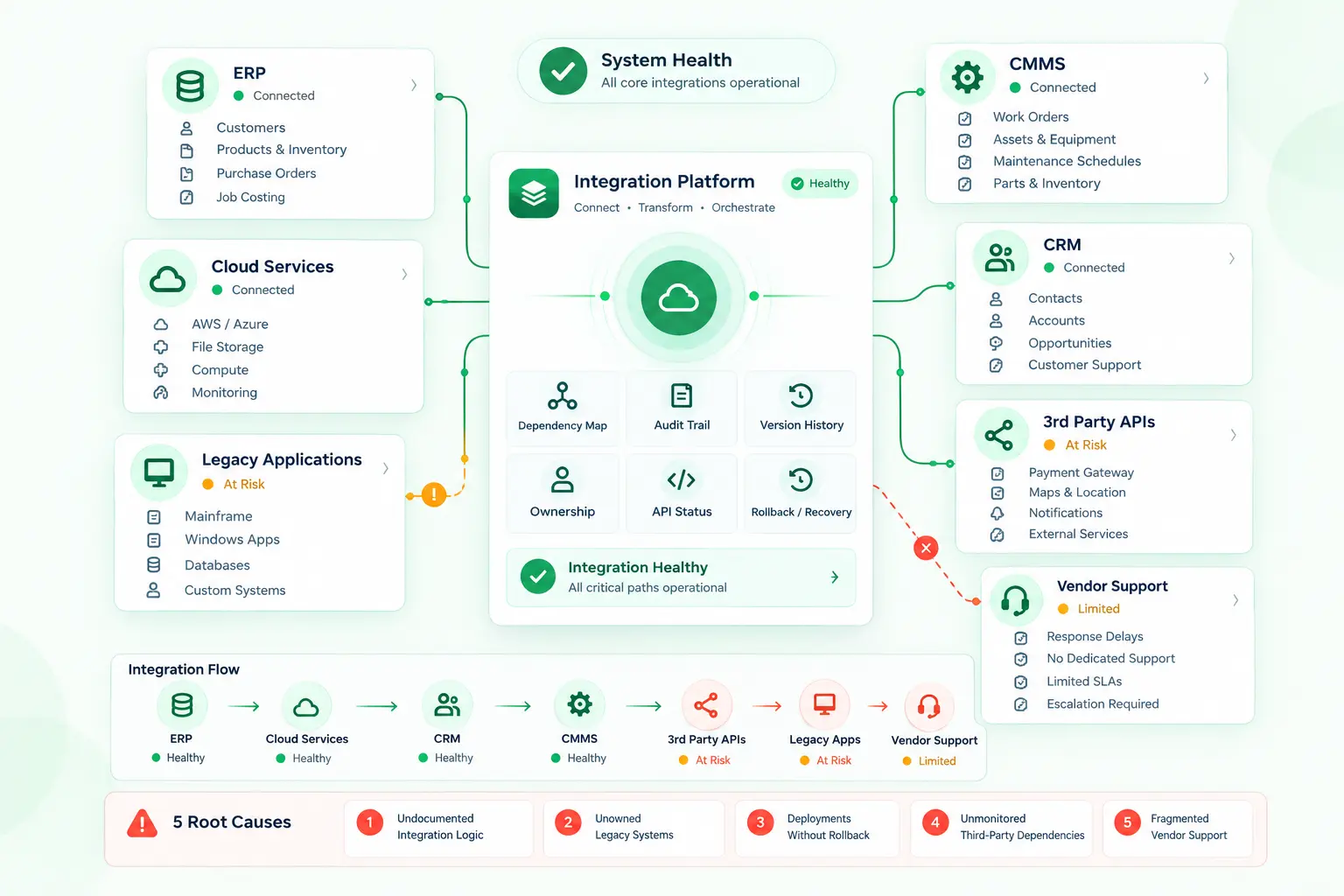
However, a major oversight happened during this software boom. Real estate firms bought these applications as standalone solutions, not as pieces of a connected ecosystem. Teams ended up with ten different tools that could not speak to one another.
We know that a functioning PropTech ERP CRM integration is the baseline for clear financial visibility. At the same time, retaining top-tier occupants requires a flawless tenant experience platform integration. And protecting the physical building itself depends on a unified facility and PropTech integration.
This is why an enterprise integration platform is an absolute necessity. When systems cannot share information directly, business operations slow down to the speed of manual typing.
Executive decisions are delayed because the data is stuck in a bottleneck. If leadership cannot view the financial and operational health of a building on one screen, the firm's competitive edge is actively shrinking.
The Growing Complexity of Real Estate Data Management
Let’s look at the root of the operational crisis in commercial real estate: corporate culture. For decades, firms have operated in deeply segregated departments. We are all familiar with the reality of data hoarding. Leasing guards on the prospective list. Property management relies on a separate database for tenant requests. Meanwhile, the finance team sits behind a wall of highly secure, completely isolated accounting software.
Because every team purchased software specifically for their own needs, without considering the broader tech stack, massive digital silos were born.
Your portfolio generates millions of data points every single day. Every access card swipe, thermostat adjustment, and maintenance ticket creates a digital footprint. The raw data is there.
But imagine what happens when leadership asks for a complex risk analysis comparing lease expirations to historical maintenance costs. The operations team usually freezes.
When executives are forced to wait weeks for a report that should take seconds, trust in the data completely evaporates. As a result, the firm ends up making multi-million-dollar acquisition and disposition decisions based on experience and gut feeling, rather than hard, empirical evidence.
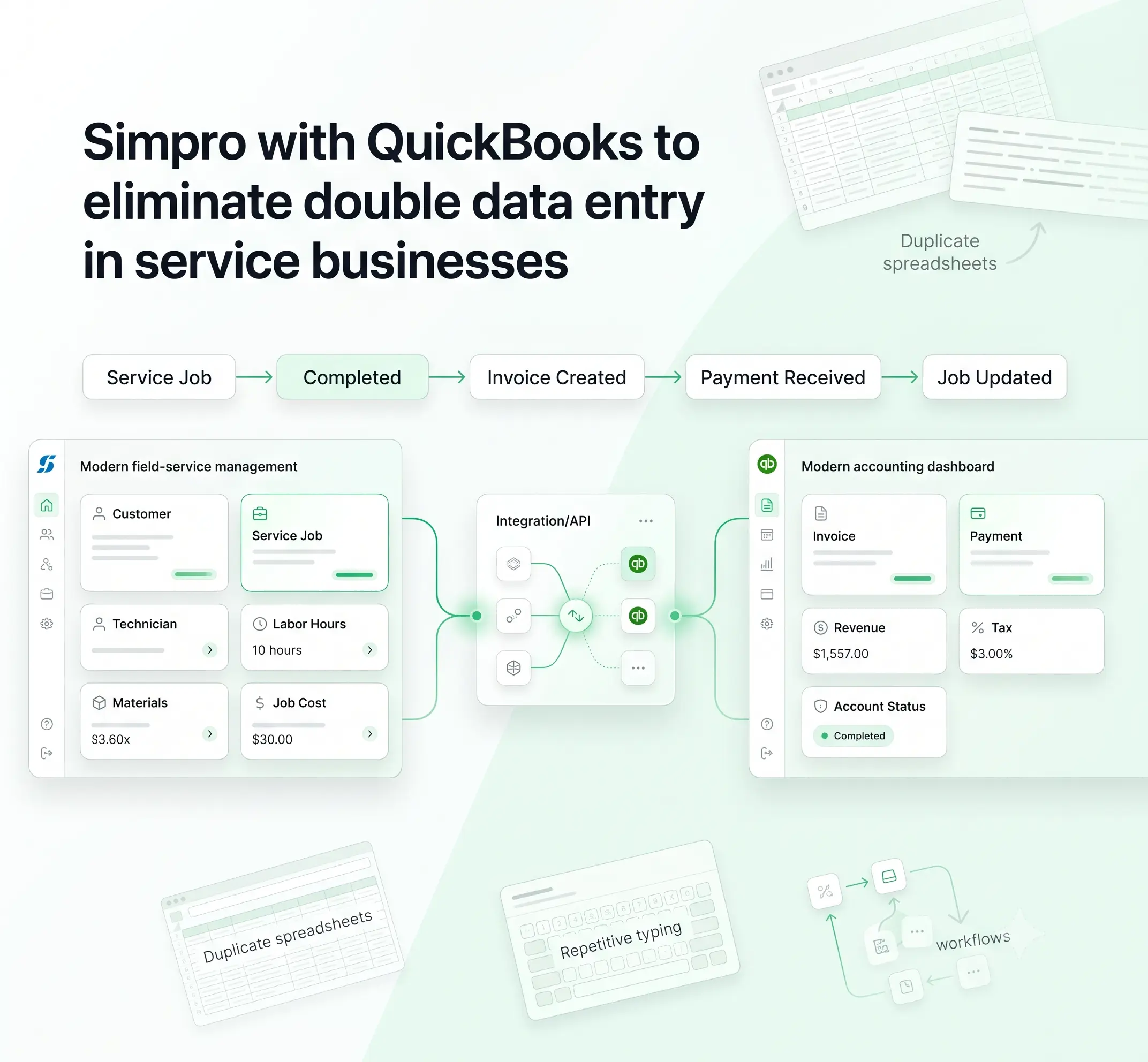
The operational cost of this disconnect hits the ground level just as hard. The exact same information gets typed out four separate times:
- The leasing agent enters it into the relationship database.
- The property manager types it into the operational software.
- The accountant keys the lease terms into the financial ledger.
- The facilities manager inputs the tenant into the maintenance portal.
This duplicate effort wastes incredibly valuable time and introduces a dangerous margin for error. Ultimately, relying on disconnected tools takes your highly skilled real estate professionals and turns them into glorified data entry clerks.
Transformative Benefits of PropTech Integration
When a real estate firm successfully connects these fragmented systems, the transformation is immediate. Moving to a connected ecosystem redefines how a portfolio operates at scale.
The real power of integration comes down to establishing a single source of truth. This structural consistency completely changes day-to-day operations through a robust real estate software integration solution.
Connected data also sharpens your competitive edge in the market. By combining internal portfolio data with external market trends, investment committees can spot neighborhood micro-trends that competitors simply miss.
On the brokerage side, proper CRM integration gives your team complete tenant profiles. Instead of just seeing a generic request for square footage, brokers see a prospect historical need for heavy electrical capacity, allowing them to match clients to specific suites and close deals faster.
Perhaps the biggest operational win is predictive asset protection. By implementing a PropTech CMMS integration, your system monitors the lifecycle of expensive mechanical equipment. It predicts and prevents HVAC failures before they happen, saving massive emergency repair costs.
Ultimately, the true value of this connectivity is scale. You cannot grow a real estate portfolio if you have to double your administrative staff to handle the paperwork. True integration allows you to aggressively increase your assets under management while keeping operational overhead completely flat.
Common Integration Challenges in Real Estate Workflows and Why Most Attempts Fail
If the benefits are clear, why do so many real estate companies struggle to achieve them? The path to integrated workflows is littered with expensive, high-profile IT project failures. Industry analyses show that 60-70% of system integration and digital transformation efforts in real estate fall short of expectations, often due to a combination of technical brittleness, data mismatches, and organizational blind spots.
In the past, the company would have software developers code the connection between the systems themselves. This method of coding an API integration is deeply flawed. It creates a rigid and brittle connection that lacks resilience.
Real estate information is notoriously heterogeneous and context-dependent. Defining usable square footage versus rentable square footage varies completely between different software providers. Without a smart layer to translate these definitions, merging databases leads to messy, corrupt data.
Beyond code fragility, several under-discussed factors drive failure:
Legacy system inertia and compatibility gaps: Many companies still depend on legacy property management or accounting software systems that have little documentation or poorly designed APIs. These were not meant for event-based and real-time synchronization, which results in synchronization problems and workflow conflict issues.
Underestimating organizational and process complexity: Integration is more than just technology. It involves integrating processes across departments such as leasing, maintenance, finance, and compliance, determining who owns the integrated ecosystem, and change management and training. Resistance to change and lack of skills among nontechnical employees, along with departmental silos, frequently derail integration efforts. The rise of best-of-breed tools (eight to twelve separate software solutions for even modest-sized portfolios) increases complexity and expenses exponentially.
Security, compliance, and scalability blind spots: Real estate manages personal information of tenants and financial information of customers, hence, triggering the GDPR or SOC 2 compliance. Custom applications integration typically lacks features such as good error handling, monitoring, retry functionality, or versioning, hence experiencing hidden errors during high workloads or vendor upgrades. Large-scale implementations have an exponentially higher failure rate compared to small implementations.
Tool-first vs. system-first thinking: Most companies tend to concentrate on connecting different applications without reengineering their processes, hence making them fragile.
Understanding integration in a modern context means moving beyond raw coding to flexible, intelligent software layers, such as iPaaS (Integration Platform as a Service), low-code/no-code platforms, or unified APIs with built-in data mapping, transformation, validation, and monitoring.
A Step-by-Step Guide to Real Estate Data Integration
For operations teams looking at a complex web of legacy software, figuring out where to start can feel overwhelming.
The biggest mistake a firm can make is trying to tackle everything at once. Attempting to rebuild the entire digital infrastructure without a phased plan causes operational chaos.
- Conduct a Software Audit: Before investing in software integration services, map out exactly what your teams are currently using. Identify the core systems of record, like the main ERP. Then, find the shadow IT, referring to the unauthorized spreadsheets and side apps employees use because the official software is too frustrating.
- Pinpoint the Friction: Do not connect systems just to say you did. Look for the actual bottlenecks. Where are highly paid analysts spending three hours a week downloading a report from one portal just to format and upload it into another? Start there.
- Define the Master Data Architecture: Establish clear rules. If a corporate tenant changes their legal name, which software is the ultimate authority? Setting this hierarchy stops systems from constantly overriding each other.
- Embrace Modern Middleware: Move away from custom, point-to-point developer coding. The new standard uses cloud integration platform frameworks. These platforms sit in the center of your software stack and act as a universal translator. They manage security protocols and ensure data flows smoothly without needing constant IT support.
- Start Small and Smart: Pick just one high-impact, low-risk workflow that will actually move the needle. Automating vendor onboarding or pulling your daily utility readings straight into a simple central dashboard are fantastic first picks. Prove it works, show the clear return on investment, and only then expand the strategy.
Looking Ahead — The Future of PropTech Operations Is Automated with Orchestrated Integrations
The future of the operation in real estate will no longer lie in expanding your existing set of standalone applications but rather in smartly automated business processes. As PropTech evolves, the companies that succeed in making integration the backbone of their technology stack will come out on top. Through the orchestration of modern iPaaS solutions, low-code automation, API data integration, and embedded AI, autonomous workflows will become the norm in the future years.
For instance, predictive maintenance will evolve beyond simple alert notifications to self-scheduling, which prevents downtime. The tenant experience platform will provide frictionless customer experience through access to relevant information gathered from the leasing, maintenance, and accounting systems.
Decision-making processes for the whole portfolio will evolve from weeks of manual data aggregation into instantaneous decisions based on integrated dashboard analytics and insights from artificial intelligence.
The development of new technologies such as agentic AI will make it possible to delegate complex multistep tasks such as contract management, lease renewals, vendor coordination, compliance issues, and basic revenue optimization to the intelligent agent. Real estate buildings, in turn, will operate in a way similar to living organisms through IoT and PropTech integration.
The key here is to have a modular and adaptable system of the best-of-breed ecosystems integrated via data automation for PropTech startups. Companies that can establish a solid data foundation by integrating master data management, semantic translation, and governance capabilities in their architecture today will be able to grow effectively while maintaining constant costs.
ConnectorHub: Purpose-Built No-Code Solution for PropTech and CRE Data Integration
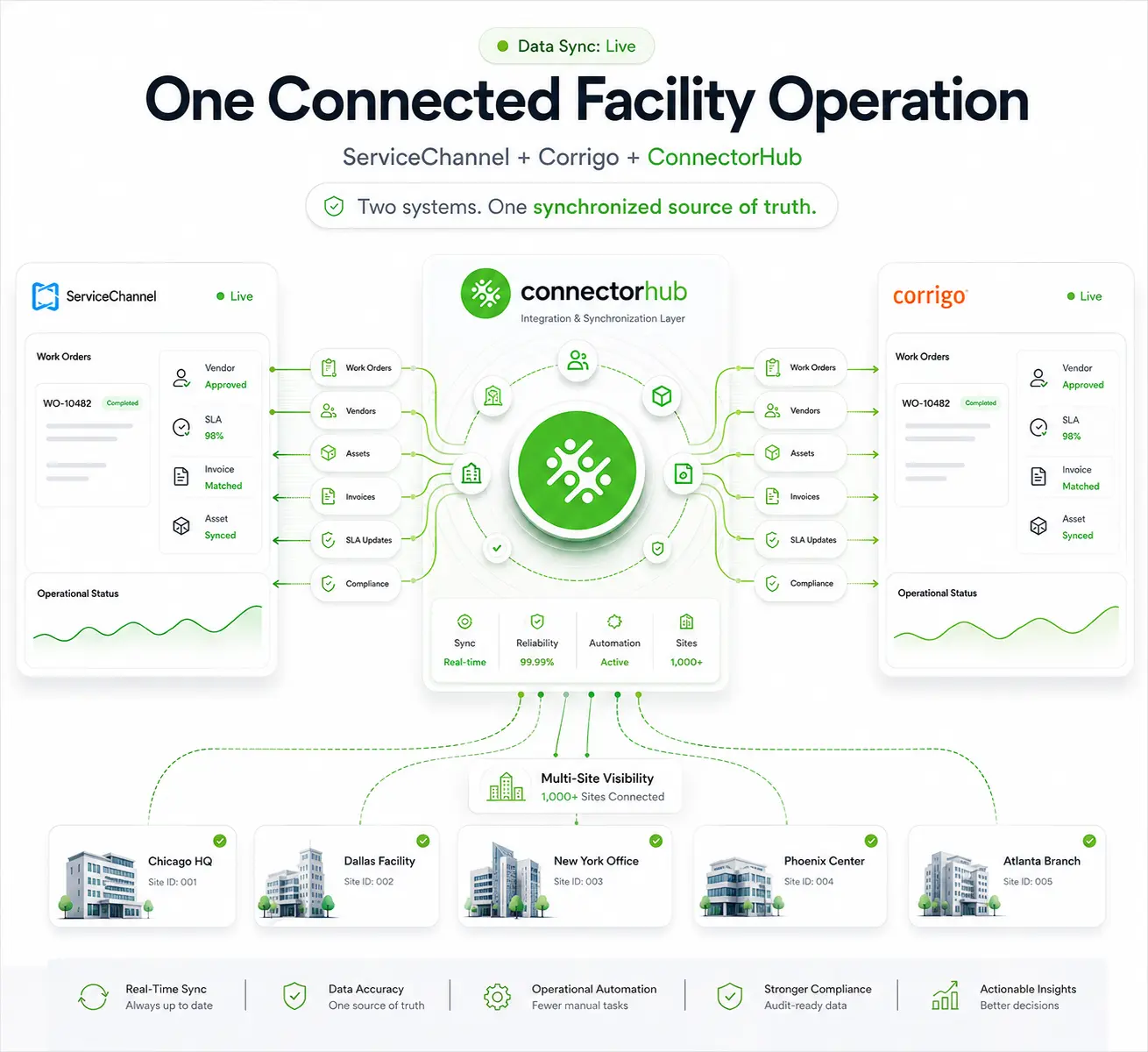
While a clear roadmap helps, the right technology layer decides whether your integration succeeds or repeats the familiar cycle of failure. ConnectorHub is a purpose-built no-code integration platform designed as a workflow builder for real estate teams and CRE operations.
Built from the ground up for the industry, ConnectorHub offers intelligent, pre-built connectors for major systems including Yardi, MRI, SAP, Salesforce, NetSuite, CMMS platforms, and IoT tools. It automatically handles real estate-specific complexities — such as translating usable vs. rentable square footage, normalizing lease terms, and syncing tenant data — ensuring clean, consistent information flows.
ConnectorHub directly solves the challenges discussed earlier:
- Replaces brittle custom-coded APIs with resilient, no-code workflows that include built-in error handling, retry logic, and versioning, minimizing technical debt when vendors update their systems.
- Overcomes legacy system limitations and data mismatches with smart semantic translation and real-time/event-driven synchronization.
- Empowers non-technical teams (leasing, property management, finance) through an intuitive drag-and-drop workflow builder, reducing IT dependency and organizational resistance.
- Delivers enterprise-grade security and compliance features to protect sensitive tenant and financial data while scaling effortlessly across portfolios.
ConnectorHub turns the intelligent “smart layer” into a practical reality, helping you move from inefficiently linked systems and manual processes to orchestrated, future-ready PropTech operations.
Conclusion
The commercial real estate industry has fundamentally shifted. The companies that will dominate the next decade won't necessarily be the ones with the deepest pockets, they will be the ones that know how to orchestrate their data. Sticking to disconnected software, endless manual data entry, and isolated departmental knowledge is no longer just a daily administrative frustration. It is an unsustainable strategy that actively drains the value out of your portfolio.
By bringing modern, no-code integration frameworks into the mix, real estate enterprises can finally break down those internal silos. This allows you to streamline heavy workflows and unlock the strategic value that is already sitting right inside your operational data.
The mandate for today’s executive is clear: connect your systems. Empower your teams to stop wrestling with spreadsheets and start doing the high value work they do best. It is time to future-proof your portfolio with infrastructure that actually works for you.