.svg)
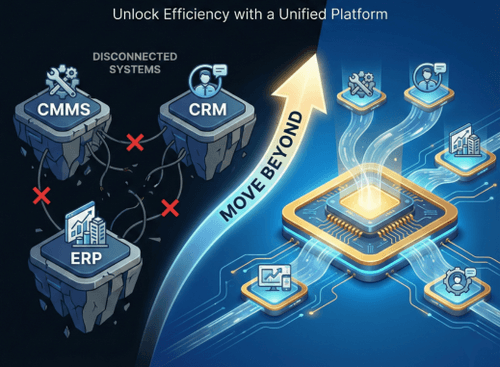
Service providers today rely on multiple systems to manage assets, customers, and finances. But when CMMS, CRM, and ERP platforms operate independently, the value of these tools diminishes.
Inefficiencies caused by such disconnected systems act like puzzle pieces that don’t quite fit together. Information is locked away in silos, which means that teams have to manually enter information, repeat tasks, and make mistakes.
For service businesses, this means that the consequences are immediate and expensive —technicians show up at a customer site without the latest information from CRM or inventory levels from ERP, which slows down the delivery of service and hurts customer trust.
ConnectorHub is here to assist you by exploring connectivity issues within your facility that you might not even be aware of. They work to establish an interconnected technology system, providing a practical plan to overcome these challenges effectively.
Understanding the Shift Toward CMMS, CRM, and ERP Integration for Service Providers
As the businesses scale, so do these inefficiencies. Industry research has revealed that discrete systems result in increased operational costs, as employees spend hours a week switching between applications rather than working. Without the ability to see what is happening in real time and communicate between systems, conflicts in schedules, outdated work orders, and unmanaged assets are not uncommon.
The end result? Delays, re-visits, wasted labor, and lost revenue. In fact, research has shown that 73% of businesses have experienced outages that have cost more than $100,000, often because problems have gone unnoticed and unaddressed because of the lack of visibility in the data environment.
Compliance and reporting are not immune to the consequences either. With maintenance history, financial information, and service records scattered across different software, the audit process is a nightmare and prone to mistakes.
Integration of the CMMS with the applications provides a flow of information that is accurate, timely, and accessible. Integration of the CMMS into the wider applications provides organizations with the power to effectively run their organizations through the integration of a centralized asset management system.
The Real Cost of "Tool Sprawl" in Service Operations
If your service business is like most, you likely have multiple isolated tools, like separate CMMS for work orders, CRM for customer and job data, and ERP for inventory and invoicing. This can lead to a situation where teams remain trapped.
1. The Cost of Financial Drain
It's simple to identify the cost of one tool, but when you have multiple tools, the cost becomes hidden:
- Lost Licensing Costs: You're left paying for multiple licenses, which often have redundant features. You also miss out on "volume" discounts for enterprises.
- Heavy Lifting for Maintenance: Each tool requires its own set of updates, patches, and servers. This leaves your IT staff doing "software maintenance" instead of bringing in innovation.
- The Cost of Integration: To get two different tools to "play nice" with each other, you need to pay for custom coding, APIs, and maintenance every time one of the tools is updated.
2. The Productivity Killer
Playing around with several tools has become part of the general routine for most of the employees in today’s workplaces.
- Context Switching: It is exhausting to switch between browser tabs and applications. It takes time for an employee to “re-focus” every time they switch screens.
- Information Silos: When information is locked away in different systems, no one has the “full picture.” This results in slow decision-making and overlooked red flags.
- Inconsistent Workflows: If Team A uses one tool and Team B uses another, the “customer experience” for your employees is confusing and unpredictable.
3. Operational Complexity & Scaling Issues
As your business grows, disparate sections in the operations tend to break under its own weight.
- No “Single Source of Truth”: It’s impossible for leadership to get a clear picture of performance because the information is spread across different dashboards.
- Blocked Growth: It’s difficult to spread IT best practices to other teams (such as HR or Finance) if your foundation system is a mess of interlocking applications.
- Knowledge Loss: When valuable tips and “how-to” information are hidden in three different databases, your team is left to reinvent the wheel every time.
Also Read: From Chaos to Clarity: How System Integration Transforms Service Operations
4. Security and Compliance Risks
Every new application increases the risk exposure.
- Larger Attack Surface: More applications translate to more login screens, more passwords, and more chances of a security blunder.
- Access Control Issues: It is very difficult to ensure that an ex-employee does not have access to each and every specialized tool, which creates huge security holes.
- Audit Torment: When it is time for a compliance audit, gathering logs from various applications is a cumbersome task that is prone to human error.
5. The "Human" Cost: Employee Burnout
Tool overload directly affects how employees feel and perform. We tend to overlook the impact of software on employee morale.
- Employee Fatigue: It is exhausting to deal with clunky software that refuses to work together, and it makes every task feel harder than it actually is.
- The Training Burden: Simplifying everything into one system cuts down on that steep learning curve and gets people up to speed much faster.
- Burnout: When IT professionals are forced to spend their day doing "busy work", such as transferring data from one system to another, they become disenchanted and seek employment elsewhere.
Although each individual tool may address a particular pain point, having different systems in place leads to a block on your budget, time, and security. This ultimately erodes margins and forces service pros to fight technology instead of focusing on great field service.
System Integration as a Solution for Connected Service Operational Systems
Through the integration of CMMS, CRM, and ERP systems, different systems are brought together in one operational setting. Instead of data being fragmented, it can move seamlessly from one system to another, offering a single source of truth that needs minimal processing.
For the service industry, this means that there is real-time access to assets, customers, and financial information, which enables expedited and informed decision-making.
The results are quantifiable. Businesses that implement integrated solutions see an average improvement of up to 35% in service delivery and a 50% decrease in operational disputes, thanks to the use of standardized data and the establishment of clear performance metrics.
Data security and compliance are also improved through standardized workflows, ensuring that data is managed consistently across all business units. In terms of inventory management, for example, integration helps to eliminate stockouts and overstocking, leading to operational cost savings of 15-25%.
Integration also assists in breaking down the silos of the departments. With everyone having the same information, the sales, service, and finance departments can work together more effectively to address customer needs more quickly and provide more personalized service experiences.
As we look at more specific examples of integration, these points will be even more clear in the context of service operations.
Best Practices for CMMS-CRM-ERP Integration in the Service Industry
With proper planning, integration can be more easily implemented and will continue to provide value over time. Here are best practices for integrating CMMS, CRM, and ERP systems in the service industry.
- Modernize Your Systems First - Before you even begin, review what you are currently using. Outdated, on-premises software typically doesn't support live data sharing or scaling. Upgrade to cloud-based SaaS solutions whenever possible. They are simpler to integrate, faster to implement, and will scale with your business.
- Define Clear Goals and Scope - You must know what you want to accomplish. Determine which data needs to flow where, such as transmitting customer information from your CRM to your CMMS or inventory updates from your ERP to your techs in the field.
- Choose Agile Platforms - Do not build inflexible, custom-coded integrations that become problematic down the line. This is where you use a cloud-based integration platform (iPaaS) with existing connectors, which contributes to maintaining your systems in harmony and enables you to adapt as your business changes.
- Clean Your Data - Integration only works if your data is accurate. Remove duplicates and get rid of useless information. Assign "owners" to specific data types, like using the ERP for finances and the CRM for customer records. Mapping this out early prevents errors in billing and scheduling.
- Decide on Sync Frequency - Not everything needs to update at the same second. Use real-time syncing for urgent info like job statuses or stock levels. Syncing in batches in certain scenarios is better because it puts less strain on the system.
- Prioritize High-Impact Areas - Start with the areas that will give you the biggest benefits. Important data includes customer information, service requests, and part prices. By working on these areas first, you can see fewer stockouts, better billing, and happier customers.
- Get Every Department Involved - Because this will impact everyone from dispatch to accounting, get them all involved in the planning process. When the people who use the software every day have a voice in how it should work, the transition will be much easier.
- Set Rules for Data Use - Establish guidelines on who "owns" what data and how it should be protected. Regular audits and system logs will ensure everything stays accurate and safe, which is crucial for staying in regulatory compliance.
- Test and Train - Perform comprehensive tests to ensure data can flow properly from all three systems before you go live. Then, when you are ready, offer hands-on training specific to each team's particular role. People are more likely to use a new system if they feel comfortable with it.
- Monitor Your Progress - Post-implementation, measure success using key performance indicators such as the following:
- Customer Service: Track response times and satisfaction scores.
- Sales: Track the time it takes to receive payment and the accuracy of orders.
- Operations: Track the accuracy of inventory and the speed of task completion.
- Finance: Track reduced labor costs and improved profit margins.
By following these steps, isolated software tools can be harnessed as a powerful force, allowing service companies to lower costs, meet SLAs, and delight customers. Integration, when executed properly, becomes a competitive advantage rather than a barrier.
ConnectorHub to the Rescue: Your Integration Partner for Modern Service Providers
ConnectorHub is a specialized integration partner for service providers, created to simplify complex system environments. Our system integrates your CMMS, CRM, and ERP systems without requiring complicated coding. By leveraging AI to integrate these applications, we break down data barriers and automate your daily operations so you can see exactly what is going on in your business in real time.

We provide more than 100 pre-built connectors and templates tailored specifically for work orders, billing, and scheduling. These functionalities enable HVAC, janitorial, and maintenance businesses to spend less time on paperwork and more time on the job. With automated mapping and SLA notifications, you can minimize errors and grow your business smoothly.
Your data is secured by high-level security standards, such as SOC2, HIPAA, and GDPR compliance. We take care of the technicalities and secure your data so you can concentrate on delivering excellent service to your customers.
Conclusion
Disconnected CMMS, CRM, and ERP applications quietly drain service businesses through duplicated effort, delayed decisions, and dissatisfied teams.
What starts as “specialized tools” quickly becomes expensive tool sprawl—higher licensing fees, constant context switching, compliance headaches, and technicians arriving unprepared. These underlying costs compound fast, squeezing margins and eroding customer trust in an industry where speed and reliability win.
Integrated platforms turn the equation around. Real-time data flow from one system to another eliminates manual re-entry and allows for predictive scheduling, prevention of stockouts, and single views of operations. Service providers quantifiably benefit as first-time fix rates accelerate, SLA breaches decrease, admin time shrinks, and technicians are happier since they don't have to fight the software to do their job.
The choice is simple. Contemporary integration, in the form of no-code solutions such as ConnectorHub, holds the key to efficiency, scalability, and customer delight without the pain of custom development. The future is one of connected business; getting there today is the savvy move.