.svg)

More work orders. Fewer workers. Tighter budgets. This was the dynamic that had been prevalent for quite a while as explicitly seen in 2024, when over 55% facility management leaders faced the challenge to do more with less as work order volumes climbed steeply as compared to the previous year.
And these are not numbers that tend to decline for the years to come, which presents a significant dilemma. Work orders are surging, teams are stretched thin, and the old ways of managing maintenance simply can't keep up.
This is where the concept of work order automation gain momentum to alleviate the resulting bottlenecks with ease. Tech-enabled work order automation simply offers a smarter, more efficient way to handle the entire work order lifecycle, taking the chaos of paper logs, spreadsheets, and manual errors out of the picture.
ConnectorHub emerges as a work order automation software that turns this idea from a complex technical hurdle into a core layer of daily routine. It transforms how work flows through your facility, who handles it for smoother handoffs, and how fast it comes back closed, even as your enterprise grows and work volumes rise.
The Conventional Work Order Management Cycle That Benefits No One
In a typical organization, a single request to fix a pump or calibrate a sensor sets off a trail of friction. An individual takes time to read the email, records the problem, keys it back into another system, calls maintenance, follows through with the updates, and eventually reconstructs the same report at the end of the week. When this is multiplied by dozens of assets and hundreds of employees, the time is lost every shift.
Every manager knows this pattern:
- No single view of what is pending or done
- Repeated data entry across multiple apps
- Inconsistent record-keeping that breaks audits
Traditional work order management software helped centralize the record, but not the process. It was still a digital filing cabinet. A structured approach to this came through automated work order management that arrived much later.
What is Work Order Automation for the Modern Enterprises
Work order automation is the shift from manually tracking maintenance tasks to managing them through connected digital systems that handle the process end to end.
The true value of this technology is being able to handle the life cycle of a job autonomously. It begins with the simple submission of a request, progresses into intelligent approval chains, where logic-based rules determine which task requests go through, along with when this happens. It then automatically matches the task with the most qualified person who happens to be in the location and has availability. Nobody needs to chase paperwork, and processes move in smaller, prompt cycles.
As work is being performed, stakeholders benefit from total transparency through live updates and mobile integration. Technicians are also able to track their activity and make vital entries in real time, which will update the history automatically once the task has been completed.
Indeed, this centralized process not only results in faster closure of the ticket but also offers the leadership precise analytical data to cut costs and establish a comprehensive operational strategy in the long run.
Understanding How the Work Order Lifecycle Evolves with Automation
By automating the work order journey, you address the specific friction points that normally drain productivity:
Not only does this make life easier for your day-to-day workload, but it also lays the foundation for more sophisticated technology-enabled facility management.
How to Roll Out an Automated Work Order Management System with Ease
As far as successful implementation is concerned, it has less to do with the software per se and much more to do with the process. By following a comprehensive implementation process, you can literally transition your maintenance culture from a reactive nightmare to a high-performance machine.
- Audit the Existing Lifecycle: First, map your current "analog" process. Determine at what stages requests seem to get stuck, approval or technician assignments, for instance, and count the number of manual hand-offs.
- Define Automation Priorities: Then, build on tasks that have a high impact at lower complexity. Basic routing and data validation automation provides quick relief while not requiring an overhaul of advanced analytics.
- Launch a Strategic Pilot: Deploy the system initially on a high-volume, low-risk work stream. Demonstrating success in a controlled environment builds the internal credibility needed for a full-scale rollout.
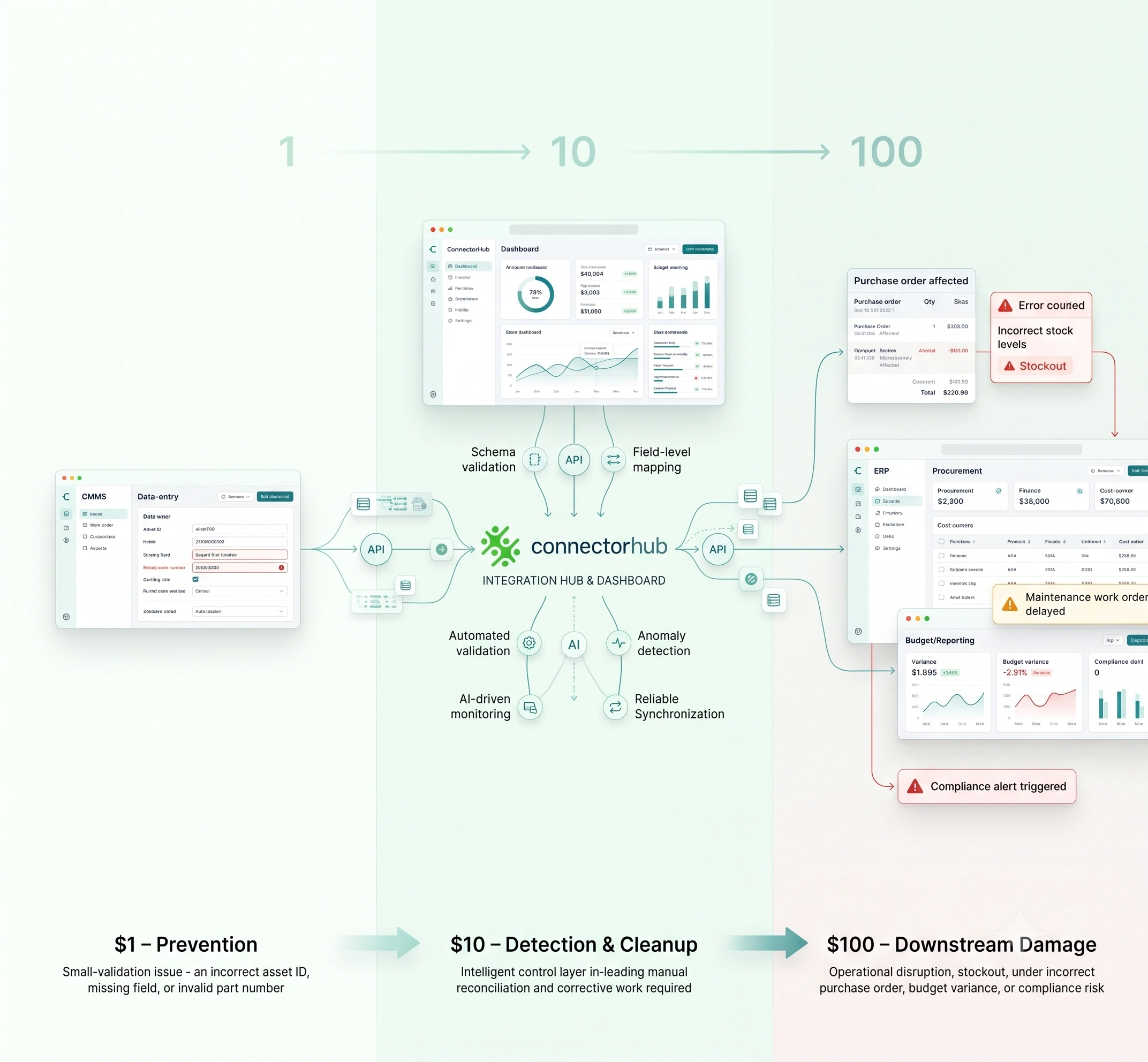
- Integrate Core Business Functions: Tie in your finance and inventory systems early in the process. When work orders are tied to real-time parts availability and budget tracking, the actual cost savings of the project become apparent.
- Scale Through Measured Sprints: A grassroots temptation is to scale too wide too fast. Wait until the key workflows have set before rapidly adding new departments or asset classes, since fast expansion will tend to amplify existing errors.
Setting up the system is only half the battle; the true value of automation is realized through a "measure and refine" mindset. By continuously monitoring key performance indicators, you transform your work order system from a static tool into a dynamic engine for growth.
Metrics That Prove Progress in Your Work Order Management
Every automation project must justify its investment through hard data. By monitoring these three key categories, you can visualize exactly how automation is refining your service delivery.
Operational Excellence
In order to get an insight into the health of your day-to-day processes, the speed and accuracy with which tasks are being completed could be observed.
- Response Time per Ticket: This measures the time that elapses between when a request is made and when a technician is sent.
- Completion Rate within SLA: Indicates how well your team follows the service deadlines agreed under SLA.
- First-Time Fix Ratio: This represents the number of jobs solved on the initial visit, indicating the accuracy of your parts and skills match.
Financial Performance
These metrics reveal the direct impact of automation on your operational budget and resource management.
- Labor Hours per Closed Job: Monitors the actual time spent on tasks versus administrative overhead.
- Rework Rate: This metric points out how often problems keep repeating, and this allows professionals to easily identify areas requiring additional training or better data on the asset.
- Cost per Service Order: Offers insight into total cost of expenditure, such as labor, parts, and travel, on a per work order basis.
Human Capital and Productivity
Automation should help you, not burden you. Monitoring "People" metrics will ensure you're scaling the right way.
- Technician Satisfaction: Assesses the level of satisfaction connected with the reduction of paperwork and the recording of physical logs.
- Attrition Among Dispatchers: If there is high turnover among dispatchers, it may indicate a problem with your human processes; a reduction in turnover means your automated solution is alleviating burnout.
- Training Time for New Staff: It calculates the time taken for the employee to become productive due to the digitized workflow.
Those businesses which implement a full-featured automation framework will always reap better-optimized business processes as well as faster turnaround times, thereby helping your employees accomplish more with less stress of things going wrong manually.
Why You Should Move to Automated Work Order Management
The implementation of an automated work order system is a clear strategy that replaces the erroneous ways of the past with a systematic, automated process.
Automation removes human error by requiring all requests to be submitted in a standard format so that technicians do not have to endure data entry errors or illegible instructions. In addition to that, automation prevents any unplanned downtime because it schedules maintenance ahead of time. In this way, you can correct potential problems before they qualify as costly failures.
ConnectorHub: A Work Order Management Platform Built for Real Operations
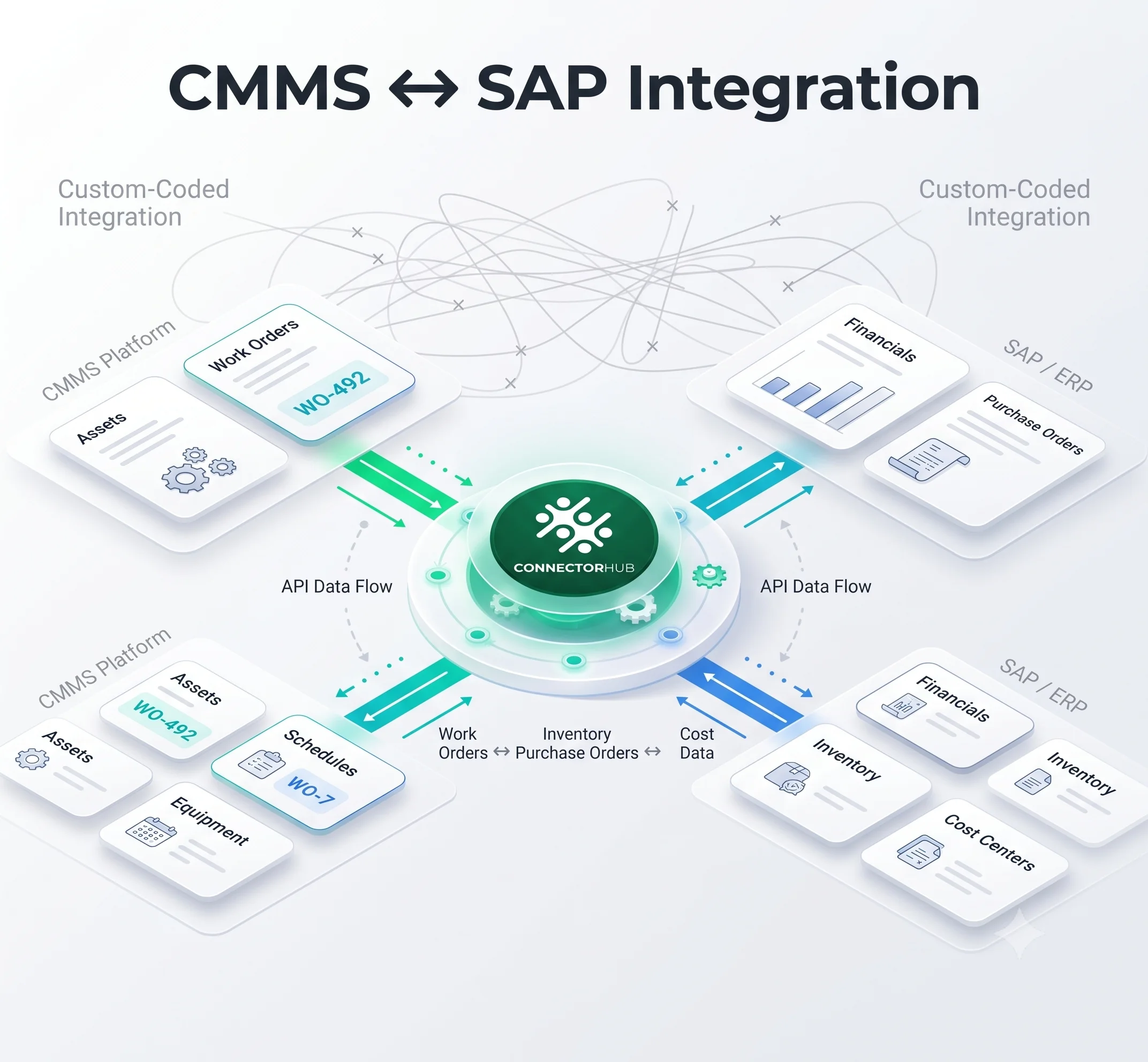
Of all the automation tools making noise today, ConnectorHub uniquely embraces the messy reality of mixed systems. Moreover, most companies have already invested a lot in the existing CMMS, ERP, and procurement software systems, which would not be feasible to replace altogether. In this way, the ConnectorHub connects the gaps within the systems, helping the operations to adapt to the trends within the industry.
- Adapting to the Future of Maintenance Workflow
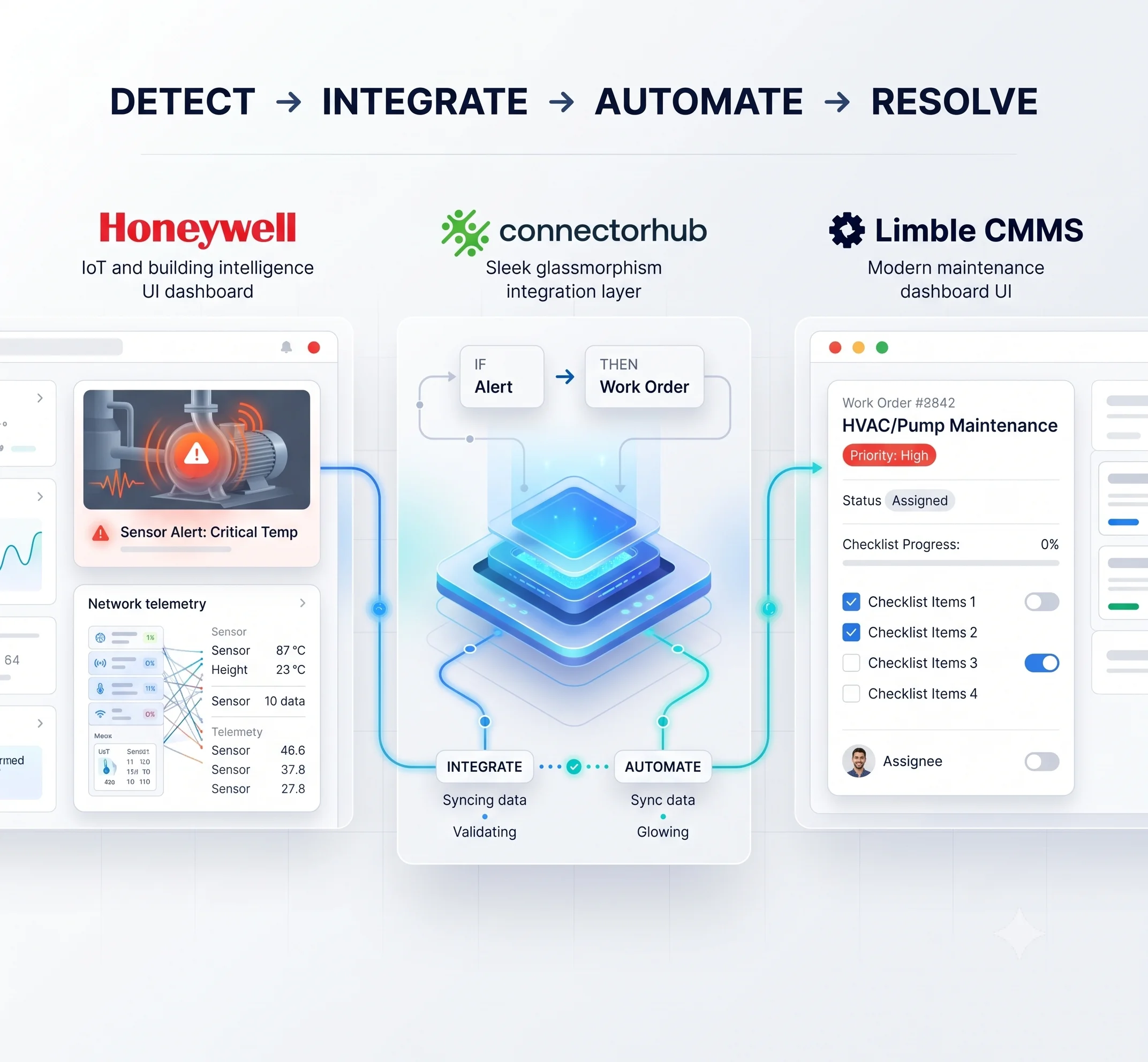
ConnectorHub is designed to meet the shift toward predictive maintenance. By integrating with IoT sensors, the platform catches early signs of equipment fatigue and triggers work orders before a breakdown can halt production. This transition from reactive to proactive care is managed through no-code integration workflow control, meaning your operational staff can adjust routing rules and forms themselves. This flexibility ensures you aren't stuck waiting on developers to make simple updates to your daily processes. - Intelligent Coordination and Execution
The platform also leverages scheduling to optimize how work moves through each site. Through the analysis of historical information, the system optimizes the assignment of jobs so that the correct technician ends up in the correct location. Upon arrival, the teams use a mobile-execution interface where they upload photos of job completions, check off boxes on digital job lists, and thereby immediately complete jobs. This does not require paperwork, and the result is that supervisors can monitor the process through live dashboards without making calls. - A Central, Shared Ecosystem
ConnectorHub provides a single, transparent digital space where your clients and service partners track the same queue of tasks in real time. This gets rid of the fragmented spreadsheets and email chains, getting all parties on the same page with regard to costs, equipment, and service delivery.
Clients using Connectorhub report steep drops in admin hours and better visibility across their facility management services portfolios. Because ConnectorHub grows through configuration rather than expensive rebuilds, teams gain these advanced capabilities in weeks rather than months. It offers a path to effective automation that respects your current budget and existing technical foundations.
Closing Perspective
Work order automation has moved past experiment. It has become the standard that asks for a mindset that treats process friction as a solvable problem, not an occupational hazard.
Work order systems are moving toward orchestration rather than simple tracking. Multiple departments—facilities, IT, HR, procurement—share the same automation backbone. As this mesh strengthens, the boundary between operations and technology disappears.
The same change is spreading to manufacturing, utilities, healthcare, and public infrastructure. The common goal is simple: get the right work done faster, with fewer errors and full proof of performance.
Platforms like ConnectorHub make that goal reachable without ripping out existing systems. They connect what already exists and push the work through cleanly, while offering space to make informed decisions that drive long-term growth.